Favorite thing: I was a bit suprised to find out that one of the most celebrated figures in Navpaktos was the spanish writer Miguel Cervantes.
He took part in a big naval battle at Navpaktos in 1571 where he ended up in prison in what is today Algeria and there he sat and wrote most of his famous book Don Quixote.
Today there is a nice statue of him at the harbour and you see his name all over the town where they still celebrate the famous spanish writer who came by there more than 400 years ago.
Written Aug 10, 2010
Favorite thing: The three battles called 'Battle of Lepanto' were fought in this gulf: that of 1499, that of 1500 and the proper one, that of 1571, destroying the Ottoman fleet.
The Holy League's fleet consisted of 206 galleys and 6 galleasses, and was ably commanded by Don Juan of Austria, the illegitimate son of Emperor Charles V and half brother of King Philip II of Spain. Ottoman forces consisted of 222 war galleys, 56 galliots, and some smaller vessels.
This was the last major naval battle to be fought solely between rowing vessels.
In 1772 another Turkish fleet was destroyed by the Russians at the entrance to the gulf. The town of Lepanto is now named Navpactus.
Updated Jan 21, 2009
Favorite thing: Navpactus (in Italian, Spanish and Portuguese: Lepanto) situated on a bay on the north side of the straits of Lepanto. It’s built amphitheatrically on the side of a hill, which lies on the sea opposite to Peloponnese between Delphi and Messologi.
The harbor is the best on the northern coast of the Corinthian Gulf. The origin of Naupactus comes from the two Greek words: ship, boat and builder, fixer. Distance from Patras is about 15 km NE and about 215 km NW of Athens with the new Rio-Antirio Bridge. In Greek legend it appears as the place where the Heraclidae built a fleet to invade the Peloponnesus.
Navpactus sits on a shoulder of a mountain range on the north while farmlands dominate the western part.
Written May 8, 2008
Favorite thing: The Gulf of Corinth is a deep inlet of the Ionian Sea separating the Peloponnese from western mainland Greece. It is bounded in the east by the Isthmus of Corinth which includes the shipping route of the Corinth Canal, and in the west by the Strait of Rion, which separates the Gulf of Corinth from the outer Gulf of Patras at Cape Drepano, where the narrowest point is crossed by the Rion-Antirio Bridge.
In medieval times, the Gulf of Corinth was known as the Gulf of Lepanto.
Written May 8, 2008
Favorite thing: The new bridge crosses the merge point between the Corinth Gulf and the Patraikos Gulf, connecting "mainland" Greece with its huge peninsula, the Peloponnese. For a 10 Euro charge, drivers can easily make the crossing.
Written Aug 24, 2005
Favorite thing: You can get to Nafpaktos by intercity bus from Athens (via Rion-Antirion). A year ago you could do it only by ferry. Now it's more comfortable because the bridge Rion-Antirion was finally finished (for Olympic Games)
Updated Aug 24, 2005
Favorite thing: Well, Lepanto used to be the old name of Nafpaktos. Here it is where the famous battle has been fought, in the 16th century: it is considered as a key element in determining the containment of the rise of the Turkish Empire. Miguel Cervantes was here too, and lost his arm in the battle; after that he decided to be a novelist and wrote the famous "Don Quijote".
Written Apr 4, 2005
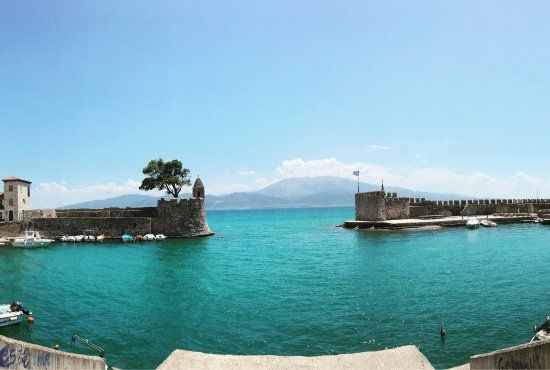
Favorite thing: Watching from the top of Nafpaktos’Castle the panorama of Corinthian and the opposite Peloponnesian line you are out of the reality in some way. Down, in front of your legs, you can see the small picturesque Venetian port dandle between yesterday and today.
Fondest memory: More info about Nafpaktos: http://www.nafpaktos.com/
Updated Jan 3, 2005
Favorite thing: The seaside of 5 and more kilometres allows to choose a nice place for swimming and sunbathing.
The climate of Nafpaktos is considered one of the best of the country. It is mild with a soft winter and a cool summer.
Updated Jan 3, 2005
Favorite thing: The historical centre which is immured, it appears an interesting, traditional town-planned set that in combination with the successive battlements of the Venetian fort compose an historic environment. The area is structured under strict orders of constructing and esthetic expression.
The types of the traditional residences that we meet in Nafpaktos’ town are folk civil residence of two floors; neoclassic residence with isolated patterns in the west side of the town; recent civil residence of the Interwar’s period to the east side of the town.
Updated Jan 3, 2005
Comments