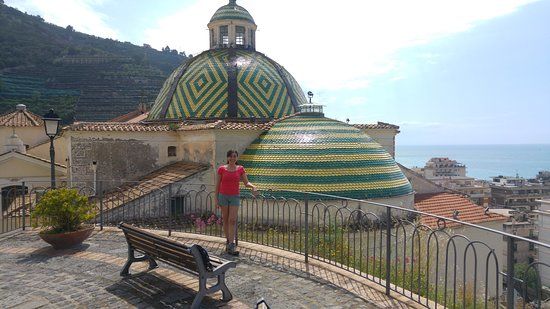
Favorite thing: The architecture is characterized by the Entrance Tower with the straw-yellow surface, probably obtained from the powdered ceramic glazes; the Moorish cloister with small columns supporting pointed arches; the Main tower; the 18th century Garden; the Well; the Turkish bath with Balnea and Theatre; the Dining rooms and Chapel that today hosts art exhibitions and events.
Fondest memory: If you're in any way interested in architecture you won't fail to notice the different influences throughout the villa. I found it intriguing to see how they'd preserved things such as the Moorish arch (see pic 5) and the turkish bath whose roof attracted me.
Updated Apr 6, 2012
Favorite thing: There are times when touring that you arrive at places and, perhaps because you've seen the image a hundred times before, the gloss is taken off.
Villa Rufolo is not one of those places! No matter how many times you see images it does not fail to enchant.
The first time I visited the dreaded Eurohaze (as we photographers call it) hung about the coast but the next time it was a near perfect day and we felt blessed to be in such a spot on such a day.
Fondest memory: I hope the pictures reflect that sentiment. The flowers in bloom making tracks between historic buildings is something I find enchanting and I'm sure many others feel exactly the same way.
Written Apr 6, 2012
Favorite thing: Villa Rufolo takes its name from an ancient family of Ravello, rich and powerful in the times of the Maritime Republic of Amalfi.
The villa suffered through carelessness and degradation until 1851 when the Scottish Francis Neville Reid bought it and brought it and revived its ancient splendor.
In 1880 Wagner, who stayed in the Villa for some time, remained astonished by the extraordinary glamour of the place and it was here he found the inspiration to compose the second act of the "Parsifal". From that time, the Villa continued to attract visitors and artists and personages as Jacqueline Kennedy and Hillary Clinton.
Fondest memory: The gardens of the villa set the scenery for the Ravello Festival. Performances of classic music and ballets of the highest level take place at night, with the orchestra playing on a stage hanging between the sky and the sea.
Written Apr 6, 2012
Favorite thing: Scala is a nice small village located in the mountain in front of Ravello. The most important monument of the village is the Duomo (cathedral) which was built in the 11th century. It has got a romanesque shape and in its interior you can see fantastic sculptures like Il Crocifisso, La Vergine and San Giovanni (the Crucifixion, the Virgin and St.John) made in 1260.
Updated Apr 20, 2008
Favorite thing: There's no escaping the impact of Wagner on Ravello - the street leading up from the main square is named after the composer who concertos are played in the Villa Rufolo during the summer months. Such a pretty street too, typical of Ravello with its steps and colourful blooms.
Written Jul 17, 2003
Favorite thing: The Belvedere della Principessa di Piemonte, has a stunning view - in clear weather - of the whole gulf of Salerno.
Truly a lovely spot with the gardens in the forefront - an ideal place to rest your legs a while whilst admiring the view.
Written Jul 14, 2003
Favorite thing: We reached Ravello by walking down the road from Scala and then up the stepped path to Ravello - a walk of no more than 30 minutes. The entrance to the town is by the church of S.Maria a Gradillo with its 3 naved aisle - see must see section.
Alternatively you can enter through the road tunnel (using the pathway at the side) and admire the view of the Gulf of Salerno as you exit. Turn right and then enter another short tunnel and you will be in the main square of Ravello.
Updated Jul 13, 2003
Favorite thing: The Duomo - the Cathedral of S. Pantaleone was a favourite church we visited in Ravello. It was erected in 1087 A.D., by the Noble family Rufolo. It can be found in the Piazza Vescovado - you can't mis it.
Check out the must see section for more info of the interior of the duomo and what can be seen.
Updated Jul 13, 2003
Favorite thing: The gardens of the Villa Cimbrone built in the twentieth century and commissioned by the English nobleman William Bechettare are dotted with statues, grottoes and temples. In the cloister, just on the left of the entrance, there is a bas-relief reproducing the seven deadly sins. The glorious view from its terrace has been coined the "Terrace of Infinity".
Villa Cimbrone: reachable from the town centre in 15 minutes' walk; the rooms have been built at the beginning of the century in neogothic style. visit time: from 9 am to sunset.
Updated Jul 13, 2003
Favorite thing: In Ravello the Moorish Villa Rufolo is the most famous monument and has glorious semi-tropical gardens. Built approximately in 1280 by one of the richest and most important families in Ravello. It inspired Wagner to imagine Klingsor's magical garden in Parsifal. (This is authentic: Wagner wrote it in the guest book in the Villa Rufolo.)
Villa Rufolo: visit time:
June - Sept. 9.30 am 1 pm and 3 pm - 7 pm; Oct. -May 9.30 am - 1 pm and 3 pm - 5 pm
Updated Jul 13, 2003
Sponsored Links
3 Reviews and 288 Opinions We stayed here for few nights last September and it was amazing. The staff are friendly and...
1 Review and 235 Opinions A charming former convent perched on the side of a hill overlooking the beautiful Amalfi coast....
1 Review and 60 Opinions This is one of the most expensive hotels in the area. The room had a fantastic view of the bay...
Sponsored Links
Comments