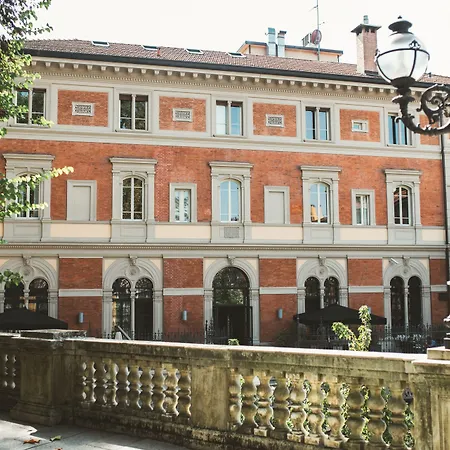
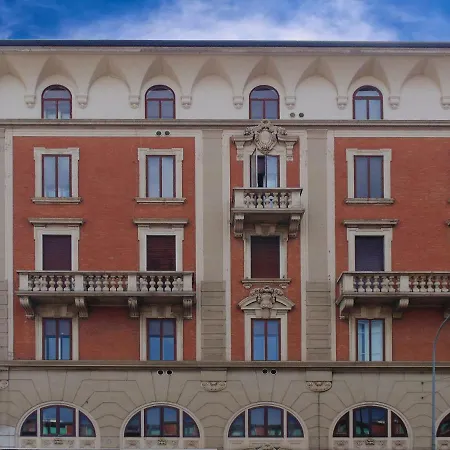
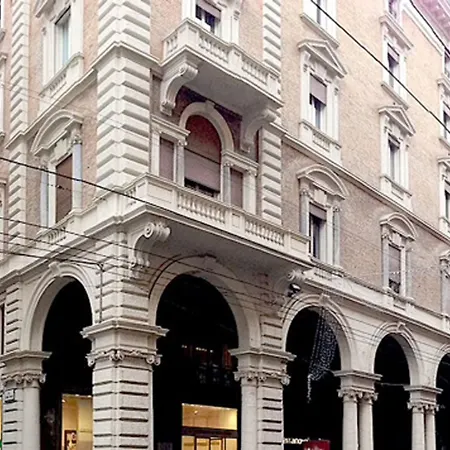
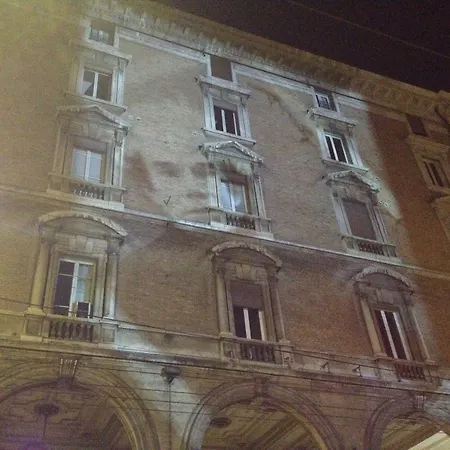
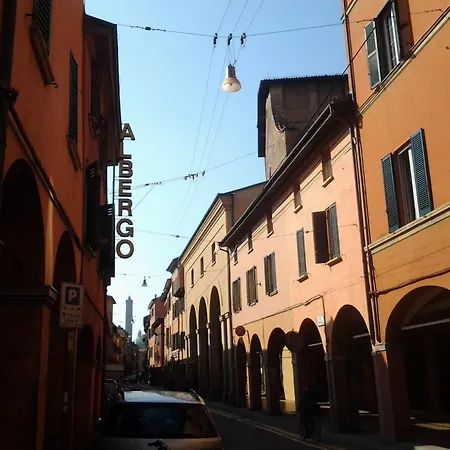

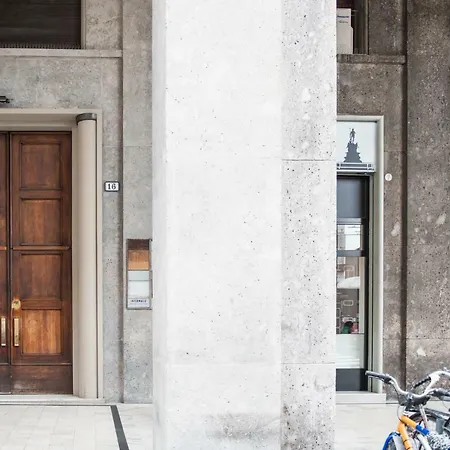

Fantuzzi is well known Bolognese noble family from the medieval times, they were rich merchants and senators. They invested a lot of money in the city area real estates, buying most of the houses in todays Via San Vitale.
The construction of this palazze started in 1521, commissioned by the senator Francesco Fantuzzi, but he died in 1533 and never saw it completed. His idea was to construct huge and very representative building which could expose the importance and richness of Fantuzzi family. The stucco works on the facade was entrusted to Sebastiano Serlio who created very suggestive look of it, adorned with the family coat of arm, elephant with the bastion on its back. The work was completed in 1538.
The Fantuzzi family was known as Elefantuzzi, combination of elephant in family coat of arm and the family name. The building has magnificent portal and to me it is the most beautiful in whole of Bologna.
Written Sep 20, 2011
Address: Via San Vitale 23
Piazza VIII Agosto is the largest square of Bologna situated in the central part of the city and not far from Piazza Maggiore. It is open air market offering cheap and low quality clothings, mostly of Chinese origins but from Chinese who live in the surroundings and work in deserted clothing factories. I didn't want to take the picture of a square with all those ugly stands and ugly cloths. Instead of the square I took picture of the memorial which is standing in the margins of the square.
Updated Sep 20, 2011
According to the tradition the church dedicated to San Bartolomeo excisted here already in the 5th century and was built by San Petronio on the site of an paleo-christian church. On the same spot where todays basilica stands used to be smaller nad pretty modest church built in the 13th century. In the beginning of the 16th century noble Bolognese family Gozzadini commissioned Formigione to design this church which still excisting today, however, in 1516 the works were stopped due to the assasination of Giovanni Gozzadini. By that time only the portico was finished and it's still visible today.
At the end of the 16th century the unfinished church belonged to the order of Teatini and they finished construction in 1627. After canonisation of San Gaetano, the founder or Teatini, the name of the church was unified with those of apostol Bartolomeo. The cupola and the bell tower were completed in 1694.
Updated Sep 20, 2011
This imposing building stands in the close vicinity of the railway station and it isnt part of the historical itinerar of the city. Actually, the tample of Sacro Cuore was built at the end of the 19th century and completed in 1928. Funny thing happened that its cupola collapsed when the temple was finished. The interior plan of the temple was inspired by the Aja Sofia at Istambul. The exteriors displaying notable influence of the Bizantine style which obviously inspired the designer of the temple or its commisioner.
Updated Sep 20, 2011
Address: Via Matteotti 25
This 2-day festival is held every year at Parco Nord in Bologna. This year bands like Arctic Monkeys, Kasabian, White Lies, The Offspring, etc.. It's organized, except for one thing, they didn't find a replacement band for one of the cancelled attractions.... I was really disappointed about it.
Tickets were between 40 to 46€ depending on the day you went.
If you want the front rows, arrive early and start queueing. The good thing is there is a mini-hill and from there you can enjoy the show in a relaxed way, especially if you don't like a certain artist.
Sandwiches were 5 € (too expensive and not so good), not to mention the huge lines to get anything to eat/drink. The cheapest thing was a portion of fries for 3€50 and they were a huge success (no more left when I went there). Before ordering, you have to pay at the cashier first and with a ticket you get what you paid for. The music was so loud that I could hard understand what the guy was telling me (they were out of some of the items).
Written Sep 12, 2011
Address: Via Stalingrado, Bologna
Website: http://www.vivoconcerti.com/iday/index.php
Once you've seen all the churches, plazas, porticos and other sites on your agenda, after you have filled your belly on the rich foods, there is still a side of Bologna that should be seen.
Do not be shy to explore the back smaller streets when you are moving from one place to the next, or if you are aimlessly wandering.
There are several examples of curious architecture (1st photo) that can be seen only if you go in the back side of the main streets.
There are other examples of art-meets-need (2nd photo) where you can see what happens when the city needs something and the creative minds are allowed to flow. These couches are a solution to the need of a resting chair, one that cannot be stolen, is impervious to the weather and stirs conversation.
Written May 4, 2011
Address: back alleys
“Joseph of Arimathe’a, an honorable counselor, which also waited for the kingdom of God, came, and went in boldly unto Pilate, and craved the body of Jesus.”
— the Holy Gospel according to St. Mark, chapter 15, verse 43
LAMENTATION Tucked away down Via Clavature is the church of Santa Maria della Vita, where Bologna’s most dramatic works of art is sheltered. To the right-hand side of the main altar stands La Pietà by Niccolò dell’Arca. The Italian poet Gabriele D’Annunzioa described this work as “a silent ‘scream in stone.’ ” Also known as the Mourning Marys, or the Screaming Marys, this emotionally charged terracotta work, created between 1462 and 1463, was once polychromed. Today these figures are au naturale, so to speak.
The figures are those present at Christ’s entombment. Those in this grouping are from left to right: Joseph of Arimathea, with a pair of pliers in his belt for pulling the nails from Christ’s hands and feet; Mary Salome (see photo #5), the mother of John the Evangelist, as with the other women she releases her pain in an open-mouthed scream; the Virgin Mary (see photo #3), whose grief seems to come from her very core, where her hands are clasped; John, who is quiet and pensive; Mary of Cleophas, mother of St. James the Younger (see photo #4), who seems to be pushing away the sight of the dead Christ; and Mary Magdalen, the strength of her sorrow forces her garments to fly behind her.
These six life-size figures, standing around Christ’s dead body, combined with their realism and their grieving states, would have made this a heart-stopping sight for worshipers in the church.
In the oratory, which is annexed to the church, and which was designed by Floriano Ambrosini, you can see another 14 terracotta sculptures designed by Alfonso Lombardi in 1522.
Open hours are Monday to Saturday, 07:30-19:30, and Sunday, 16:30 to 19:00.
Updated Apr 26, 2011
Address: Via Clavature, 10
Phone: +39 051 236245
Academic of Music 'Gioacchino Rossini' .
The Philharmonic Academy of Bologna was established in 1666 on the part of the nobleman Vincenzo Maria Carrati. It was based at the family seat, the palace which is now seen as n13 in Via Guerrazzi. Saint Antonio from Padua was chosen as its patron saint and the image of an organ bearing the motto "Unitate melos" was chosen as its coat of arms. lts principai aim was to gather professional musicians "to form a long lasting unity dedicated to making beautiful music".
Updated Apr 4, 2011
Address: Piazza Rossini, 2
There are so many churches in Bologna (well, everywhere in Italy) that you could be excused if you put your foot down and said Not Another Church, Thank You! But please consider for a moment that the Oratory is (a) small, (b) full of frescoes begun around 1500 by the leading artists of the day, depicting various scenes from the life of St. Cecelia and her spouse, who were martyred when they refused to recant their Christian faith, and (c) periodically the site of concerts in honor of St. Cecelia, the patron saint of music.
Admission is free. The hours are daily from 10:00 AM - 1:00 PM and 2:00 - 6:00 PM.
Updated Nov 3, 2010
Address: Via Zamboni 15 - 40126 Bologna
Phone: 051 225970
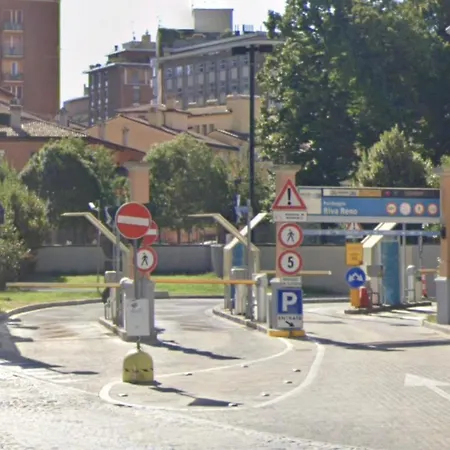
Once known as la Chiesa di San Bartolomeo di Reno, this small church dates back to the 13th century. It was reconstructed in 1536 and renovated again in 1730, when the outside frescoes were painted. Unfortunately, the frescoes are faded and badly conserved. It is said that the church was renamed as il Santuario Madonna della Pioggia (Madonna of the Rain) after a much needed rainfall that arrived following a severe drought in Bologna in 1561. The church is located at a small piazza were via Riva Reno crosses via Galliera.
Updated Jul 29, 2009
Address: Riva Reno, 124 (at Via Galliera)
Sponsored Links
Savhotel Bologna
1 Review and 404 Opinions This 4-star hotel is located near Fiera di Bologna, so the area isn't very interesting if you aren't...
Ramada Encore Bologna Fiera Bologna
2 Reviews and 429 Opinions This 3-star hotel was chosen for its location, that is, it was close to Parco Nord (a 10...
Metropolitan Hotel Bologna
1 Review and 314 Opinions We stayed in the Met Apartments. You book the apartments through the hotel and check in and out at...
Travel tips and advice posted by real travelers and Bologna locals.

Once known as la Chiesa di San Bartolomeo di Reno, this small church dates back to the 13th century. It was reconstructed in 1536 and renovated again in 1730,...
198 members live in Bologna
Q: Hi to all, Can i have some info regarding day trips from Bologna. i prefer bus travelling but info about train is...

A: Ferrara, Rimini, Ravenna, Cortona, Modena, Faicenza - all easily accessible by train.
Read 4 Replies
1

A lot o f Vt members wrote about Bologna, the history, the cuisine and more. I was born, I live and work there but I'm not the typical bolognese woman: I’m 43, I have a 23 month's baby, I ride a...
2

Bologna, chief town of the Italian region Emilia Romagna, is located between the two rivers Reno and Savena in the Po Valley (Pianura Padana), backing the Apenine Tosco-Emiliano. The town has a...
3

One of Italy's best kept secrets, if such a thing were possible, Bologna is a treasure overlooked. It has a unique identity, rich in art, music, architecture and history, and boasts Europe's oldest......
4
Bologna - Capital of Emilia-Romagna

Bologna is underrated. The capital of Emilia-Romagna is a wonderful city. It is not filled with big tourist groups like nearby Florence, making it a joy to wander the streets. It has a stunning big......
5

We arrived in Bologna during the rush hour and my first overall impressions were of a madhouse with thousands of people rushing everywhere. By the time we left several days later we realised this is...
Build your own Bologna page
Sponsored Links