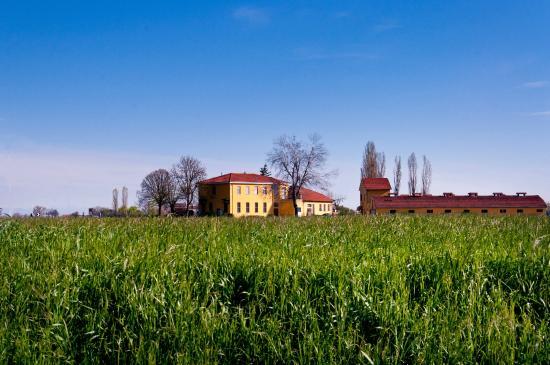
We visited Caseificio Sociale "Pongennaro" in Soragna to see how Parmigiano Reggiano is made.
About 15 farmers have joined together to make this product. It can only be called Parmgiano Reggiano if the cows are from here, the cheese is made here and ages here. Then it is certified as the real deal. We enjoyed seeing all the processes and bought a nice sample of cheese. Parmigiano Cheese is aged three years and the outside of the container gets darker as it ages.
This is in "the food valley" of the Po River. Lots of corn is grown here and an herb for the cows to eat to help their digestion for good milk production.
I went to Parma outskirt to visit a special Farm. The Azienda Sperimentale Stuard is the result of years of study about chili peppers. Right now they have over 500 variety of peppers, for cooking or just for decoration.
They have a huge online catalogue from where to order plants or seeds and twice a year, in May and in October they organize a special event to meet their customers and show to everybody willing to know more about chili their so called "catalogue field", a big square of land where a few plants of each variety is planted. They have the most hot chili in the world here and every year several chili experts come here to check out the newelty.
The owner put a lot of passion in his work and every year select new variety and nurture them.
The field is a fantastic explosion of colors and shapes and it is a joy to explore.
At the farm is possible to buy chili's seeds, chili fruits, wonderful compositions of chili and several different products made, of course, of chili. We saw salsa of various kind, bruschetta spread and even grappa made out of chili.
In 2012 the Chili festival will be held Sunday 14 October.
Go to Sorogna, very near Parma, to visit the Museo del Parmigiano Reggiano. It is located in an 18th Century cheese factory on the grounds of an old castello. They showed a film on the traditional way of making cheese, and then gave us a tour of a modern process. It takes 600 liters of milk to make one big wheel of cheese!
Naturally, they have a sales shop to visit at the end of the tour
Open weekends, 10 a.m. to 1 p.m.; 3 p.m. to 6 p.m., from March to early December.
Entry: 5 Euro
c/o Corte Castellazzi,
Via Volta, 5
Soragna (Northwest of Parma)
Camera d’Oro, the Golden Room, is the most celebrated at Castello di Torrechiara. It is thought that it was meant for newlyweds. Another possibility is that it was the castle’s chancellery. The castle’s master, Count Pier Maria Rossi had his will drawn up here. The school of Benedetto Bembo produced this series of frescoes. The theme is courtly love. A female figure, thought to be Bianca Pellegrini, Pier Maria Rossi’s lover, is dressed as a pilgrim wandering from one Rossi estate to another; in the areas between the arch supports are the Rossi estates in the mountains; the ones in the plains are painted in the lunettes (see photos #1 and #2). The square tiles (see photos #2 and #3) are fashioned in four designs and cover much of the walls; they add a beautiful dimensional note to the room.
La Sala del pergolato, the Trellis Room, was frescoed by Cesare Baglione. He painted a vine covered trellis on the ceiling. In the 18th century landscape scenery was added, covering up Baglione’s original female figures.
The long, rectangular and high-ceilinged Salone dei Giocolieri, Hall of the Jugglers, is a light-filled room. Cesare Baglione has frescoed this salone in the grotesque style, which is used in much of the fresco work throughout the castle (see photo #4). Centrally located on the main wall are naked acrobatic figures (see photo #1), juggling hoops; they form a human pyramid as they ride on the backs of lions. What a splendid display (see photos #2 and #3)!
In photo #5 I love the elaborate door-surround fresco. Some of the side fresco has faded away. The overall impression is so ethereal recalling a grand time in the distant mist of the past.
“Soprano Renata Tebaldi, one of the most beloved opera singers of all time — Arturo Toscanini, hard to please, said she had “the voice of an angel” — died yesterday in the Republic of San Marino, where she had a home, her doctor told The Associated Press. Miss Tebaldi, who had been in failing health for several months, was 82.”
— from Renata Tebaldi’s obituary by Anthony Tommasini, “The New York Times,” 20.December.2004
A highlight of a visit to Castello di Torrechiara is the display of costumes worn by Renata Tebaldi during her career. The fabulously frescoed rooms provide a rich stage setting for these bits of operatic history. Although Tebaldi was born in Pesaro along the Adriatic, when she was three years of age, she moved with her mother to Langhirano following her parent’s separation. Her mother gave up a promising singing career to become a nurse during the First World War, but sent her daughter for music lessons in nearby Parma.
These costumes were worn by Tebaldi in “Tosca” at the San Francisco Opera, 1955 (see photo #3); “Tosca” at La Scala, 1952 (see photo #4); and “Falstaff” at La Scala, 1950-1951 (see photo #5).
“I have God to thank for the gift of a particularly beautiful, natural voice.”
— Renata Tebaldi (1922-2004)
In her childhood, Tebaldi was a member of the church choir in Langhirano, the town nearby to the castle. She is buried in the family chapel at Mattaleto Cemetery in Langhirano.
Since February of 2010 Castello di Torrechiara has put on permanent exhibition costumes and other items, including large-format photo reproductions related to Renata Tebaldi’s career. Entitled “Un Csatello per La Regina” (Castle for a Queen) this exhibition showcases Tebaldi’s career from beginning to end. I especially liked the many steamer trunks stacked high that Tebaldi would travel with shown at the start of the exhibition.
Among Tebaldi’s costumes on display at Castello di Torrechiara are those from “Joan of Arc” (see photo #2) and “Manon” (see photo #5).
One of the most delightful reasons for visiting Castello di Torrechiara are the fabulous frescoes throughout the castle. I always say when visiting castles and palaces and art museums that were once palaces to “Look up.” Some of the most beautiful sights are on the ceiling.
In la Sala di Giove, the Jupiter Room, the late-16th century frescoes were painted by Cesare Baglione. The room takes its name from the image of Giove (see photo #1) at the center the ceiling. The leader of the gods is shown holding his trademark thunder bolts; he surrounded by putti, scrolls and architectural images. Naturalistic decoration, dating from the 18th century, adorns the walls.
Again the ceilings in the richly frescoed rooms of Castello di Torrechicara are the place to look for some beautiful works of art.
La Sala della Vittoria, the Victory Room, is a well-preserved explosion of fanciful fresco magic. The room’s eponymous Victory (see photos #1 and #2) is shown within an elaborate oval-shaped medallion at the ceiling’s center. She is in flight, holding a laurel wreath, against white clouds and a patch of blue sky. Sphynxes, putti, birds, and other creates, real and fanciful, frolic amongst architectural elements, all linked together by fruit-laden festoons.
Castello di Torrechiara is arranged in rectangular plan, with four towers rising at the corners and linked by crenellated dovetailed walls. One of the towers is twice as tall and dominates the others.
The castle is located 10 miles south of Parma, in the heart of the rich agricultural land that the region, Emilia-Romagna, is known for.
Sponsored Links
Sponsored Links
Comments