February - “Sabato Grasso” (Fat Saturday)
Pre Lent Festival - Carnival in the Square
End of May - The “Festa of the Tiella”
A cultural celebration of the typical local dish - La Tiella, a cross between a pizza and a calzone. Typical stuffings include diced calamari with parsley, garlic, oil, hot pepper and just enough tomato sauce for color. Other stuffings include escarole and baccalà (dried codfish), egg and zucchini, spinach, and ham and cheese.
St Erasmo
A three day festival at the end of June, in honour of the Patron Saints of the city of Gaeta. The evening before, the town pays traditional homage and devotion with offerings of candles and flowers.
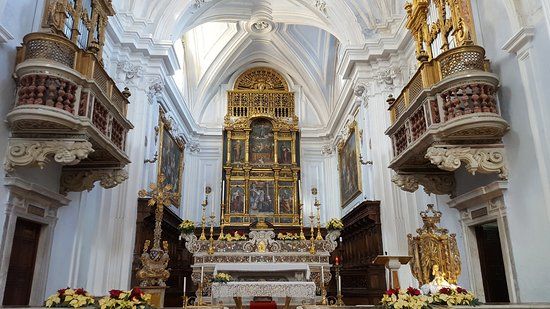
On the feast day there is a solemn procession with the statues and relics of the “healing saints” - Sant’Erasmo and San Marciano from the Cathedral of Sant’Erasmo to the City Hall.
The waterfront comes alive with festivities, music, food. In the evening there is a wonderful firework display.
2nd Sunday in August - Feast day of Madonna di Porto Salvo also known as - “The Feast Day of the Sea”
A special boat decorated with flowers and colourful bunting takes to the sea transporting the statue of “La Madonna del Mare”.
This is followed by a flotilla of small vessels who sail to just outside the port. Prayers are then said for the safety of sailors and fishermen and a garland of flowers is cast onto the water. This tradition has been continued for over 1000 years.
Back on land there is musical entertainment and festivities, culminating in a grand show of fireworks.
October Food Festival
A gastronomic celebration of local recipes, and wine, where locals offer samples of their freshly prepared delicacies.
New Year
Dancing and Fireworks
For more information about this area visit my BLOG: http://trecancelle.wordpress.com b%
Updated Oct 24, 2008
Website: http://trecancelle.wordpress.com
We discovered in 2006 more about the newer section of Gaeta. Its history is not as easy to discover as the Ancient center. Borgo was the name that was given to the area external to the wall of the medieval area.
The first area inhabited outside the historical walls dates to the 9th century with the peasants and fishermen who would gather around the rough defensive castle on the hill that was later called dei Cappuccini. There, the first church was built and dedicated to the patron saints of the town. About 1459,ipeople know that only about 900 people lived outside the walls in the Borgo area but almost 5,000 lived behind the walls. Today, more people live outside the wall than inside the ancient center.
The center portion of the Borgo looks much the same today as it did then with the alleys brancing off the main street [Via Indipendenza]. Via Indipendenza is the "back-bone" of the old part of Borgo. It keeps its same look and has a peculiar charm, a picturesque and ancient air about it.
But, the maritime area of the Borgo has changed a good deal. The days of the Austrian rule lasted 30 years [18th century] and much changed then. The Bourbons conquered Gaeta again, and the Borgo continued to widen and become more populated.
Then the Borgo became an autonomous commune and seperated from Gaeta and was named Elena in honour of Princesss Elena Petrovich of Montenegro, wife of Victor Emmanuel II [future king of Italy]. Some old people still call it Elena; actually it is named Porto Salvo todayP
Updated Nov 17, 2006
The area outside the walls called the Borgo gained population, economic ascent, and prosperity while the city behind the walls [old Gaeta] faltered. But, the people of Borgo id not feel safe..they were outside the fortress and did not feel protected. They wanted administrative independence; so, on February 18, 1897, they separated from Gaeta and became Elena.
The old town was a "very faithful Bourbon stronghold" [Giuseppe Napolitano in Del Comune Di Gaeta] and after the seperation, became quite isolated. On the other hand, Elena benefited from the seperation. The split only lasted for 30 years, and in February of 1927, Gaeta and Elena were joined together again. At that time they passed from the province of Caserta to that of Rome.
Today, the town is called Gaeta again, but the differences between what was the Borgo, Elena and Old Gaeta are still evident.
Porto Salvo, as it is called today seems so much more modern and industrial. The majority of the shopping area is here as well as the schools. I smile when I think that we always call Porto Salvo "the new section of Gaeta" when the center of it with its narrow alley-like streets are quite ancient, indeed.
Written Nov 17, 2006
Before I ever visited Gaeta, I had eaten Gaeta Olives. Many of you probably have seen them in the stores, especially at Olive Bars.
Much has changed over the years in Gaeta. Little donkies and horses used to be ever present in the town. Today, cars, motorcycles, and even suv's have replaced them. But Gaeta still exports olives all over the world.
The olives probably should be named Itri Olives [a small town very near to Gaeta] because that is where the majority of them are grown; however, Gaeta is where the olives are exported throughout the world.
At one time in this area, the cultivation of olives was more important than the cultivation of grapes.
So, the next time you are in the store, check out the Olive Bar and try some Gaeta Olives; you'll be glad you did!
Updated Nov 17, 2006
L'Annunziata is thought to be one of the most remarkable ones in Gaeta.
It was originally both a church and a charitable institution. It later was used to give shelter to foundlings and orphans. It was founded in 1321, and in 1355 it became a hospital.
Today, it is an "old folk's home where it has been organized as a local arts and crafts museum and a little picture-gallery" [Giuseppe Napolitano in Del Comune Di Gaeta].
It has a lovely entrance with a courtyard and a Chapel of the Conservatory. It has numerous artistic works.
The church was modified in the early 17th century, but later on, it was enriched with numerous remarkable workds of art such as the wooden choir, the picture of the Annunciation, and a fifteenth century tomb of Caracciolo.
But, it is most famous for the so-called "Grotta d'Oro (Golden Grotto) or Chapel of the Immaculate Conception where Pope Pius IX used to retire to pray.
To me it is so beautiful with it four divisions, especially the clock and the bells.
Updated Nov 16, 2006
1997 Gaeta traditions: Still true in 2006
1. Italian stores open Sat. morning; close Sun.; remain closed Mon.til 4:00 PM.
2. Riposofrom the hours of 5 to 7 when most businesses shut down; workers return home for lunch & a long nap. Shops reopen from 5 to 8.
(We would abide by Riposo! )
3.Late dinners. Gaetans cannot believe how early Americans eat. We learned to wait until at least 7:30 PM, but locals do not even think about eating dinner until after 8:00 PM!
4. Passagata,the evening ritual of walking in Gaeta, along the water, old town square. People stop to talk to friends & relatives about the day's events. Locals dress up.
5. Eating: I found, to my delight, that Italians do not rush their meals! They linger. During dinner, they have lengthy conversations, watch "football"(soccer), & sometimes sing.
Order:
a. ante pasta(appetizer)
b. prima(the pasta course)
c. secundo(meat or fish)
d. Contomi(vegetables or salad)
6. Mandatory Wine: Wine, the beverage of choice. It is mandatory to drink wine if you are invited into an Italian home! (Beer is acceptable with pizza.)
7. Portions of Food: By my standards, the portions are large; it is perfectly fine to ask, "con due piatti" 2 plates. Or, "mezzo portione" half portion.
8. If you go to an Italian home for dinner, be prepared to have a "digestivo" such as:
a. "amaro" (cafe liqueur)
b. "limoncello"(a lemon liqueur)
c. "manderincino" (Mandarin liqueur)
9. "Piano": "Piano" means to slow down. Learn to relax & enjoy.
(Most of our meals would last at least two hours, sometimes three. We really agreed about leisurely dinners)
10. Gelato: Italians of Gaeta seldom take dessert with the meal; instead, they get up after dinner & walk to their favorite "Gellateria" (ice cream store or stand)
11. Summer Vacation: Italians have more vacations than Americans. Italy seems to shut down in August. Many of them come to Gaeta's famous Serapo Beach.
Updated Nov 16, 2006
2006 UPDATE: We learned that in 1944, this date marked the end of the nazi occupation of Gaeta and the arrival of the Allies. Many of Gaeta's inhabitants had emigrated or taken refuge in the "hinterland". After 8 months, the 1st tanks of the Allies came to relieve the fears of the citizens. "It was May 19th but it looked like Carnival. In the merry bustle of the moment, when all were clapping their hands shouting hurray for USA! Hurray for the Americans!..." (A. Riciniello)
In September of 1943, the Germans bombed the Cathedral. On September 24th the Germans feared the possibility of an American landing so for 8 months they killed over 250 people, destroyed its wharfs & piers, set fire to the countryside. (T. Viola) After knowing this, I really felt a strong emotion each time I passed the small park and its War Memorial.
The War Monument is located in Villa Comunale and was unveiled in 1927. Evidently, it has changed completely since then.
Something that both Allan and I commented on many times as we traveled throughout Italy was that every little town and village had a monument to honor those who died in wars.
Gaeta was no exception.
In the small park near our apartment in the ancient portion of Gaeta, there stood a tall war Memorial Statue of, I assume, Victory/Nike, Goddess of Victory.
On the ground in front and back of the statue was a flat plaque with the names of those from Gaeta who died in each of those World Wars.
It was so ironic to see the local children playing soccer beside this somber statue. Often, the ball would be kicked to the statue, and one boy would run (right over the plaques) to fetch the ball. How innocent they were, too young to know the significance of those names.
As I read the names, I pictured in my "mind's eye" young, fresh-faced soldiers who had sacrificed their very lives, and they had no idea that a stranger from a foreign country would be reading about them years later and sheding a tear in their honor.
Updated Nov 16, 2006
UPDATE 2006: I was forlorn when we returned to Italy to see that the Italian had decided to dress like Americans...and not fashionable Americans. Instead, of the leather, sweaters, dress pants, etc., this time, we observed tennis shoes [even white ones], sweats, tattered jeans [jeans are the standard now!]. Also, I noted more tatoo markins, piercings on the teen-agers, and a general sloppiness that I had not seen before. THIS REALLY SADDENS ME!
Fashion plays a large role in Gaeta society.
The people of Gaeta are well dressed and take pride in their appearance. They do not dress "down" in cut-offs, T-shirts, shorts, "ratty" jeans, etc. Instead, they wear designer jeans or slacks, shirts/blouses, sweaters, sport coats, leather coats, boots, and leather shoes.
Some of the younger people do try to emulate American youth by wearing high-priced sneakers and sport-logo sport's wear
If you do not wish to "stick out like a sore thumb", then dress accordingly. If you don't mind being an American "tourist", then go ahead and wear white sneakers. I advice you to wear black sneakers.
As the famous saying goes, "When in Rome (Gaeta), do as the Romans (Gaetanis) do"!
The photo was taken in the Medieval section of Gaeta during the week. This young couple is typical of the fashion.
Updated Nov 16, 2006
As usual, Allan and I ate a gelato a day [sometimes Allan ate more!]
We returned to an old favorite of ours from 1997 called Il Pinguino where we loved their deserts. They put a waffer atop the cone for dipping and for advertisement since the name of the establishment is stamped on the waffer. Piazza Traniello, 29, Gaeta. Telephone: 01286910599
We also tried the gelato one night at Il Molo; it never seemed to be open in the afternoon.
It had good gelato and lots of customers. [di Valerio Paolo, P. Del Pesce 1/2, Gaeta. Telephone 0771-464721
In the newer part of Gaeta, we tried Gelato at Il Sole, Piazza XIX Maggio, Gaeta. Phone: 01145160592.
We also ate Gelato at Bar Gelateria Platani at Lungomare Caboto, 612, GAETA. Telephone: 0771-460048
All the gelato was delicious. My favorite was from Il Pinguino. [tried and true]
Written Nov 14, 2006
Phone: See Text
While living Gaeta for two months, we were fortunate to share many local ceremonies.
One Sunday afternoon for several hours, it seemed as though the entire town came to the graduation ceremony for the National Guard.
The town plaza was "roped" off, chairs were set up, a band assembled, the church clergy led the way, and after numerous introductions, the ceremonies began.
It was a festive occasion with family, friends, and interested townspeople in attendance. Being a "towns people" for two months, we joined in.
Updated May 9, 2005
Sponsored Links
1 Review and 32 Opinions GRAND HOTEL LE ROCCE $47.00 to $95.00 USD Panoramic beach view Beach, Near the Sea, Bar,...
61 Opinions
2 Reviews and 35 Opinions TheGajeta Hotel Residence is an outstanding place to stay in Gaeta. It's location is just excellent....
Reviews and photos of Gaeta attractions posted by real travelers and locals. The best tips for Gaeta sightseeing.

While living Gaeta for two months, we were fortunate to share many local ceremonies.One Sunday afternoon for several hours, it seemed as though the entire town...
23 members live in Gaeta
Q: We are planning a trip to this area and want to pick a town with train access as well as bus to explore the region. We cannot...

A: I haven't been in any of the three towns, but having lived in Lazio, let me tell you what I "know". Terracina has a train station...but not many trains stop there. It...
Read 4 Replies
1
Gaeta--Hidden Jewel Between Rome & Naples

The Historical Center of Gaeta is an active, an authenic, and an ancient portrait of the Italy that I had always heard and read about. See the new 2006 travelogues, updated tips, and new tips We...
2

Will be popping in to check it out again next year. The castles...........the upper one .....Arogonese and the lower Angevin. The upper part has a rectangular shape and cylindrical tower in 3 of its...
3
Gaeta, the Italian beach resort

Gaeta is a small town on the west coast of Italy about half way between Rome and Naples. Gaeta has a beautiful, big, sandy beach, and this is where Italians vacation in the summer, and the population...
4

Gaeta is located between Rome and Naples, and has been a favorite seaside resort since the ancient Roman era. During the middle ages Gaeta became a fortified city. Naturally fortified because of the...
5

Summer's here!!! Gaeta's populations swells during this timeframe especially during August. Time to hit the beach and party on.......
Build your own Gaeta page
Sponsored Links