The inside is much better than the outside!
This was our third visit and we can confirm what I wrote a few years ago: The inside is much better than the outside !
Once my eyes got accustomed to the penumbra inside the church on that late afternoon of December,. I got overwhelmed by the space and the marvellous decoration. Our last visit was in April so that there was more light Inside.
The paleo-Christian structure of the basilica divided into a nave and two side aisles by rows of Ionic columns is nearly perfect. But unique are the fifth century mosaics. The nave mosaics recount four cycles of the Old Testament featuring Abraham, Jacob, Moses and Joshua. Across the triumphal arch are scenes of the New Testament. The apse whose mosaics decoration was executed by the Franciscan Jacopo Torriti illustrates the life and death of Mary.
Unfortunately for the visitor, as the church is rather dark, the details of these mosaics are not as visible as one would like them to be. (The mosaic photo is not mine by lack of light.)
Impressive is the canopy or baldaquin over the central altar. Just before that altar is a reliquary crypt called "The Confession". It was constructed on demand of Pope Pius IX (1846-1878) to contain pieces of ancient wood which tradition holds to be part of the Holy Crib. The imposing statue is that of Pope Pius IX kneeling before the relic contained in a precious crystal urn trimmed in silver.
I will come back on two beautiful chapels "Borghese" and "Sistine" .
of this basilica.
Open (2013): 7 - 19 h (winter 18 h); Sundays 9.30 - 12 h. Free.
This is the largest of the 26 churches in Rome dedicated to the Virgin Mary - thus the Maggiore (Major). It's also one of four papal basilicas in Rome and the only one to retain its original paleochristian layout. Although greatly altered over time, the current structure dates from the 5th century and was constructed on the site of a 4th-century Roman basilica. As the legend goes, Pope Liberius, who'd had a vision of the Virgin, ordered the first church built on spot where she'd appeared, and the layout was dictated by a miraculous August 5th snowfall that outlined the shape. The 'Miracle of the Snow' is still celebrated in the basilica today.
Because it's so old and so important there's far too much to cover in a paragraph or two! It's primarily known for its glittering, well-preserved mosaics - 5th century in the nave and arch, and 13th century in the apse - but has many other interesting assets such as:
• Glorious baroque-style Borghese/Paolina Chapel containing a venerated icon of the Virgin known as Salus Populi Romani (Salvation of the Roman People). Some believe it to have been painted from life by St. Luke (although it's more likely 13rd century) and that it once prevented a plague.
• Impressive side chapel (Sistine) with the tombs of 2 popes, beautiful altar with bronze angels and golden tabernacle
• Cosmati marble flooring
• The tallest campanile in Rome
• The tombs of St. Jerome, St Matthew the Apostle, Gian Lorenzo Bernini and family, Paolina Borghese Bonaparte (sister of Napoleon) and Popes Nicholas IV, Sixtus V, Clement VIII, Clement IX, St. Pius V and Paul V
• Columns flanking the nave that were either original to the first basilica or recycled from a pre-Christian Roman building
This is a not-to-be-missed of Rome's churches. Admission is free and there's a VERY nice virtual tour with eight, 360-degree views on this website:
http://www.vatican.va/various/basiliche/sm_maggiore/index_en.html
One word of caution: while the basilica itself may be open, masses may be occurring at the high altar or in any of the chapels so no sightseeing is allowed in those areas during those times; review the schedule of services before you go. Sunday is the least favorable day for a visit due to heavy mass lineup.
Hours and other info:
http://www.060608.it/en/cultura-e-svago/luoghi-di-culto-di-interesse-storico-artistico/chiese-cattoliche/basilica-di-santa-maria-maggiore.html
The exquisite mosaics in the church of Santa Maria Maggiore date back to the time of Sixtus III (Pope from 432-40). Other mosaics in the church are not as old, but still old – dating back merely 700+ years to the late 1200s.
The oldest of the mosaics from this time can be seen in the nave and on the triumphal arch which spans the altar area of the church. These older mosaics are considered to be the most important mosaics in Rome done in the Classical tradition. While the mosaics are small and difficult to see, it is worth the effort. You might want to consider bringing binoculars with you to get a better view (I sometimes also use my camera’s zoom lens if I don’t have binoculars available). On the left and right sides of the nave are Bible scenes from the Old Testament – Abraham, Jacob and Isaac on the left with Moses and Joshua on the right. The triumphal arch in the center contains New Testament scenes from the life of Christ.
There are additional mosaics in the apse of the church – these are the later mosaics which date to the time of Nicholas IV (Pope from 1288-94). This artwork depicts the Coronation of the Virgin with leading men of the church included in the scene – Nicholas IV, Cardinal Colonna, etc. The scene with the enthroned Virgin is similar to the earlier mosaics found church of Santa Maria in Trastevere, which date back a century prior to these. Continuing in the apse, the mosaics under the windows show scenes from the life of Mary (whom the church is named for) with her Dormition as the central scene.
In addition to the inside mosaics, visitors can find mosaics dating back to Nicholas IV on the main façade within the loggia. There are scenes which depict the legend of the church of Santa Maria Maggiore, the “legend of the snow.”
Of special interest to me in Santa Maria Maggiore was the tomb of Rome’s favorite sculptor, Gian Lorenzo Bernini. It can be found on the right side of the high altar in the form of one of the steps. This was a bitter disappointment for me as I thought that such an artist that created so many wonderful sculptures and architectural structures for the city would have warranted something a little more than a step with his name on it.
Bernini’s tomb is not the only tomb in this church. The tombs of six popes and a couple cardinals are in the church, as well as the sister of Napoleon Bonaparte, Pauline Bonaparte (famous for her risqué pose in the Bernini sculpture on display at the Borghese Gallery) also are located here.
Through the centuries, some major artists and sculptures have had a hand in creating what we see today. Some of these are Carlo Rainaldi (tomb of Clement IX), Bernini (sculpture of Saint Cajetan), Ignazio Jacometti (bust of Pope Pius IX), and Arnolfo di Cambio (several sculptures). The wonderful mosaics were mostly done by unknown artists, although the mosaics clearly stand out as the best art in the church.
The Basilica of Saint Mary Major is the largest of the 26 churches in Rome dedicated to the Virgin Mary. Because of both the size distinction and the fact it is a Papal Basilica (thus policed by the Vatican and not Italian police), the church gets to have the “Major” classification on its name. Also, because it is a Vatican church in the country of Italy, it gains the status similar to foreign embassies.
Architecturally, Santa Maria Maggiore is a pleasing mix of styles dating back to the 5th century. The original church was built in typical an early Christian manner, visible today in the wide nave with two side aisles and the rounded apse at the altar end of the nave. The nave is supported by 40 columns that may date back from the earlier church or another Roman building. The campanile (bell tower) is from the medieval period (1300s). Various side chapels and the ceiling were built during the Renaissance and the loggia in the front of the church’s façade is from the Baroque period.
While there is so much to see in Santa Maria Maggiore, the mosaics dating back to the 5th century were one of the major highlights for me. These mosaics line the top of the nave with scenes from the Old Testament, cover the triumphal arch (the archway between the nave and the apse) with scenes from the lives of Mary and Christ, and the apse has some magnificent mosaics of Mary and her coronation.
There is lots of gold gilding inside the church; it is said (although not confirmed) that this gold came from the Incas, a gift from Spain’s King Ferdinand and Isabella out of the gold brought back by Christopher Columbus.
Santa Maria Maggiore has some high quality relics that attract countless pilgrims to the church, including wood pieces considered to be from Christ’s manger (the crib He was placed in at birth) and other wood pieces supposedly part of Christ’s cross. Each of these relics are kept in elaborate reliquaries for pilgrims to view.
At the high altar, resting underneath the triumphal arch is the altar decorated with lion’s paws and cherubs and lots of gold. The confession down the steps immediately in front of the altar contains a large kneeling statue of Pope Pius IX by Ignazio Jacometti. The reliquary of the Holy Crib is in this area and the statue appears to be kneeling before it.
Surprising with this "Basilica Maggiore" (papal basilica) is its peculiar layout on the Esquiline hill. If, as most visitors, one arrives by the via Cavour, the back of the church, the apse is first to appear.
There is no entrance on this side on Piazza dell'Esquilino. Walking upwards around the church to the piazza S. Maria Maggiore, one sees a huge loggia between two palaces.
If there was not the "campanile" the medieval bell tower, the highest in Rome with 75 m, the visitor would think to be facing just another palace of the 18th c. not a basilica!
Actually the façade facing east is the work of Ferdinand Fuga (1741); it has a portico of five arcades and an upper loggia with three arches, which covers the thirteenth-century mosaics by Filippo Rusuti of the previous façade. The mosaics can only be visited on a special guided tour.
The palace flanking the façade on the right is from 1605 and the second building on the left was designed by Ferdinando Fuga in 1743 to give an overall uniformity to the site.
The layout of the church seems to find its origin I a pious legend called the "Miracle of the Snow". In 352 Pope Liberius and the patrician Giovanni had a same dream that the place for a church dedicated to the Virgin would be shown to them in a miraculous way.
On 5th of August it snowed on the Aquilino hill and pope Liberius could trace the layout of the future church in the fallen snow.
A nice legend from which derives the other name for this church: "Madonna della Neve" and the feast mass each year on 5 August.
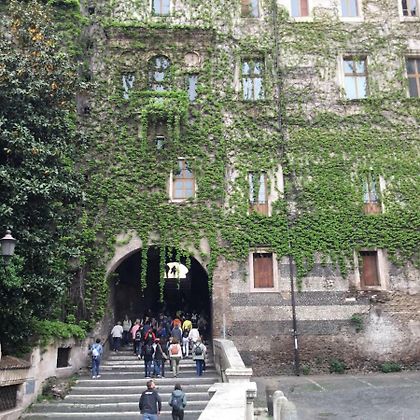
The 4 Major basilicas of Rome benefit in agreement with the Lateran treaty of 1929 of the privilege of extraterritoriality. The large stairs outside the apse are on extraterritorial ground where Italian policemen have no right of access. They are therefore closed to the public by a high metallic fence in order to avoid incidents (see photo 1).
Open (2012): 7 - 19 h (winter 18 h); Sundays 9.30 - 12 h. Free.
This chapel, on the left side of the nave of Santa Maria Maggiore, is the most beautiful chapel I have seen in Rome. It was a private chapel, still separated from the nave by a high iron forged gate, built (1606 -1612) by order of Pope Paul V Borghese and designed by Flaminio Ponzio.
In this chapel of a rare beauty is kept above the altar a famous icon of the Madonna and Child called "Salus Populi Romani" meaning Protectress of the Roman People.
The low relief, by Stefano Maderno, above the altar shows Pope Liberius tracing the perimeter of the basilica in the snow according to the legend.
The Borghese chapel (also called Pauline chapel) is shaped as a Greek cross. Powerful pilasters in Corinthian style support four large arches, upon which rests the dome with the Assumption of Mary painted by Il Cigoli. Several great artists of that time, a.o. Cavalieri d Arpino, participated to the decoration which combines art and faith in a perfect union.
The papal monument in honour of Paul V is on the left side of the chapel.
Open: 7 - 19 h (winter 18 h); Sundays 9.30 - 12 h. Free.
SM Maggiore is, simply, stunning. It should be the first Roman church you enter...........far less grandiose and 'in your face' than St Peter's, its mosaics and marbles dazzle, its complexities fascinate. If you have time to only visit one Roman basilica, make it this one.
SM Maggiore dates from the fifth century, but there was a church on the spot from around 352AD. Pope Liberius dreamed that the Virgin Mary told him to build on a place where there was no snow lying on the Esquiline Hill, and so he did: the first church was called Santa Maria delle Neve (of the snow). This event is commorated on August 5th, when a special Mass is held and white rose petals fall from the ceiling (and the firemen create artificial snow in the piazza outside in the evening!).
The original building is inside an 18th century shell, but it is still intact. There are tombs of Popes, and another Sistine Chapel (the marble in the church was 'recycled' from the ruins of ancient Rome, and is truly beautiful). Bernini is buried here, and a reliquary supposedly holds parts of Christ's crib.
The floor is decorated with swirling patterns of mosaics, there are wonderful original mosaics inside the dome and in the loggia.....so much to see that I've made a travelogue about it.
Da Vinci Code fans should not miss the 'eye in a triangle' painting, which is rather tucked away in the first chapel on the right as you enter.
Is considered one of the most beautiful churches in Rome and a patriarchal basilica dedicated to the Blessed Virgin Mary. According to a legend, a vision of the Virgin Mary appeared to the Pope commanding him to build the church, and the floor plan was outlined by a miraculous snowfall
Churches are not only used for worshiping God, they’re also nicely decorated with gold walls and live life patternson the floor. The pictures on the wall in Santa Maria Maggiore gives us small sneak peeks about human relations and was their version of Youtube 1500 years ago.
It was built 1500 years ago, but it hasn’t changed much. The lights under the paintings will only blow for two minutes before they go off- to avoid the pictures being damaged by the heat from the candies.
The Papal Basilica of Saint Mary Major, known also by other names, is the largest Roman Catholic Marian church in Rome. There are other churches in Rome dedicated to Mary, such as Santa Maria in Trastevere, Santa Maria in Aracoeli, Santa Maria sopra Minerva, but the greater size of the Basilica of Saint Mary Major justifies the adjective by which it is distinguished from the other 25.
Under the high altar of the basilica is the Crypt of the Nativity or Bethlehem Crypt, with a crystal reliquary designed by Giuseppe Valadier said to contain wood from the Holy Crib of the nativity of Jesus Christ.
Sponsored Links
Albergo Del Senato Rome
5 Reviews and 1446 Opinions The Pantheon is my favorite building in Rome and might be my favorite building in the world. The...
Campo De' Fiori Rome
5 Reviews and 896 Opinions It has been completely renovated but still with a very traditional elegant decor. I am not sure if...
Hotel Lancelot Rome
5 Reviews and 799 Opinions This Christmas, for the first time ever, we were away for the holidays. The family arrived at...
see all Rome member meetings
Sponsored Links
Comments