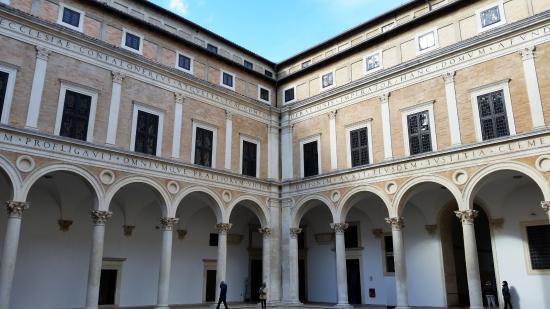
The dukes of Urbino came from House of Montefeltro. Within the palace, on some of its ceilings, the family’s coat of arms is displayed. Again, looking up brings rewards. To form the coat of arms, three golden bands on a shield of azure are combined with the Holy Roman Empire’s eagle, granted when the family was made a vassel of the emperor.
All of the examples shown here of the coat-of-arms of the dukes of Urbino were found in Palazzo Ducale.
Written Apr 20, 2011
“Because of the talent which the painter Raphael of Urbino possesses, he has decided to come to Florence for a time, to perfect himself in his art. His father was dear to me for his many excellent qualities, and I had not less affection for his son, who is a modest and agreeable young man, and one who will, I hope, make all possible progress.”
— from a letter by Elisabetta, Duchess of Urbino to Piero Soderini, Gonfaloniere (judge) of Florence, dated 1.October.1504
ROYAL PATRON Raffaello’s father, Giovanni, was the court painter to Duke Federico III. Elisabetta married Federico’s son, Guidobaldo. The courts of both father and son were the most brilliant in Europe. All the arts florished here, espcially literature, poetry and painting.
We climbed to what seemed like the highest point of this hilltop town to visit the monument honoring Urbino’s most famous son, Raffaello Senzio. Beginning in 1894, sculptor Luigi Belli took threee years to complete the monument. Orginally it was placed in Piazza Duca Federico, between the cathedral and Palazzo Ducale. It was moved to a park in 1947. One of the pedestal’s bas-relief panels (see photo #3) above shows Raffaello directing work on St. Peter’s Basilica.
Written Apr 20, 2011
Palazzo Albani is one of the most important in the city and currently a building in the University of Urbino. Palazzo Albani, in its present-day form, is a splendid princely residence of the 18th century. In the mid-17th century several adjoining houses were bought by Orazio Albani (1576-1653) and later by his sons Jerome and Charles. This set the stage for the building we see today.
The brother of Pope Clement XI, Horace, and his nephew, Annibale Cardinal Albani, are given credit for having completed, in the second and third decades of the 18th century, the acquisition of several large buildings. The reconstruction project was worked on by several architects, including Carlo and Francesco Fontana, followed by Philip Barigioni, Giambattista Bartoli and Peter Paul Alfieri.
The Albani family coat-of-arms (see photo #3) hangs immediately above the door. And above a window directly above the entry door is the coat-of-arms of Pope Alexander VIII (see photo #2); this pope created Giovanni Francesco Albani a cardinal
Updated Apr 20, 2011
Born in Urbino on the 22nd of July 1649, Giovanni Francesco Albani was sent to Rome at the age of 11 to study at the Roman College. He was a brilliant intellectual, with high morals and very pious; these qualities caused him to rise rapidly at the papal court. On 13.February.1690, he was created a cardinal-deacon and later Cardinal-Priest and was ordained to the priesthood.
At the age of 51, in the Conclave of 1700 the Sacred College of Cardinals selected Cardinal Albani the next pope, after deliberating for 46 days. Because Cardinal Albani was known for his for justice and prudence, taking the name Clemente was fitting.
Thanks to the Albani family Urbino experienced what could be called another Renaissance at the start of the 18th century. Giovanni Francesco, who had become Pope in 1700 with the name of Clement XI, and his grandsons, Cardinals Alexander and Hannibal, were patrons and promoters of endeavors, which improved the face of the city, enriching it with works of art.
This monument to Urbino’s native son stands not far from his family’s palazzo, now a building in the University of Urbino.
Updated Apr 20, 2011
The interior of the Church of the Holy Spirit is a single room, rectangular in shape. The treasure of this little church is the barrel-vaulted ceiling, divided into 15 squares depicting the four prophets, the seven gifts of the Holy Spirit and scenes from the Old Testament, including the Judgment of Solomon (see photo #5).
On the walls are fourteen paintings depicting the Virgin, Mary Magdalene and the Apostles (see photos #2 and #3); they are thought to have been painted by Urbino’s native son, Girolamo Cialdieri.
A beautiful Pentecost hangs behind the altar (see photo #4); it is attributed to Federico Zucca.
Written Apr 19, 2011
The small Church of Santo Spirito is located along the Via Bramante within the district of Saint Lucia. Documents give the church’s origin as 1554; but a congregation of the Holy Spirit existed as early as 1398. The extent of the façade’s decoration consists of the marble surrounding the door and the window above it.
The scroll work and the classically-inspired fluted columns are quite fine. The rounded pediment above the entry door is craved with a chalice and the Eucharist (see photo #4).
Updated Apr 19, 2011
This 18th century fountain bears the coat-of-arms of Pope Benedict XIII; it stands opposite Palazzo Albani, the stars on the fountain are taken from the coat-of-arms of the Albani family. Pope Clemente XI was a native son of Urbino and the Albani family.
Updated Apr 15, 2011
The church of San Domenico in Urbino is located opposite to Palazzo Ducale. Built by the Dominican community between 1362 and 1365, the church was consecrated in 1365. However, some frescoes of the apse indicate that it is likely that some parts of the building are a few decades older.
The church was restored by Philip Barigioni between 1729 and 1732. The facade is made of brick and is distinguished by a double staircase, that goes on to converge at the porch. It was made of travertine between 1449 and 1451 by Maso di Bartolomeo.
Luca della Robbia is responsible for the grouping that shows Madonna and Child with Saints Dominic, Thomas Aquinas, Albert the Great and Peter the Martyr in glazed earthenware This is a perfect copy, the original, dated 1451, is located at the Palazzo Ducale across the street.
The facade has been changed from the original by adding two windows, but the frieze decorated with plant motifs has been retained.
The interior is made up of a nave only, following the renovation work of Barigioni the decorations along the walls have been lost. Between 1950 and 1960 two pictorial cycles of frescoes in the apse, from the 18th century, attributed to Antonio Alberti da Ferrara came to light. They are currently kept at the Galleria Nazionale delle Marche and the Diocesan Museum Alban.
Updated Apr 12, 2011
Address: Rinascimento Square
This red granite obelisk was first raised at the Temple of Isis in Sais, Egypt in 580 BC, and taken to Rome in AD 90.
Brought to Urbino in 1737, it was placed in front of the Church of San Domenico.
The 18-foot tall obelisk was donated by Urbino’s native son, Gian Francesco Cardinal Alberti, who went on to become Pope Clement XI.
Written Apr 12, 2011
“Elisabetta’s wedding was settled to take place early in 1488. She had already seen the young Duke of Urbino, who was almost her own age, a handsome boy, of cultivated tastes, but afflicted with hereditary gout. They appeared to have been mutually attracted to each other, and there seemed to be every prospect of happiness.”
— from “The Most Illustrious Ladies of the Italian Renaissance, Elisabetta Gonzaga, Duchess of Urbino” 1905 by Christopher Hare
The Duomo was constructed on top of the ruins of a sixth-century church. Completed in 1604 and then destroyed by an earthquake in 1789 it was rebuilt. The Duomo has a NeoClassical façade and houses important art works, including the “Last Supper” by Federico Barocci. The Museo Diocesano has a collection of glass, ceramics, and religious items.
The Sienese architect Francesco di Giorgio Martini designed the cathedral on the order of Duke Federico III. After the earthquake of 12 January 1789 the people of Urbino were forced to rebuild their cathedral entrusting the project to the Roman architect Giuseppe Valadier.
On the church’s central pediment (see photo #4) are three white marble sculptures of the Theological Virtues, Faith, Hope and Charity. While at the ends of the two side sloping pediments stand likenesses of St. Augustine, on the left and Saint John Chrysostom, on the right.
Written Apr 11, 2011
Sponsored Links
121 Opinions
96 Opinions
Reviews and photos of Urbino attractions posted by real travelers and locals. The best tips for Urbino sightseeing.

“Elisabetta’s wedding was settled to take place early in 1488. She had already seen the young Duke of Urbino, who was almost her own age, a handsome boy, of...
3 members live in Urbino
Q: We will be visiting Urbino in early April. We would like to take a day trip to San Marino while we are there. Are there any tour...

A: Best to get a bus to Pesaro and then a train to Rimini, you may have to change at Ancona. You can get the 72 bus from Rimini rail station to San Marino. This sounds...
Read 4 Replies
1
It's worth trying to find Urbino

No one could say we weren't fully equipped. We had Frommer's, Michelin, Rick Steves (all with maps), plus a fairly decent country map from the Avis place. Frommer's cautioned that many people...
2

I've got some interesting experiences in Urbino. I'd love to share with you the 10 tips I've written, the 13 photos uploaded, and 0 travelogues I've created.
3
One of the Reasons We Came to the Le Marche

Known as The City of Art, Urbino was the busiest city that we visited. It was so busy that we could not find anywhere to stay. All the hotels, pensiones, rooms, hostels, etc. were booked. The entire...
4
Urbino, a brief special visit for a Festa del Duca

Well, what can I say about Urbino? Actually not much because it wasn’t a typical travel visit that brought me here. I came here with special people late afternoon of August 15, 2010 for Festa del...
5

The famous renaissance city of Urbino, the birthplace of Raphaello is well worth a visit. The city is full of steep narrow streets leading to piazzas, few cars are allowed into the city, so it is a...
Build your own Urbino page
Sponsored Links