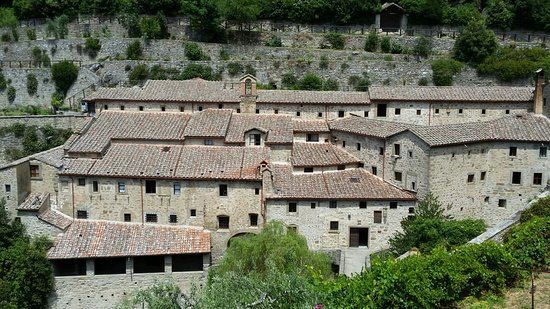
Favorite thing: Take some time and read the multitude of information on the Cortona website - http://www.cortonaweb.net/eng/.
It has a wealth of information on everything from accommodations to cultural nuances to 360 degree views of the main spots in the city. It is a must visit for anyone planning a trip to the little town of Cortona.
Written Apr 13, 2009
Favorite thing: Sooner or later, if you spend some time in the town, you're going to end up here.
It's a hub of activity with students from the nearby bible college drifting in and out and with municipal buildings nearby it seems there's always something happening.
Its proximity to the also-busy Piazza Signorelli where the Palazzo Communale is located also helps make this the vibrant area of the town.
This piazza gets more sun and thus seems to attract more people.
Updated Nov 14, 2006
Fondest memory: There are plenty of those narrow cobblestoned back alleys to keep you intrigued, darting off main road to who knows where. Every so often I too would dart off to explore, sometimes a pleasurable experience, other times an embarrassing dead end.
Updated Feb 10, 2005
Favorite thing: By the time I arrived in Cortona after having dramas paying my B&B bill, it was time for a cuppa. The B&B is normally run by the matriarch and she was in hospital and the patriarch had no idea how to scan and use credit cards so I had to go to a bank. Unfortunately, the branches I went to were only small and couldn't handle something as difficult as an actual withdrawal, so I went back to the B&B hoping for a miracle. It didn't happen so I went back to Castiglion Fiorentino again and lucked out this time and made a withdrawal. By the time I got back with the money the son had arrived and he could use the credit card machine but it was all too late, I had the cash.
Fondest memory: Every cloud has a silver lining though and the son, reasonably fluent in English, explained to me the winemaking process and we sampled a couple and I ended up buying a bottle of his quality wine of which only 2,000 are made annually. I've now got some boasting rights with my son who is somewhat of a conoisseur.
So, by the time I arrived at Cortona, I was ready for some relaxing morning tea. At Piazzale Garibaldi I found the right spot.
Updated Oct 16, 2004
Favorite thing: When you get to Cortona it is worth your while to get a map of the town from the tourist office. Not only is it somewhat necessary to navigate efficiently, it is also a beautiful piece of work! The map is punctuated by 2-d drawings of some of the major buildings of town, and has some attractive watercolor-like backgrounds and renditions of sights outside of town (including the monastery I'm obsessed with, see my other tips.)
Arezzo also has the same type of beautiful map...these are great for scrapbooks.
Written Jul 30, 2004
Favorite thing: This gem of Renaissance architecture dating from 1485 is located on the southern hillside.
It was all designed by Francesco di Giorgio Martini, Sienese painter, sculptor, architect and engineer, who belongs to a select group of Renaissance practitioners, including Brunelleschi, Alberti, Michelangelo, Peruzzi, and Leonardo da Vinci, who excelled in several of the arts at the same time. A native of Siena, he may have been trained by Vecchietta (1410-1480), both a successful painter and sculptor. Francesco di Giorgio's early career is too poorly documented to make definitive judgments.
He appears in extant records in 1464, when he produced a wooden sculpture of St John the Baptist (Museo dell'Opera del Duomo, Siena). In 1464 Francesco was charged with overseeing the intricate aqueduct system of Siena for a three-year period and similar assignments as an engineer and architect continued to come for the remainder of his life in Siena and in other centres. His fellow Sienese painter Neroccio de' Landi (1447-1500) became his partner, perhaps as early as 1469, until litigation abruptly dissolved the relationship in 1475. In the 1470s Francesco painted two different versions of the Coronation of the Virgin, one in fresco for the ancient Hospital of Santa Maria della Scala, done in 1471 (destroyed), and another, originally for the Benedictine abbey church outside Siena at Monte Oliveto, c. 1472. Francesco signed a Nativity that was commissioned in 1475.
By the mid-1470s, Francesco di Giorgio's other skills were in strong demand, and in 1477 he was already in the service of the famed Federigo da Montefeltro of Urbino, primarily as a military engineer and architect. He built a great chain of fortifications for the Duke of Urbino, somewhat amazingly for a man designing churches, he is credited with inventing the landmine! He also designed relief sculpture, intarsia decorations, medals, and war machines for his patron.
Fondest memory: Francesco di Giorgio was in Naples in 1479 and in 1480. In 1484 he began his most famous building, the centrally designed Church of the Madonna del Calcinaio outside Cortona. Returning to Siena from time to time during the same period, he continued to receive various official commissions, including the bronze angels for the high altar of the Sienese Cathedral (finished in 1498), but no paintings are recorded later in his career. Francesco, summoned to Milan to give advice on how to design the dome of the Cathedral, came into contact with Leonardo da Vinci, who later owned and annotated one of Francesco's manuscripts.
The Sienese artist, along with important Florentines and a few other "foreigners," participated in a competition for designing a façade of the Cathedral of Florence. Back in Naples during the 1490s, he continued to be active in Urbino. In 1498 he finally returned to Siena for good when he was made capomaestro (head) of the works at the Cathedral. Francesco died in Siena toward the end of 1501, leaving behind, in addition to the works already mentioned, a series of manuscripts of the greatest importance devoted to architecture and engineering. No documentation confirms that he continued to paint after the Nativity, although critics usually assume later activity, including the magnificent newly discovered essentially monochromatic frescoes in the Bichi Chapel of Sant'Agostino in Siena which have been attributed to him.
Late in life Francesco di Giorgio may have turned to painting again, following work done in bronze relief, most famous of which is the Deposition in Venice, and four bronze angels for Siena Cathedral, but the attributions made for a late period are full of problems since Sienese painting toward the end of the fifteenth century has not yet been carefully studied. Outsiders begin to dominate the local scene. Perugino, Pinturicchio, and Signorelli, all active in Siena, overshadowed Francesco as a painter.
Updated Jun 14, 2004
Favorite thing: This is what Cortona looks like coming from the southern side on the road from Perugia - a classic Tuscan hilltop town.
Fondest memory: Cortona dominates Valdichiana and the Trasimeno lake and was an important Etruscan settlement before becoming a Roman town during the social war and then gained prosperity during the Middle Ages. The city was sold in 1411 to the Florentines and became part of the Grand Duchy of Tuscany. The best thing with Cortona is the view, a harmonious landscape where the mountains of Siena meet the green valleys of Valdichiana. The visit starts from the majestic remains of the boundary walls which go back to the Etruscan period.
Updated Jun 14, 2004
Favorite thing: If you are staying at Cortona for more than a day or two and want something to do then I can certainly recommend a couple of hours in Castiglion, just a few kilometres north on the Arezzo road.
Though it's only a small hilltop town it does have that wonderful medieval feel to it, despite being damaged in the Second World War.
It has all the usual suspects - cobblestones, church, portals, walls etc and has some lovely views over the Tuscan countryside.
I have separate pages for it should you want more details.
Written Jun 5, 2004
Favorite thing: As the earth rotated and the sun's light faded, once again I found myself on the balcony of the bar ristorante Tonino on the Piazza Garibaldi, taking tea in a blissful atmosphere. The smoke had all but cleared and the road to Perugia was totally visible, arrow straight and beckoning me onwards but I tarried awhile, soaking it all up, thinking these are the times on earth to cherish, and that's exactly what I did.
Written May 29, 2004
Favorite thing: Could this be the house that spawned a book? No, it isn't but frankly, I didn't know and I didn't really care. I just happened to notice the spring bloom of the wattle and thought I'd take a snap then later realised that this is the side of Cortona where the book was written.
It's actually higher up where "Under the Tuscan Sun" was written.
Updated May 28, 2004
Sponsored Links
1 Review and 110 Opinions My husband and I spent a week at this beautiful and charming inn. The accommodations were first...
1 Review and 59 Opinions It's a wonderful place,in close proximity to the most fascinating towns of central Italy, renowned...
1 Review and 5 Opinions This is an incredible place to stay. Atop a hillside amidst olive groves and vineyards, you'll find...
Reviews and photos of Cortona attractions posted by real travelers and locals. The best tips for Cortona sightseeing.

Could this be the house that spawned a book? No, it isn't but frankly, I didn't know and I didn't really care. I just happened to notice the spring bloom of the...
2 members live in Cortona

Q: How can I get from Lucca to Cortona by bus?
A: I am not aware of a bus from Lucca to Cortona, I think you will need to take the train. You will need to change at Florence and then catch the short bus ride from the...
Read 4 Replies
1

It's quite amazing what a little publicity can do. There was a painting sitting in a gallery then someone gave it a rap in the 1920's and the rush was on. The fact that there are many superior works...
2

Cortona is a small town perched on a hill about 25km away from Arezzo, which takes a surprising hour by bus (though parts are rather scenic). While it has its roots with the Etruscans, little...
3

Cortona is a beautiful hillside town in Tuscany. I'm am fortunate through Liz's relatives to say I now have family here. Her Aunt Melva and Uncle Giacomo have a magnificent Villa. I had heard about......
4

I have always idealized Italy and its particularities. I studied the language in University, I dreamed of studying at my University's 'campus' in Cortona, I revelled in the cooking style, I read the...
5

I came to Cortona because I am one of those American women who saw Under the Tuscan Sun one too many times and something about it just called to me. Although the movie is very different from the book,...
Build your own Cortona page
Sponsored Links