
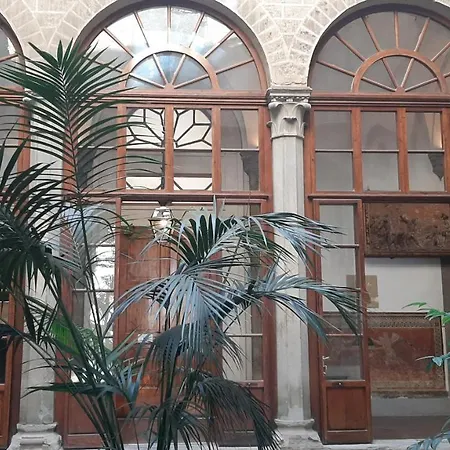
The masses that mob the Accademia for a look at that big, naked guy? This is where I’d send half of them instead - if I didn’t want to screw up a very good thing. My #2 favorite behind the Uffizi, this is one of those marvelous small museums that’s big on presentation without standing three-deep to see it. The other huge bonus is the space it occupies: a 13th-century government palazzo steeped in dark, medieval charisma. Dark indeed, this forbidding pile was also Florence’s prison for a time - “Bargello” was the title of the local Chief of Police - with its more unfortunate guests condemned to final send-offs in the courtyard.
If you’re on overload from the collective miles of paintings at the Uffizi, Accademia and Pitti Palace, you will find this museum of largely three-dimensional works a welcome respite. Scattered over three floors, the sculptures, ivories, coins, armor, tapestries, ceramics, weapons and whatnot are uncrowded and beautifully displayed for 360-degree viewing where appropriate. The stars of the show are:
• Donatello’s marble and bronze Davids; the latter the more notable of the two
• Giovanni Bologna’s winged Mercury
• The panels submitted by Lorenzo Ghiberti and Filippo Brunelleschi in the competition for the duomo’s baptistry doors (Ghiberti won; you’ll see why)
• Colorfully enameled Della Robbia reliefs
• Michelangelo’s woozy Bacchus
• Chapel where prisoners were held before execution with remnants of frescos attributed to Giotto and his students
My favorites are some of the chubby little putti doing all the funny things that putti do but it’s all well worth the ticket price - especially to be able to enjoy a browse in relative sanity!
Some good things to know:
• The gallery is closed on the 1st, 3rd and 5th Sunday; 2nd and 4th Monday of each month; New Year’s Day; May 1st; Christmas Day.
• Hours are limited: 8:15 -13:50 (at time of this writing)
• Galleries are handicapped accessible with lifts to the upper floors
• Large bags, backpacks and umbrellas must be checked (free)
• Entrance to the museum is covered under the Firenze Card or Friends of the Uffizi pass
• As with almost all of Florence’s museums, photography/filming is (maddeningly) not allowed although you may snap away in the courtyard and upper loggia. I managed a sneaky shot of the chapel fresco with what is said to be one of the earliest known portraits of Dante: he’s in red, above the kneeling figure on the right.
Dating back to 1255, the architecture of the Bargello is somewhat similar to that of Palazzo Vecchio in the sense that they both look like fortresses; in the case of the Bargello, it makes total sense since it used to be a prison and the inner courtyard that now houses so many great sculptures was the scene of executions for about 200 years. The Bargello became a museum in 1865, which makes it one of Italy's oldest public museums. It houses the world's largest collection of Italian Medieval and Renaissance sculptures. Among the museum's most famous pieces are Michelangelo's drunken "Bacchus" and Donatello's bronze "David". I also thought the Carrand Collection, an ecclectic collection of decorative arts put together in the 19th century by Jean-Baptiste and Louis Carrand, was very interesting to see. In some cases, it was possible to look at the jewels and brooches through magnifying lenses, and it was amazing to see all the work that had gone into making something so small. There's one ring in particular I really would have liked to get my hands on...!
Admission to the Bargello is only 4 Euros and you don't need to book in advance. Open daily from 8:15 am to 5:00 pm.
This is the National Museum of Sculpture. A visit here will find such masterpieces as Bacchus by Michelangelo and David by Donatello. The building itself was originally built during the 13th Century to house military captain whose duty was to keep the peace. In the 16th century, the Medici made it the home of the "Bargello" or Police Chief. In the courtyard, executions were carried out intil the late 18th Century when they were abolished. Today, the museum is a major attraction.
Located behind the Palazzo Vecchio, on the via del Preconsolo, is the Bargello Museum (Museo Nazionale del Bargello). Housed in the stupendous Bargello Palace (Palazzo del Bargello), built in 1255, the museum contains the most wide-ranging collection of medieval and Renaissance sculpture in Italy.
On show are pieces by Michelangelo (including his first major sculpture, a drunken Bacchus, completed when he was just 22), another David (this one by Donatello) and pieces by della Robbia, Verrocchio and Ghiberti.
The National Museum has its setting in one of the oldest buildings in Florence that dates back to 1255. Most tourist groups skip it, others who stay in town only a couple of days don't include it in the list of must-see. I found this museum very important, especially for people who know something about art...
Here you can find most famous works by Donatello including bronze David, some works by Michelangelo (1475-1564): Bacchus, the relief representing a Madonna with Child, Brutus and David-Apollo. There are also bronze sculptures by Giambologna... and many more intereting things.
I found about three hours for this museum early in a morning and very gald I didn't skip it. Too bad they don't have a well printed book about the collection, I bought whatever they had.
The Museo Nazionale del Bargello bears a bit of a resemblance to the Palazzo Vecchio (primarily because of the tower), but there are a few more similarities, primarily because of both buildings' association to power and authority. The Palazzo del Bargello, sometimes called the Palazzo del Podestà, was built in the 13th century and first used as the house of the magistrate and then as a police station. This was also the site of some of mediaeval Florence's prisons and more than a few people were tortured by the well in the courtyard. Luckily, such goings-on don't occur any more in the Palazzo del Bargello. Today it is the home of a large collection of Tuscan Renaissance sculpture. The Sala del Cinquecento has some of Michelangelo's earlier works here, like his Bacco and Madonna col Bambino. The courtyard features a Giambologna statue (Oceano), while the Sala del Trecento holds more Gothic works. In the Salone del Consiglio Generale on the first floor you will find many of Donatello's works, including his Marzocco, a copy of which stands in the Piazza della Signoria. Note as well that this area used to contain the cells of prisoners. At the end of the hall is the Cappella di Santa Maria Maddalena, whose walls are decorated with frescoes because this was the 13th century workshop of Giotto before it became a place of worship. The second floor contains works from the della Robbia family collection, the most famous of which is the Fanciullo.
The Museo Nazionale del Bargelo or Il Bargello was named for the police or Constable (Bargello) who ruled from here. Now the National Museum houses one of the most impressive collections of Renaissance sculptures anywhere in the world (namely three stories of treasures by Florentine Renaissance sculptors and a collection of Mannerist bronzes).
Bargello is the oldest administration building of Florence. It was built in 1255. Used as police department and jail. They also used it to execute criminals. Hundred years later, it's using as museum (1st national museum of Italy) nowadays. There are big saloons inside for Michelangelo, Donatello, Giambologna and Cellini. You can also see golden door panels here as i mentioned about them at baptistry tips.
the bargello was built in 1255 as florence's town hall. in the 16th century it became florence's prison. in 1865 the bargello was converted to an art gallery showcasing florentine renaissance sculpture. some examples from the collection are michelangelo's "bacchus", giambologna's "mercury", verrocchio's "lady with a posy", and donatello's "david".
WORLD OF SCULPTURE
IF THE UFFIZI IS OUT OF THIS WORLD FOR PAINTINGS THE BARGELLO IS THE PLACE FOR SCULPTURE
THE BARGELLO WAS AT ONE TIME FLORENCE'S PRISON AND TORTURE CHAMBER DURING THE MEDICI PERIOD UP TO 1859 DURING THE RENAISSANCE THE PEOPLE WHO WERE EXECUTED HERE HAD THEIR PORTRAITS PAINTED ON THE WALLS OUTSIDE
THERE ARE MICHELANGELO AND DONATELLO SCULPTURES, BRONZES BY CELLINI AND GIAMBOLOGNA HIS MOST FAMOUS BRONZE MERCURY IS ON DISPLAY HERE
Sponsored Links
Hotel David Florence
7 Reviews and 1121 Opinions We have stayed with this establishment many times. Initially, it was because they have free parking...
Rapallo Hotel Florence
4 Reviews and 149 Opinions I spent 4 days in hotel Rapallo in February, a very cheap budget hotel I found on the Internet. I...
Grand Hotel Florence Florence
2 Reviews and 357 Opinions We didn't have to pay because we were using Frequent Travelor points. This was a 5-star hotel, and...
Sponsored Links
Comments