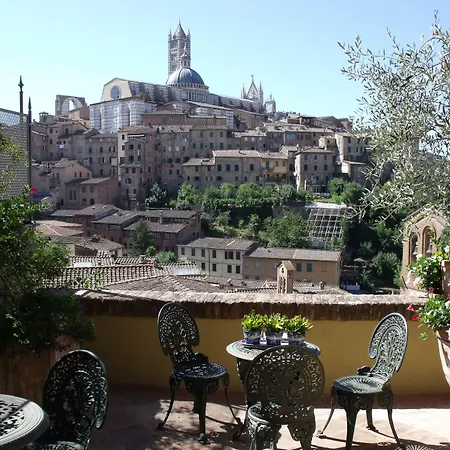

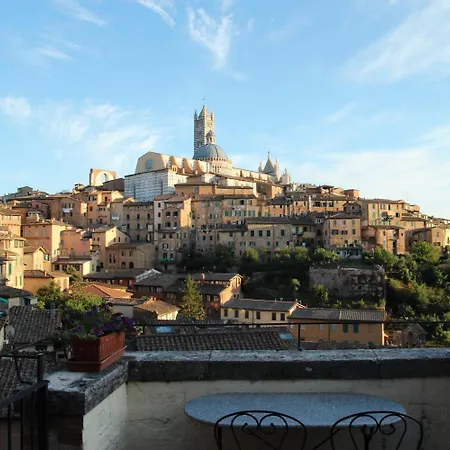

On my first trip to Siena, I was simply amazed at the floors in the Cathedral – inlaid marble that make up pictures, geometric designs, mosaics, etc. It was simply amazing to me. The cathedral itself is unique looking with its black and white stripes (colors of Siena) and dates back to the 1200s, although the floor took more than 300 years to complete!
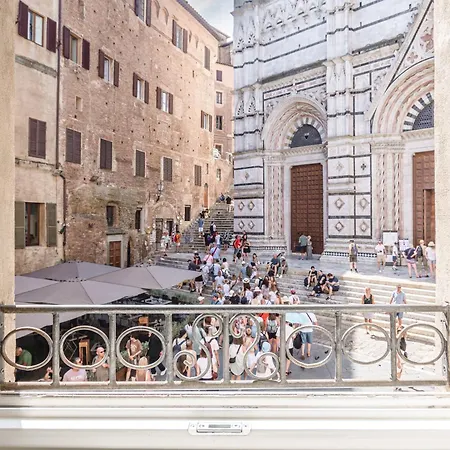
At one time, Siena wanted to make the cathedral larger so that the current cathedral would form the transept (the shorter horizontal bar of the cross shape) of a much larger cathedral. Outside near the entrance to the Cathedral Museum you can see the layout with the new façade marking the end of the new plan. Obviously, this never happened – but it would’ve been massive had they accomplished it!
As you look at the outside of the cathedral and see the statues, note that these are copies – the real ones are now on display in the cathedral museum, having been placed inside to protect the original art from the weather. On the inside of the cathedral, there is so much to see. There are rounded arches that show the Romanesque style of the original building but there is ribbed vaulting since the church was finished in Gothic styling. Around the edge of the nave near the top are the heads of popes – lots of heads – makes you question how there could have been that many popes!
To the left is a monument to Piccolomini Pope Pious that has some statues at the bottom – look closely and try to figure out which one was done by a young Michelangelo. Spoiler alert….answer is coming up….the one on the bottom left and possibly the one on the right.
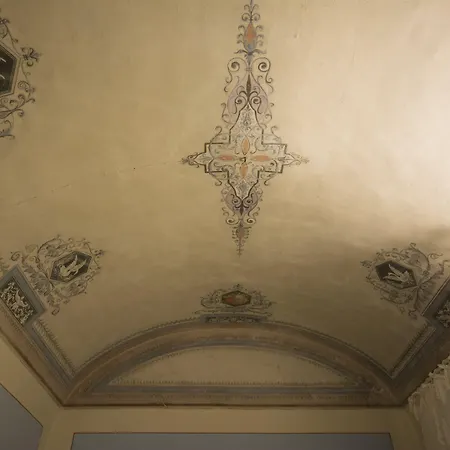
On the left side of the nave is the Piccolomini Library that you can walk around – it is full of beautifully decorated old manuscripts in display cases as well as music books. The frescoes in this room are stunning with their three dimensional gold look.
After leaving the library, you come back into the nave and the pulpit is pretty close by. This marble pulpit was where the sermon was first introduced in the language of the everyday people (instead of Latin). It was designed by Nicola Pisano and his son, Giovanni. You can see the Renaissance styling in the expressions coming through on the reliefs in the pulpit. The Last Judgment shows a more expressive style by Giovanni than his father’s work; perhaps a progression in Renaissance influence?
On the right transept is a small chapel with a wonderful Mary Magdalene by Bernini.
There are lots of other beautiful things to see in this cathedral. Look up at the dome – it is spectacularly painted with blues and golds.
This is one of my favorite places to be in Italy. I hope you like it too.
If you want to see photos of the wonderful floors in the cathedral, visit my Travelogue about the floors.
Updated Feb 9, 2012
Address: Piazza del Duomo
The Baptisty is located behind the cathedral and was designed to support the cathedral walls and keep it from falling over – a type of buttress. The true artistic treasure in this building is the font that has bronze reliefs of the life of John the Baptist by Ghiberti and Donatello.
As you look around the base of the font, you will see the new style of work – if you have already been to Florence and seen the Baptistry doors, these will look familiar. That’s because Ghiberti did two sets of those doors! But Donatello was really the one that developed the varying degrees of relief to show depth in a sculpture (as seen in the relief of his St George that is in Florence’s Bargello Museum – with a copy in one of the niches outside of Orsanmichele).
Look around at these reliefs, and then take a closer look at the one showing the feast of Herod. Notice the expressions of horror in the people’s faces as Herod’s head is shown them on a platter. Then look at the background and the various levels of depth with the building. That’s Renaissance style for sure! And Donatello was a master at it!
Written Feb 9, 2012
Address: Piazza del Duomo
The crypt basically rewrites history with its recently discovered original frescoes. It seems that that crypt was filled in with old shoes, pottery, and other things to support the walls of the cathedral and keep them from falling down. Only recently – 15 years ago – was the crypt cleaned out and what a surprise was in store for everyone – there were absolutely gorgeous frescoes in there by three artists, perhaps one was a young Duccio. Because the frescoes had been away from the light for so many centuries, the colors remained vivid and fresh looking.
These frescoes of the Passion cycle are more proto-Renaissance; the artists were coming out of the medieval style and painted with some emotion, but the bodies of the people need work (look at how curved Christ’s body is). This rewrites history since before this was discovered, it was thought that Pisa was ahead in proto-Renaissance painting and now it seems it was really Siena (not that the towns are competing for that title or anything!).
An interesting side note is you can see the dome of the Baptistry on the wall opposite the frescoes.
If you are into art history, the crypt is a must-see!
Written Feb 9, 2012
Address: Piazza del Duomo
Like most old towns the most impressive and expensive buildings were the ones devoted to religious functions and here in Siena there is no exception. The Duomo was closed for repairs on the day we visited so we only got to see the outside, we even went all the way around the back to see if there was entry there. One of the striking and outstanding features of the Duomo was its bell tower. Built in what gives the impression of an inverse triangle, the tower begins with a single arched window, or opening on the first floor and proceeds to climb toward the sky, adding an extra window with pillar on each floor, until on the final floor you can see 6 openings with 5 pillars. A very interesting and eye catching structure.
Updated Jul 21, 2011
Address: Piazza del Duomo
Website: http://www.discovertuscany.com/siena/siena-churches/duomo.html
What can I say that hasn't already been said? This is a magnificent church! If you have an opportunity to stop by Siena, please see this church. I know there are many, many churches in Italy but this is one not to be missed. Unique qualities of this church are the striped marble design inside and out. The mosaic floors depicting images from the Old Testament. It also has the Piccolomini Library that houses choir books and frescoes.
You must by a ticket to enter. The ticket office is behind the church off the the right side.
Please see my travelogue for additional photos!
Updated Jun 24, 2011
Address: Piazza del Duomo (what a surprise!)
I am glad that I attended a mass in Siena’s duomo before I went inside for a visit. This gave me the moments to experience a church in its original meaning. Fact is that for me the inside didn’t live up the hype I have read about before I went inside. For my taste it is overly decorated and the many single artworks get lost in the whole “arrangement”. To me it is too inhomogeneous as a whole, compared for example to Basilica San Marco in Venezia. Some single work of art is splendid, like the inlay marble floor with its many scenes from the bible and legends. In fact this is what impressed me most in the cathedral because of the very delicate work and the attention to the details, like the little snake and the snail in the “Allegory of Mount of Knowledge”. And also Libreria Piccolomini impressed me for the clarity and the intensity of the colours. But all in all - too much for my taste.
But I think the main reason why the cathedral did not leave that much of an impression to me as it should have was that I saw the one in Orvieto two years ago. The Orvieto one is very similar from the outside but has much more of delicate mosaic artwork on the façade. One day I will know why. But nevertheless, yes, Siena’s duomo is worth a visit, of course.
Opening hours:
They are too diverse as that I would write it all down here. Please check the website given below.
Admission fee:
For the duomo alone it is 3 Euro and 6 Euro when the whole floor inlay work is visible. In case you want to visit the museum and panorama “tower”, baptistery, crypt and oratorio altogether, the combined ticket is 10 Euro and valid for three consecutive days. Please note that the ticket booth is not in front of the cathedral but where the entrance to the museum is (to the right side of the duomo in the back).
Duomo on Google Maps
Updated Dec 18, 2010
Address: Piazza del Duomo (what a surprise!)
Website: http://www.operaduomo.siena.it/
Siena’s cathedral is very famous and crammed with visitors at almost any hour. In case you want to visit the cathedral as what it was once been built for – as a church – you should attend a mass. I once did it in Venezia’s Basilica San Marco and it was something very special. So I asked when mass would be held in Siena’s cathedral and went there on November 1st (All Saint’s Day, a holiday in Italy). As for Venezia, it was very special. In a way it was also good for improving my Italian. The mass was held in Italian but leaflets were available with the full text of the mass.
Mass times in the cathedral:
Weekdays (incl. Saturday): 9 and 10 a.m.,
Sundays and holidays: 8, 11 and 12:15 a.m.
(Admission is free of course duing times of mass).
Duomo on Google Maps
Updated Dec 18, 2010
Address: Piazza del Duomo (what a surprise!)
The duomo's crypt isn't really a crypt, in the sense that it was never used for burials. This underground space, located below the duomo's choir, was discovered by pure chance during excavation works carried out in 1999, and in 2003 it was open to the public for the first time in over 700 years. The 13th century frescoes that decorate its walls, depicting different scenes from the New Testament, make it possible to guess that the crypt was part of the cathedral's original design but that it was later abandoned for one reason or another. Also, through plexiglas panels laid on the floor of the crypt, it's possible to see the foundations of a church probably dating back to the 9th century, which was most likely destroyed to make room for the new cathedral. Pictures are not allowed inside the crypt in order to preserve the frescoes, but it's yet another site that makes Siena stand out as one of the most interesting cities to visit in Tuscany.
Admission to the crypt is also included in the duomo's combined ticket (12 Euros).
Written Jul 30, 2010
Address: Piazza del Duomo
Phone: 0577 283 048
Website: http://www.operaduomo.siena.it
Construction of the duomo's baptistery began about 100 years after that of the cathedral. It was completed in 1325, and the splendid baptismal font was added about a century later. Six Italian sculptors (including Donatello) collaborated to create the font's carved panels that together represent the life of St. John the Baptist, to whom the baptistery is dedicated. The last additions made to the baptistery, and the main reason why I would describe Siena's baptistery as the nicest one we got to see during our trip to Italy, were the colourful frescoes that decorate its roof and walls. These were completed towards the end of the 15th century by Vecchietta, one of the leaders of the Sienese school of painting, with the help of several of his students. And the best part is that pictures (without flash) are allowed!
Admission to the baptistery is included in the duomo’s combined ticket (12 Euros).
Updated Jul 30, 2010
Address: Piazza del Duomo
Phone: 0577 283 048
Website: http://www.operaduomo.siena.it
There is no doubt that Siena's Cathedral is the star attraction of the city. Built during the 13th century, the cathedral is covered with layers of black and white marble that reflect the city's coat of arms. The cathedral's amazing facade is made of pink marble and decorated with countless statues, gargoyles and splendid mosaics. Perhaps one of the biggest differences between Siena's duomo and the one in Florence, for example, is that Siena's cathedral is just as lavishly decorated inside as it is outside. From floor to walls and windows to ceiling, some of Siena's most renowned artists have contributed and paid tribute to the city's history and traditions through their numerous works of art, which include a magnificent pulpit sculpted by Nicola and Giovanni Pisano, the same father & son duo responsible for the pulpits found at Pisa's duomo and baptistery. However, the feature I thought was the most impressive in the duomo was the floor, which is entirely covered with marble mosaics. The Piccolomini Library, which was built to house the book collection of Enea Silvio Piccolomini, is another one of the cathedral's treasures. Born in Siena, Piccolomini would eventually become Pope Pius II and the amazing frescoes that decorate the library depict some important scenes from his life.
Because the duomo is Siena's most popular attraction, I would recommend buying your ticket first thing in the morning - there can be quite a long line at the ticket office, but after that it's pretty easy to access the different sites. For 12 Euros, we got a combined ticket that gave us access to the cathedral, the baptistery, the crypt, the cathedral's museum, the Santa Maria della Scala museum, and the San Bernardino Oratorio. It was well worth it!
Updated Jul 30, 2010
Address: Piazza del Duomo
Phone: 0577 283 048
Website: http://www.operaduomo.siena.it
Sponsored Links
Borgo Grondaie Siena
3 Reviews and 285 Opinions This was the most magical place we stayed the summer of 2005. We spent almost 2 months throughout...
Pensione Palazzo Ravizza Siena
1 Review and 444 Opinions Out of the five hotels we stayed at in Italy, this was by far our favorite. Large rooms and...
Villa Elda Siena
1 Review and 194 Opinions We stayed at the hotel around Chrismas. The usual rates of about 190 Euro where reduced to 80 Euro....
Piazza del Duomo (what a surprise!)
Duomo tips and photos posted by real travelers and Siena locals.
Write a Review
There is no doubt that Siena's Cathedral is the star attraction of the city. Built during the 13th century, the cathedral is covered with layers of black and...
34 members live in Siena
Q: Where is the best place to rent a car in Siena? We are staying in a B and B near San Francesco Church and know that AutoEurope...

A: Googlemaps will show you where 'Viale Europa, Siena' is (quite some way from the historical centre). I can't recommend any particular hire company but would suggest...
Read 2 Replies
1

I've got some interesting experiences in Siena. I'd love to share with you the 44 tips I've written, the 51 photos uploaded, and 1 travelogue I've created.
2
Siena: a good place to learn Italian :-)

So this was my “entry” into famed Toscana. I don’t like the Toscana very much, especially because of the hype people create around it. It is as if many non Italians reduce Italy to Toscana only and......
3

The very first view I had at the town of Siena was indeed spectacular. I came to town around 7:00PM and have parked my car next to the huge fortress of Medici, opposite to which, on the next hilltop,...
4

Siena deserves to be one of the top tourist attractions in Tuscany. Even filled to the brim with tour groups it is still enchanting. Surely no one can fail to be captivated by the wonderful Piazza del...
5

The rivalry between Tuscany's two major cities - Florence and Siena - is anything but legendary. Rivals since the Middle Ages, Florence was identified with the pro-pope Guelphs while Siena sided with...
Build your own Siena page
Sponsored Links