
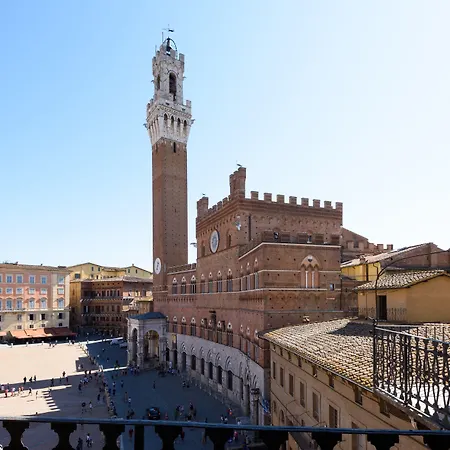
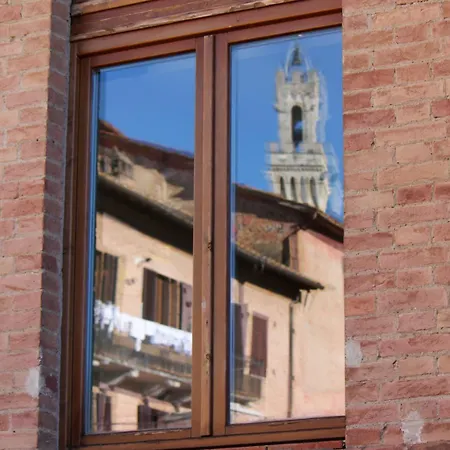

For most of us, the Palazzo Pubblico (City Hall) and its adjacent Torre del Mangia are little more than a spectacular backdrop to Siena's grand meeting place - the Piazza del Campo.
These iconic landmarks are well worthy of attention on their own merits. Construction of the palace began in 1297, its purpose being to serve as the seat of government for the Sienese Republic. Its architectural style is at times described as Italian medieval, and at other times as Gothic. So - which is it? Maybe Italian medieval with Gothic influences? We did not tour the palace, but have read that the highlight is the number of frescoes, all of which are secular and devoted to the effects of good and bad government.
The campanile (Torre del Mangia) was built between 1325 and 1344, intentionally designed to be taller than any in Siena's rival state, Florence. In fact, it was the tallest building in all of the Italian peninsula at the time. A mechanical clock was added later in the same century.
By all means, take time to look at each of the sculptures surround the pool of the Fountain of Joy. If you have a detailed guidebook, check it for some quirky additions to the biblical scenes. For instance, Rick Steves' enormously popular "Italy" guidebook suggests looking for the snake-handler woman and two naked guys about to tossed in. Of course you can always allow yourself to be entertained by the pigeons scuffling with each other to drink the water from the mouths of wolves.
Il Campo strikes you as an unusual location for a world-famous horse race which pits city neighborhoods against each other. It may be large for a piazza or town square, but is definitely small for a race track. It is irregular in shape, and the terrain is far from level. If I had not seen numerous videos and films of Siena's "Palio," I would never have believed it could take place here, let alone be packed with thousands of frenzied spectators.
It was far more peaceful on the cool, drizzly day of our early October visit. Even so there were quite a number of visitors, for Il Campo is Siena's main meeting place, and most of the city's landmarks are nearby.
Surrounding the piazza are a number of bars, restaurants, gelaterias, the city hall and tower (Palazzo Pubblico and Torre del Mangia), and the intriguing Fountain of Joy (Fonte Gaia). In the course of time, I will post "Things to Do Tips" for each.
A masterpiece of Sienese Gothic architecture, il Palazzo Pubblico is one of the symbols of Siena. It was constructed between 1297 and 1344 as the seat of the government of the Republic of Siena. The building had a fourth floor added in the 17th century, but otherwise has conserved its original look. As is often seen in Siena, the lower floor is made of stone, while the upper floors are of red brick, and triple mullioned Gothic windows pierce the façade. The building dominates Piazza del Campo, particularly with its magnificent sky scraping 100-metre tower, la Torre del Mangia, the highest mediaeval tower in Italy. Nowadays, il Palazzo Pubblico houses a museum, il Museo Civico, with some of Siena's most impressive works of art, not to mention the display of the palace itself. Unfortunately, due to time constraints, I was unable to visit the interior of the museum (surely next time!), but was able to access the open courtyard in the centre.
For more photos, check out the travelogue: "Palazzo Pubblico."
Shaped like an irregular half circle (or sometimes described as a shell), Piazza del Campo is the beating heart of the city of Siena. It had been the location of several marketplaces for many centuries earlier, but in 1349, the city of Siena began the grand plan of creating this magnificent space by merging a couple of campi and destroying surrounding buildings as a symbol of the greatness of the city. The newly opened space was paved in red bricks and turned into la Piazza del Campo that it is today. The ground paving was divided into nine triangles that converge at the drain known as il gavinone, with each triangle representing one of the nine Noveschi who ruled Siena at the time. Dominating il Campo is the Palazzo Pubblico and its sky-scraping Torre della Mangia, and within it is the famous white marble fountain, known as Fonte Gaia, by Jacopo della Quercia. Nowadays, il Campo is most famous for keeping up the Mediaeval horserace tradition of il Palio di Siena.
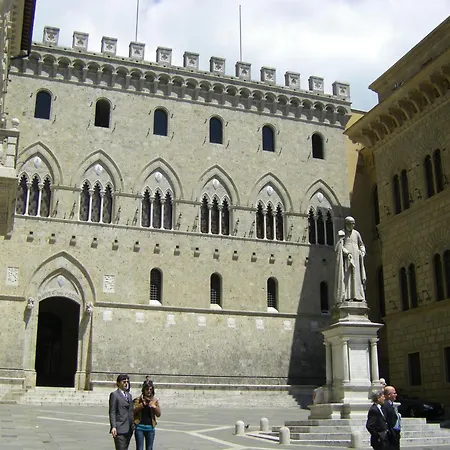
Commissioned by the prominent Sansedoni family in the 14th century, their namesake palazzo is the second most dominant structure surrounding Piazza del Campo. It was built in red brick with the typical Sienese Gothic windows decorating its façade. Its irregular shape follows the curvature of the piazza and it is topped by a long red brick tower. The palazzo was heavily renovated in the 18th century, which is when many of its interior frescoes were painted. it is nowadays occupied by the Fondazione Monte dei Paschi di Siena (the Foundation belonging to the Sienese bank)
An imposing palace near Piazza del Campo, Palazzo Piccolimini was built in 1469 by the family of Pope Pius II. It was designed by the architect Bernardo Rossellino and in a Florentine-Renaissance style, rarely seen in Siena. Since 1858, part of the palazzo has housed the rich archives of Siena. (Note this palace should not be confused with the nearby, similar-looking Palazzo Piccolomini delle Papesse, designed by the same architect for Caterina Piccolomini, the sister of Pope Pius II. Her palace is distinguishable by the rugged lower façade).
Known as la Cappella di Piazza, this open-air chapel was built in 1352 at the base of la Torre della Mangia to commemorate the end of the plague. It is dedicated to the Virgin Mary as a thanks for saving the town from the black death. The original design, by Domenico d'Agostino, was modified over the next two centuries to give it the look we have today, essentially a mix of Gothic and Renaissance styles, rather similar to la Loggia della Mercanzia, but more elaborately decorated. The Sienese sculptor, Antonio Federighi (15th century), is responsible for the frieze and its mythical creatures in the upper part of the Cappella di Piazza.
One of the prime monuments in Piazza del Campo, la Fonte Gaia is an exquisitely carved marble water basin that serves as a drinking fountain. A system of canals bringing water from the surrounding countryside converges right into the fountain, which was carved in 1419 by the celebrated Sienese sculptor, Jacopo della Quercia. Unfortunately, the statues and carved marble panels seen here in il Campo are replicas, created in 1868 by Tito Sarrocchi. The originals were transferred to il Palazzo Pubblico for protection, where they are on display as part of il Museo Civico.
The center of town is the Piazza del Campo, a shell-shaped public square and the site of Siena’s two-times-a-year horse race, the Palio de Siena. As you look at the piazza, try to imagine it filled to the brim with people in the center and along the edges as the horses race around the outside of the “track”. I haven’t been to one, but I can imagine and would like to go at least once to one of these races.
When no races are going on, the piazza is a nice place to meet up with people at the many cafes and shops around the edge, or at the fountain in the center of the piazza. The fountain, the Fonte Gaia, was built in 1419 and was a source of pride for the Sienese people since they had to use hydraulics to get the water up hill (there is no river in the town!). Miles and miles of tunnels were built to bring water from aqueducts to the city.
The piazza is lined with tall buildings, but the centerpiece is definitely the Palazzo Pubblico, the town hall, with its tower.
Sponsored Links
Villa Elda Siena
1 Review and 196 Opinions We stayed at the hotel around Chrismas. The usual rates of about 190 Euro where reduced to 80 Euro....
Athena Hotel Siena Siena
2 Reviews and 525 Opinions The hotel cleaning staff broke the keyboard to my laptop. The manager John Luigi called me a liar,...
Pensione Palazzo Ravizza Siena
1 Review and 555 Opinions Out of the five hotels we stayed at in Italy, this was by far our favorite. Large rooms and...
Sponsored Links
Comments