Favorite thing: Gubbio’s tourist office is very helpful with maps and additional information about the town and the region. For example I got magnificent posters in photo quality of all the major festivals and the city for free. Grazie mille, Evelino Vagnarelli!
For quick orientation: have a look at the marvellous town map at the (fee) parking lot at the right hand side of Piazza Quaranta Martiri (see main photo). It is a piece of art and shows the major buildings as little ceramic reliefs and the symbols of the traditions which are so much alive in Gubbio: the crossbows (balestre), the ceri and San Francesco and the wolf.
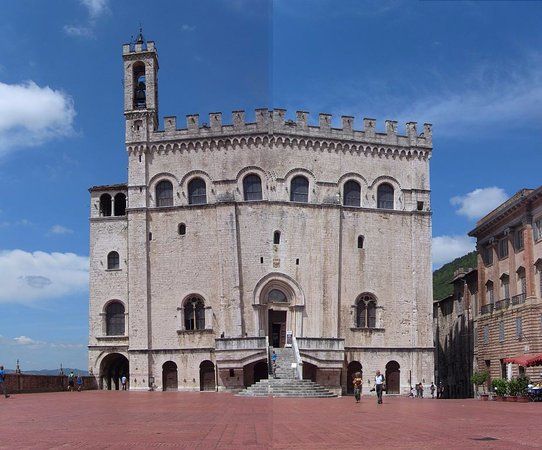
When I look at the list of events in Gubbio (2009 at the time I write this) there is something going on every month. Not only the important festivals of Ceri and Palio della Balestra but also the many food exhibitions and festivals like the truffle fair end of October (see to-do sectrion) and also the Altrocioccolato in October, a kind of alternative to the famous Eurochocolate in Perugia. There are music festivals like Gubbio No Borders jazz festival (August), Gubbio Summer Festival which is the theatre season in July/August in Teatro Romano. Many towns in Umbria have formed an association called Teatro Stabile dell’Umbria with many performances throughout whole Umbria, including Gubbio. Then there is Umbria in Danza (dance festival, also in summer) and theatre in Teatro Communale (located in Via del Popolo, quartiere San Martino) in winter. In summer, a festival called Life in Gubbio is being held at Piazza Grande in front of the marvellous Palazzo dei Consoli with music, dances, theatre, discussions but rather modern ones.
Have a look at the BellaUmbria link above or, since this does not list every event, better have a look at Gubbio’s website (though only accessible through the Italian version) at the events listed on the right hand side. They are listed per quarter (as in 3 months).
The tourist office is located in Via della Repubblica, the road which leads uphill from Piazza Quaranta Martiri. It is on the left hand side, a couple of metres past the clock (meeting point clock).
© Ingrid D., December 2009 (just in case, RickS or others come along and think they can steal texts).
Fondest memory: Riccardo Casagrande's excellent site for iPhones - more to come :-)
Updated Aug 2, 2011
Favorite thing: Quartiere San Martino is Gubbio’s oldest quarter. Its symbol is the crown and it is present on the street signs (photo 1) and on one of the set of four flags (photo 4). San Martino’s church is San Domenico (see photo). Originally it was dedicated to San Martino but in 1287, after enlargement, it was handed over to the Domenican order and thus is now called San Domenico. When I was in Gubbio in Oct. 2009 it was not open. I have read that restorations are going on. Next time maybe, because the church contains beautiful artwork of Ottaviano Nelli. I also liked the very much characteristic shop sign of Macelleria Pompeo (see photo). This butchery is in business since 1859, proud of belonging to San Martino (the crown) and has the three ceri in their logo, each with the saints’ symbols and colours: blue helmet for San Giorgio, yellow mitre of Sant’Ubaldo and red flame for Sant’Antonio.
San Martino is also famous during Christmas time when life size terracotta statues are put up as a giant nativity scene throughout the whole quartiere.
Have a look at the video on youtube with music by Angelo Branduardi and other websites with photos of San Martino’s presepe. Gubbio’s special website has listed and described all nativity scenes and decoration in Gubbio. Next year I will see these in real life :-)
Update, December 2010:
Just found another video of San Martino's presepe, with more close up exposure of the statues.
© Ingrid D., December 2009 (just in case, RS or others come along and think they can steal texts).
Updated Dec 21, 2010
Favorite thing: Since I revisited Italy in 2007 I knew that I want to learn the language to be able to talk to the people and read descriptions in the smaller museums. And of course to watch my most favourite of all Italian series online, Commissario Montalbano. But I also knew that I don’t want to go to one of these language schools which might be good but nothing for me and my way to learn. Because Umbria left a deep impression on me after my fist trip April 2008 I thought why not have a look for language options in Umbria (I knew that there are loads of private lessons in Toscana). To my utmost delight I found …a website with title “Italiensch in Gubbio” (Italian in Gubbio): Edvige Galasso, an Italian woman, teaches Italian in the town I desperately wanted to revisit because I got so fascinated about its culture, tradition and festivals! And I was even over the moon when I read that she does not teach huge groups but prefers to give one-to-one lessons. Just what I was looking for! I emailed her, she immediately replied, we discussed details, my knowledge in Italian up to now, she recommended and even booked me the charming Residenza di Via Piccardi and finally I was able to give her the dates after I had booked my flights. Luckily for me end October wasn’t peak time for her so I could chose the lesson hours when I was in Gubbio. Since it was a perfect golden October I wanted to catch golden Gubbio as much as possible and had lessons from approx. 10 a.m. to 1 p.m. and from 5 p.m. to 7 p.m.
Since I speak Spanish and had Latin at school but no Italian lessons so far, I didn’t have the slightest idea of how much I actually know, but her way of teaching was fantastic. After 30 minutes she already knew “where I was” and “picked me from there” (that’s German expressions of what I want to say). The book she had recommended and bought for me was excellent and I learned quickly. I loved the fact that she didn’t race through the matter but gave me a solid foundation of Italian with all the necessary grammar (usually I hate grammar, but the way she taught it was fun).
Fondest memory: .
Thank you dear Edvige for having given me one of the most valuable gifts ever – the key to your language! And thank you for having taken me on this most memorable day out to meet your friends so that we could have the chance to immerse into these fascinating arts of bell ringing, cross-bowing and flag throwing. And thanks for the wonderful jewellery you make! I wear them with pride! I look already forward to May next year :-)
Bad news for non-German natives or speakers: she teaches only German speaking people (Swiss, Austrians, Germans and anyone who speaks German). This is not meant as discrimination but she lived and taught Italian in southern Germany for 17 years, thus is fluent in German. And since she teaches independently from schools on a private base, she cannot issue specific language certificates as schools do. But then... who needs certificates??? I want to learn Italian and with certificate I would not learn better or quicker, haha.
Lessons are 25 € per hour (one hour equals 60 minutes with her and not 45 like for the language schools), or 40 € for two people.
Edvige Galasso, Italian in Gubbio.
© Ingrid D., November 2009 (just in case, RS or others come along and think they can steal texts).
Updated Dec 9, 2010
Favorite thing: They are not as obvious as in San Gimignano, but then San Gimignano has a complete different location on top of a hill and not on a slope. But I would bet that Gubbio has just as many towers. Have a look over the town from the balcony of Palazzo dei Consoli and you will see what I mean (see photo). Several of these towers are inside the town walls and were also built by the several families to demonstrate power and strength. I have yet to find out which one belonged once to which family and what it stood for, next time! In addition to the ones in town many towers of the town wall are also still exisiting, including many parts of the town wall itself plus entrance gates. My most favourite part of town wall is the one in my main photo. The best view for this one is from outside of chiesa San Francesco in the afternoon when the sun starts to descent and spills out magic light over the city. With the slender trees in front of the wall, it makes for a magnificent photo :-)
© Ingrid D., December 2009 (just in case, RS or others come along and think they can steal texts).
Updated Dec 9, 2010
Favorite thing: San Pietro is the southern quarter of Gubbio’s old town with the rose as its symbol. The main church is San Pietro, located in the south of town. This is a huge church and from the photos I saw it must be beautiful inside with a big wooden carved organ and three naves. A church with more than one nave is quite unusual in Gubbio’s old town, as for the churches at the hill slopes it would have been too much of an architectural challenge. But since San Pietro is located in a rather flat part of Gubbio, side naves were possible to build. Attached to the church is a convent, rather big as well. Oh and the post office is located in San Pietro.
© Ingrid D., December 2009 (just in case, RS or others come along and think they can steal texts).
Updated Dec 9, 2010
Favorite thing: San Giuliano is east of San Martino, both are divided only by the riverbed of Camignano (dry in summer). Its symbol is the falcon and its main church is not San Giovanni Battista (“Don Matteo’s church”) but the tiny chiesa San Giuliano next to Palazzo Bargello in Via Consoli. It is also seat of the Università dei Sarti, the dressmakers or tailors. Fontana dei Matti’s, the famous fountain, name, by the way, is Fonte di San Giuliano. The best view over San Giuliano is from the balcony of Palazzo dei Consoli (see photo). Famous buildings in this quartiere are of course Palazzo dei Consoli and Palazzo Bargello, Casa Sant’Ubaldo in Via Baldassini below Piazza Grande, the park Ranghiasci and chiesa San Giovanni Battista.
© Ingrid D., December 2009 (just in case, RS or others come along and think they can steal texts).
Updated Dec 9, 2010
Favorite thing: Quartiere Sant'Andrea is the eastern part of Gubbio’s old town, it stretches along the hill up to the basilica and its border with southern San Pietro is Corso Garibaldi. Sant'Andrea’s symbol are three plumes and its main church is San Marziale. Similar as for San Martino’s church, San Marziale was once devoted to Sant’Andrea, it was a monastery one and said to have been built on the remains of a temple for Mars (thus the name – Marziale). This church is the oldest in Gubbio, dates back to 1000. I also haven’t been inside but must see it next time. From the city map I saw that Sant'Andrea has the highest amount of churches, such as the important San Francesco della Pace (where the statues of the saints for Ceri are being kept), S. Maria Nuova, chiesa della SS Trinità, S. Maria dei Servi and I think also the cattedrale belongs to Sant'Andrea.
© Ingrid D., December 2009 (just in case, RS or others come along and think they can steal texts).
Updated Dec 9, 2010
Favorite thing: Italian cities are, like many other cities and towns on the planet, divided into “districts”. In the past they had administrative significance but this is nowadays this is mostly gone. But in towns and cities which held their tradition very high, these districs still play an important role not only through festivals. Venezia La Serenissima is one example where six sestieri (6x one sixth) form the city. The same is for Ascoli Piceno. In case of Trevi, Spello and Lucca it is three districts, consequently called terzieri. Siena has 17 districts but they are called contrade. And Gubbio’s old town has four districts – four quartieri: Sant'Andrea to the east, San Pietro to the south, San Martino to the west and San Giuliano to the north. They are surrounded by the city walls. San Martino and San Giuliano are divided by the riverbed (which is dry in summer), San Pietro and Sant'Andrea by Corso Garibaldi and Via della Repubblica forms the east-west line. Together they all meet (more or less) at Piazza Grande. Each of the quartieri has a main church, which gave the district its name. Some are of lesser importance nowadays like in the case of San Giuliano: its main church is San Giovanni Battista. Each of the quartieri also has a symbol which is present on the street signs or quarter signs, on the flags and on the balestre, depending which quarter is represented. But from what I have seen, there is not much competition between the quartieri, as it is the case in Siena where the contrade fight fiercly against each other during the Palio (the horse race). In Gubbio, the symbols, thus quartiere, are often present as a whole, I believe that they signify the harmony of the town and quartieri. But I will find out more during my next visit. And I will also find out which society or guild inhabited the quartieri originally. But maybe it was not one of these but local important families? No matter which, I will find out.
© Ingrid D., December 2009 (just in case, RS or others come along and think they can steal texts).
Updated Dec 9, 2010
Favorite thing: We tend to forget that Italia’s Appenine Mountain region is earthquake region. I don’t mean that it should scare anyone to visit this beautiful region of Italy, but to raise awareness why some buildings might be closed for restoring or why even some roads or paths are not accessible.
The most horrible days in Umbria’s recent history were September 26 and 27, 1997. This was when an earthquake (5,7 on Richter scale) hit Umbria with epicentre near Foligno. Eight people died, thousands were unsheltered. And the roof of Basilica San Francesco Superiore collapsed. Most tragic was that two monks and two technicians who were cleaning up dump from a former “light” earthquake inside the basilika died under the debris of the collapsing roof. The technicians belonged to a TV team who had planned to record part of the cleanup, so a video of this exists. It shows how horrible the earthquake must have been. Luckily, thousands of people worldwide donated and conservators came to work as volunteers to help restoring the Cimabue frescos. They did an amazing job, sieving more than 1200 tons of debris and sorting out around 300.000 pieces to restore the work. Only 2 years after the earthquake the basilica could open again. Most of the donations went to Assisi since the Holy Year year 2000) was nearing. The other villages with similar bad damage had to work longer to rebuild and restore their buildings and churches, Norcera Umbra for example. Even now, 13 years later, you can see the scars the earthquake left in many villages and often, churches are not open to visitors.
Earthquakes are not uncommon for Umbria and the surrounding provinces. We all remember the horrible earthquake (5,8-6,3 on Richter scale) April 6, 2009, which destroyed the centre of
L’Aquila (Abruzzo region) where more than 300 people died and hundreds of thousands of people were homeless. Also recently a minor earthquake (4,2 on Richter scale) hit the region west of Deruta (south of Perugia). The reason for this is that the African plate moves northwards and slides under the Eurasian one. Gubbio though was not affected during these two in 2009.
Now that I update this (August 2010), the path of Via della Cattedrale towards Palazzo Ducale is closed due to renovation. Several cranes are placed in the eastern part of town, also due to renovation. But luckily Gubbio wasn’t affected that much by the 1997 earthquake. The most destructive one the locals experienced was on April 30, 1984, one of 5,2 on Richter scale. Luckily no one was killed, but several people were wounded. This again makes me feel sure that Sant’Ubaldo also watches about the lives of his people during earthquakes. When I was in Gubbio in May and early June 2010, obviously a minor quake happened (2,1 in strength). I didn’t notice it but found out only now, during my research.
© Ingrid D., February 2009 (just in case, RickS or others come along and think they can steal texts), update August 2010.
Updated Dec 9, 2010
Favorite thing: When you walk through Gubbio, please take extra notice of the building styles, even if you are not really interested in architecture. No, I don’t mean to find out if they are Gothic or Roman or Renaissance or what kind of pinnacles they have, but how they have been built on this very steep ground. I was fascinated already when I walked uphill to Piazza Grande and stopped at the stairs which lead uphill from Via Baldassini (the street below Piazza Grande). The piazza’s supporting basement is huge and does look more than a system of archways intentionally built for hiding, storage or something similar. But no, this exceptional basement was needed to make it possible to build the piazza! I didn’t find sizes, but I assume each of the four big arches is 20 m high and 10 m wide. They are hollow “inside”, towards the hill, and this all was necessary to make sure that the whole weight of Piazza Grande and the two palazzi won’t make the piazza and the buildings collapse at a point in time. Given the fact that this all dates back to 14th century without the “modern” techniques of CAD, it is a masterly architectural achievement. Something we tend to forget in our so organised and technically dominated world of today. Palazzo dei Consoli has an additional “weight support”: the loggia which faces the valley was also meant to be a “light weight” (not to add too much weight onto the supporting structure to the road below).
You will certainly notice many archways in Gubbio’s streets between the houses and the main parallel roads. They have a similar effect: not too much weight on the ground by the houses. Another example is Gubbio’s cathedral or duomo: it does not have any side naves, simply because it would not have been possible to construct them without the church eventually sliding downhill. So it has only the main nave and additional supported by the arches in the side walls outside (photo 5). But the funniest structure was the house in photo 4: obviously more space was needed upstairs, so they simply extended it in the upper floors.
© Ingrid D., February 2009 (just in case, RickS or others come along and think they can steal texts), update August 2010.
Updated Dec 9, 2010
Sponsored Links
2 Reviews and 90 Opinions My wife and I did not stay at the hotel but we did have a great lunch time meal in the hotel's...
1 Review and 99 Opinions When I arrived in Gubbio in April 2008, I was a bit exhausted from the road traffic. It was late...
2 Reviews and 0 Opinions The best part about the stay is the hostess Federica Biagotti. She is warm, friendly, and someone...
Reviews and photos of Gubbio attractions posted by real travelers and locals. The best tips for Gubbio sightseeing.

When you walk through Gubbio, please take extra notice of the building styles, even if you are not really interested in architecture. No, I don’t mean to find...
4 members live in Gubbio
Q: other then spend money on a driver to port me to gubbio, how do i arrive?? I am aware ther are no trains to this town. I also at...

A: You can take a train from Perugia to Fossato di Vico, and then take a bus (18 or so km). Or you can take a bus directly to Gubbio from Perugia Fontivegge railway...
Read 12 Replies
1
Gubbio: a very proud, very pure Umbrian town

I dedicate this page to my glorious society of balestrieri di Gubbio and to the people of quartiere Sant’Andrea. You all have a special place forever deep in my heart. I would like to thank you for......
2

Gubbio, is one of those glorious towns in Italy that was much more important yesterday than today. It's builded on a hill in Umbria, not too far from Perugia. Founded by the "Umbri", an anchent...
3

Gubbio is a small quiet old town, with not much going on in everyday life. Although i liked it here, it was nothing too much... i found it similar to the atmosphere of bulgarian old towns, with the......
4
A Town with Great Character, History, Traditions

We arrived in Gubbio on Market Day. The square was alive, and we were hungry. A bit later we were enjoying fresh cheese, various salume, and breaded fish such as squid and calamari from the street...
5
One of our favorite Umbrian Towns

What a delight it was exploring this town. We visited on an early May morning, and the town was virtually empty of tourists. What a pleasure this is when compared to the packed tourist traps of...
Build your own Gubbio page
see all Gubbio member meetings
Sponsored Links