Gubbio Things to Do

  Gubbio, Loggia dei Tiratori
by Trekki
 
  • Gubbio, Loggia dei Tiratori
      Gubbio, Loggia dei Tiratori
    by Trekki
  • Delicious Calabria - olives, onions, peperoncino
      Delicious Calabria - olives, onions,...
    by Trekki
  • Corteo Storico, at Palio della Balestra :)
      Corteo Storico, at Palio della Balestra...
    by Trekki
  • Civic Museum of Gubbio
      Civic Museum of Gubbio
    by cmcard2
  • Picture Atop the Civic Museum of Gubbio
      Picture Atop the Civic Museum of Gubbio
    by cmcard2
 

Most Recent Things to Do in Gubbio

Sort by: Most recent | Most helpful

Write a Review
Festa dei Ceri: highlight of Gubbio's events
Trekki profile photo

4.5 out of 5 starsHelpfulness

Trekki 2152 reviews
Ceri Mezzani, alzata - volo del angelo :-)
4 more images

Without doubt, Festa dei Ceri is THE highlight in the year of Gubbio. It is being held to honour patron saint Sant’Ubaldo, at the evening of his death, May 15. In contrast to many other festivals, Festa dei Ceri is not and will never be one for tourists; it is purely local and very much part of the majority of locals’ life. (More about this in the local customs section) Another characteristic of this festa, or better another expression of the “ceri” and their dominant role for the locals are the “youth development trainings” (haha, sorry for the silly management word). In addition to May 15, the young generations have their Ceri celebrations as well: Ceri Mezzani for the guys between 16 and 24 on the second last Sunday of May and Ceri Piccoli for the kids around 10 years on June 2nd. The latter is maybe the most moving of all three, because it is fascinating to see how the adults help the kids during the day. But this is another story for the local custom section.

The origins of Festa dei Ceri date back in the very past and even the locals are not sure if it is a religious or a pagan one. The religious origin is connected to Gubbio’s patron saint, Sant’Ubaldo Baldassini, who died May 16, 1160, so the festival is held on the eve of his day of death. It is said that in the very past, the people were carrying candles all around in town that day and finally up to the basilica. These candles have been displaced by the huge wooden candles, the ceri, in 16th/17th century. Each of the ceri is devoted to a saint and each saint represents a specific colour and specific guildes:
Sant’Ubaldo – yellow – stonemansons, builders, miners,
San Giorgio – blue – haberdashers, blacksmiths, carpenters, tailors, cobblers,
Sant’Antonio - black – countrymen, donkey riders, landowners and students.

During the days of Ceri, the activities start early, very early. At 5 in the morning, the drummers walk through town to wake up the three capodieci, the leaders of each cero “group”. Then they all and an increasing crowd of locals walk to the cemetery to honour the deceased ceraioli. This is followed by a mass in Chiesa dei Muratori. Then, at approximately 10 in the morning, the three ceraioli groups walk through town and carry the saints around which will be mounted on top of the wooden ceri later. The emotional highlight is the so-called alzata, the raising of the three ceri followed by the three circles around Piazza Grande’s middle on Piazza Grande. This is at 11:30 and in a way the most “dangerous” part for visitors who are not aware of the emotional heat of the whole festa. During Festa dei Ceri I was on the piazza, near the stairs to the palazzo and I felt like a sardine in a bin. Luckily, during Ceri Mezzani, I was invited on top of the palazzo (thanks dear campanari!!) so that I had a much better view. I hope my photos reflect the atmosphere on Piazza Grande during alzata time a bit. The race itself, up to Basilica Sant’Ubaldo, is in the evening though. Before this, the three ceraioli take their ceri through the city, especially to the houses of old ceraioli where they pause and bend down; in a way this is to honour the locals and the saints. The race itself starts at 6 p.m. at the southern end of Via Savelli and it is a wise idea not to be near the course at the narrow parts of the city (see warnings section). Since it is impossible to watch the whole race, the best points to watch are Via Federico and behind Porta Sant’Ubaldo. From there you are close enough for excellent views but far enough not to be in the way when the carrying ceraioli change places, which is similar to relay.
The race ends at approximately 8 p.m. at Basilica Sant’Ubaldo, where several rituals are carried out before the saints are being brought back to town in the evening procession. In my opinion this is the most emotional part of Festa dei Ceri. This is when the heat of the race transforms into veneration for Sant’Ubaldo, when the people sing O Lume della Fede (Oh light of faith, his song), and when no one screams or talks otherwise. The veneration is visible in the faces of the people. This is why I always recommended to at least seeing parts of the evening procession to every guest at Federica’s place. Because this is when Festa dei Ceri shows what it is: the love for the saint who biologically died 850 years ago but who is so alive and part of the peoples' life.

Space is not enough here to explain this festa. Words will never be enough to explain the emotions for Sant’Ubaldo and the festa. Maybe Giampaolo Pauselli’s short video brings across at least some impressions. For those who want to see more, another set of videos is excellent, although 10 minutes each: part 1 and part 2.

Festa dei Ceri has such a high impact that the three ceri are featuring Umbria’s flag. And the emigrants from Gubbio, who settled in Jessup, Pennsylvania, celebrate Festa dei Ceri at Sant’Ubaldo Day.

This year, UNESCO will decide if Festa dei Ceri will be listed in the Intangible Cultural Heritage List.

My recommendation: try and come to Gubbio in May to see this splendid heritage festa. But try and come for Ceri Mezzani or Ceri Piccoli. These are a tad bit less crowded and thus a tad bit safer to visit.

Update March 2011:
Festa dei Ceri is even so important in Gubbio and parts of Umbria that a huge storm of protest happens this year (2011): local elections are set to be for May 15 and 16. The locals are furious and the newspapers full with protest, especially Gubbio. It is unlikely that the locals will go to vote. There are serious discussions to postpone the election days.

© Ingrid D., January 2011 (just in case, RickS or others come along and think they can steal texts).

Updated Feb 18, 2012

Website: http://www.ceri.it/ceri_eng/index.htm

Related to:
 Arts and Culture
 Religious Travel
 Festivals

Was this review helpful?

The amazing tradition, ancient crossbowing
Trekki profile photo

4.5 out of 5 starsHelpfulness

Trekki 2152 reviews
Taking down the target (tasso)
4 more images

Visting Palazzo Bargello and seeing the history of Gubbio’s medieval crossbowing is exciting. But this is only one small part of the whole. If you are interested in this very old tradition then you should come to town end of May or in the middle of August. These are the days when Gubbio’s crossbowmen, the balestrieri, have their tournaments. The biggest is Palio della Balestra®, held every last Sunday in May, and the smaller, albeit more intimate in my opinion, is Torneo dei Quartieri on August 14.

Palio della Balestra® has its origin 550 years back in time. These days Federico da Montefeltro II of Urbino and his wife Battista Sforza came to Gubbio quite often. One official occasion was the market and event days held after the city’s celebration in honour to patron saint Sant’Ubaldo. This was the day when the protectors of the city, the glorious society of crossbowmen, held their annual Palio together with the ones of Toscana city of Sansepolcro to demonstrate their skills. Gubbio’s Societá dei Balestrieri possesses a document of May 16, 1461 where this is mentioned. And the Palio della Balestra® dates back to this day, which makes it the longest performing historical festival in Italy (also longer than the one in Siena). The day starts with the lecture of the banda, the document where the herald of town reads the invitation for official event to the townspeople. Andrea R., who does this nowadays, is an excellent herald and can throw you indeed back into the ancient days of the first Palio (listen if you like, I took a video of his announcement Magis cor vobis Ikuvium pandi, translates into "Gubbio welcomes you with open heart"). Around noon the first trial shootings take place on Piazza Grande and at 16:00 Gubbios balestrieri, their drummers, cavalieri and madonne start the historical procession, corteo storico, from Palazzo Bargello, the society’s seat (photo 5). They proceed through town and meet with the cortege of Sansepolcro’s balestrieri and at 16:45, all arrive on Piazza Grande where the rituals of exchanging gifts and blessing by the bishop are being executed. Of course, the campanari ring the Campanone on top of Palazzo dei Consoli. The whole event is accompanied by several performances of Gubbio’s sbandieratori, the flag throwers. And at the end, the target, called tasso, is being brought into a secluded room to determine the winners. This is indeed a complicated process, the arrows often have to been taken out with the help of pliers (photo 4).

The other contest, Torneo dei Quartieri, is more intimate, as I already mentioned. It is much more colourful because each of the four quarters arrive on Piazza Grande in their own historical processions. In between the shootings, many of Gubbio’s artists perform, such as the ballet, and solo dancers. In August 2010, the ballet performed Carmina Burana, very much emotional. I have made short videos (see my Gubbio videosection). The best though is the evening. Each quartiere helds a party, and what a party!! The band sings until late after midnight (at 1:30, when I left the party, they were still singing), and the atmosphere is magic! It was certainly the best festa ever I attended. I hope my videos bring this across, the ones which are labelled Sant’Andrea, “my” quartiere. There is a video about Torneo dei Quartieri (August 2010) on youtube.

There is much more to the crossbow contests in Gubbio, and this is why I have written more about it in the local customs section. At this point I want to thank the Glorious Società dei Balestrieri for everything they did to me, including having accepted me as a member. Thank you for everything! I honour this very highly!

The dates of the contests are:
Last Sunday in May: tournament between Gubio and Sansepolcro,
August 14: tournament between Gubbio’s quartieri

© Ingrid D., January 2011, text completely new written (just in case, RickS or others come along and think they can steal texts).

Updated Jan 27, 2012

Website: http://www.balestrierigubbio.com/video/

Related to:
 Budget Travel
 Arts and Culture
 Historical Travel

Was this review helpful?

Festa dei Ceri
andy-g profile photo

3.5 out of 5 starsHelpfulness

andy-g 49 reviews

Next time I'll go to Gubbio, it must be on May 15th. In that day a wellknown happening has its place: the "Festa dei Ceri". It's an old tradition, and people from Gubbio as well as tourists crowd the streets to see it.
Given that I haven't seen it, yet, I've no pictures to show you.
The "Ceri" are very large poles that are carried by the chosen persons in a race through the town. There are several teams, but the funny thing is that everybody knows who's going to arrive first. Infact, the first team to arrive is already given. It's a matter of ability, not of speedness!
Look at the link below for details

Updated Apr 4, 2011

Was this review helpful?

Palazzo Ducale: master view and magic art
Trekki profile photo

4.5 out of 5 starsHelpfulness

Trekki 2152 reviews
Master view from Palazzo Ducale's terrace
4 more images

After a few minutes walk along Via della Cattedrale the outer buildings of Palazzo Ducale come into sight, some of which are partly still damaged from 1997’s earthquake. The entrance to the palazzo areal is quite obvious: the portcullis is open. Some fascinating frescoes, albeit partly damaged or otherwise gone, are inside the archway. And there is also a hole in the wall at a bit higher level (maybe from the earthquake) where the wooden beams and part of the wall construction can be seen. When I stepped out onto the terrace (photo 2) for the first time in April 2008 I found a magnificent view over Gubbio’s houses and the surroundings. Palazzo dei Consoli and its bell tower stick out like the symbol of the town. The small kiosk offers life saving snacks and caffè, but that is a story for the restaurant section.
On the way further uphill (only a few metres though) I saw the fascinating façade of Palazzo Ducale, in a kind of illusion painting, suggesting “diamonds” (photo 3). The palace can be visited, and only in August 2010 I managed to do just this, with a special guide: Marcello Minelli, patriarch of the Minelli family, who have a restoration business in Gubbio and who have made the replica of Federico da Montefeltro’s Studiolo. This magnificent wood inlay work was made for Palazzo Ducale in Gubbio in 15th century but was stolen in 18th century and in private hands for a long time. Metropolitan Museum in New York purchased it 1939 and it is now on display there. In 2000, with the help of funds and organisations in Gubbio, the reconstruction of Studiolo was started by Minelli family. In October 2009 the work was finished and Gubbio’s Studiolo officially opened for the public. So it was fascinating to walk with Marcello into the room and listen to his explanations of how difficult it was to find wood old enough for this work and how they created the three dimensional illusions, this work is so famous for. Photography isn’t allowed inside the palazzo, and even if I was allowed to take photos, I promised the staff not to publish these. But then, on the Met’s website the original Studiolo is described in many photos. And, local Danae Film Production made a short video on youtube about the Studiolo in Gubbio.

But it is not only the Studiolo what makes a visit to Palazzo Ducale a must in Gubbio. It is their huge collection of artwork of Mastro Giorgio, a local artist who became famous for having invented the lustre technology. And when I was in the Palazzo in August 2010, they also had a fascinating exhibition about Dante and his Divina Commedia. And it was also Minelli family who made the showcase woodwork with amazing inlay work for the printed versions of Inferno, Purgatorio and Paradiso. In addition, as permanent exhibition or rather illusion: holographic techniques by Paolo Buroni bring Federico da Montefeltro back to his Palazzo in Gubbio. He talks to an angel and there is a holographic puzzle on the floor which is being activated when people walk over this part of the floor. To my delight I found that there is a short video about the Famtasma di Montefeltro on youtube.

So yes, it is well worth to visit Palazzo Ducale and I am a bit ashamed that it took me 2 years to do this. On the other hand, I could not have had a better guide than Marcello Minelli. Grazie mille Marcello for your time and explanations!!

The Palazzo’s website (see website section) is still under construction in parts. But it already gives a good overview on their photo collection (Galleria), and also has some sketches of the palazzo’s architecture.

Opening hours, Palazzo Ducale:
Tuesday to Sunday, 8:30 a.m. – 7:30 p.m.
Entrance fee: 2 € for adults, 1 € for students (18-25 years), free for kids until 18 and adults over 65.

Palazzo Ducale on Google Maps

© Ingrid D., February 2009, complete revamp and photo exchange, December 2010 (just in case, RS or others come along and think they can steal texts).

Updated Jan 6, 2011

Address: Gubbio, Palazzo Ducale

Phone: +39 - 075 - 927 58 72

Website: http://www.madgubbio.it/

Related to:
 Castles and Palaces
 Historical Travel
 Architecture

Was this review helpful?

Gubbio and the dinosaurs :-)
Trekki profile photo

4 out of 5 starsHelpfulness

Trekki 2152 reviews
Gubbio, Gola del Bottaccione
1 more image

For those interested in geology, Gubbio has an interesting sight to offer: Gola del Bottaccione, on the road to Scheggia. In 1980, US scientist Walter Alvarez and his father Luis have discovered a very high concentration of chemical element Iridium here in the boundary between Cretacious and Tertiary layers. This high concentration of Iridium and other elements of the Platinum group, found not only in Gubbio but in other parts of the world at this layer boundary, has finally lead to the assumption of a huge meteorite impact, which, with the resulting climate change, has lead to the extinction of the dinosaurs and other biological life 65 million years ago.
This layer is visible from the street, but there is also a small hiking path for closer viewing. It is approx. 1 km north of Gubbio, easily to reach by walking.

From November 25, 2010 until April 2011, Palazzo dei Consoli hosts an exhibition about dinosaurs in context with the discovery of this “Iridium Anomaly”. The full exhibition, called Il Pianeta che cambia (The changing planet), which was set up with the help of American Museum of National History (New York) can be visited in Perugia, Palazzo Baldeschi from October 2010 until June 2011. Additional information on Gubbio’s special website (currently at the bottom of this website).

Gola dei Bottaccione on Google Maps

© Ingrid D., December 2010 (just in case, RickS or others come along and think they can steal texts).

Updated Dec 29, 2010

Website: http://jsedres.geoscienceworld.org/cgi/content/abstract/61/3/315

Related to:
 Budget Travel
 Hiking and Walking
 Historical Travel

Was this review helpful?

San Giovanni Battista, “Don Matteo”’s church
Trekki profile photo

4.5 out of 5 starsHelpfulness

Trekki 2152 reviews
During Festa dei Ceri, San Giovanni (right)
4 more images

The beautiful and simple chiesa San Giovanni Battista is located between Piazza Quaranti Martiri and Palazzo dei Consoli with a magic view up to the palazzo and the belltower with the big bell Campanone. The church is nice inside although very plain. I couldn’t take pictures though since it was always something going on when I was indide (a wedding, and services). It is the church of quartiere San Giuliano and also for the people of Sant’Andrea. During May a marvellous big flag with the falcon, symbol of San Giuliano, decorates the piazza in front of the church (main photo). The bells of San Giovanni are also rung manually at specific events, such as the celebration of the Madonna on May 24. Thanks again to Luigi Barbi, who has invited me to join him, his nephew and Claudio M. when they went upstairs to ring the bell that evening. On November 6, 2010, I missed to join them, when they were also ringing the bell on the occasion of the church service which was held for Società dei Balestrieri. It was their celebration of the end of their active year, Giornata dei Balestrieri.

But in addition to be one of Gubbio’s churches it also became famous throughout whole Italy because it is “Don Matteo’s church”. Many of us “oldies” will surely remember Terence Hill as a star of the good and funny spaghetti westerns together with Bud Spencer. But he is Italian (born in Venezia La Serenissima, by the way) and returned to his homecountry some time ago. Since 2000, he is famous for being Don Matteo in the series aired by Italian RAI channel. I was told that Gubbio is nowadays quite well known in Italy mainly through this series. On Terence Hill’s website is a section about these series (click on the link given at the bottom left). And if you are lucky, you might see some filming during the autumn months. When I was in Gubbio in Oct/Nov 2009 it was already too late.

Chiesa San Giovanni Battista on Google Maps.

© Ingrid D., November 2009. updates December 2010 (just in case, RS or others come along and think they can steal texts).

Updated Dec 27, 2010

Website: http://www.eugubininelmondo.it/en/MappaCitta.html#ChiesaSA

Related to:
 Architecture
 Historical Travel
 Religious Travel

Was this review helpful?

Loggia dei Tiratori & Piazza dei 40 Martiri
Trekki profile photo

4.5 out of 5 starsHelpfulness

Trekki 2152 reviews
Gubbio, Loggia dei Tiratori
4 more images

Piazza Quaranta Martiri at the bottom of Gubbio is most likely where travellers to Gubbio will arrive. It is a wide and open space and filled with hustling and bustling life. Gubbio’s market is held here on Tuesdays. Small food stalls with delicious products are set up daily under the arcades. The dominating church is chiesa San Francesco and only after my second visit to Gubbio (Oct. 2009) I have been inside. It is indeed a very beautiful one with frescoes all over. And it also plays an important role in Gubbio’s history. When San Francesco came to Gubbio, he was invited by the wealthy Spadalonga family, a dynasty of wool traders. They gave him shelter and gave him clothes. So this is where he got the brown frock from. He always had a good relationship with this family and they donated of their storage room when San Francesco’s followers wanted to build a church in Gubbi after his death. The wall of this storage room is now part of the inside walls of chiesa San Francesco. Even if chiesa S.M. Vittorina is more related to him, chiesa San Francesco is the one which is devoted to him and his life with frescoes and stained glass windows. Next to the church is a cloister (Chiostro della Pace). But I could not find out how to get there. Next time for sure, because given the descriptions I have read it must be marvellous. And it should also have the sigillo della custodia Eugubina inside and the Francisoc library with more than 10000 books, some of which are of 13th century. Yes, I must find out how I can visit the library!
Next to San Francesco’s entrance portal is another statue of San Francesco and the wolf, by the way.

Another obvious building at the piazza is Loggia dei Tiratori, the long two-storey building with an open loggia on the first floor. In the past it was the house of Gubbio’s weavers’ guild. After dyeing the fabrics, they were stretched to a defined size and dried here (the fabrics, haha, not the weavers…). At Loggia dei Tiratori’s eastern wall is a huge beautiful old clock, but that’s a story for the local customs section.

Piazza Quaranta Martiri has its name in memory of the brutal massacre, the brainsick German SS nazis were responsible for on April 22, 1944: they picked fourty (quaranta) locals and executed them….The memorial is outside the city walls and when I come again I will lay flowers. I am also grateful to all the people I met in Gubbio for their hospitality and friendliness. This means very much to me given my actual nationality.

Loggia dei Tiratori on Google Maps.

© Ingrid D., February 2009, updates in December 2010 (just in case, RS or others come along and think they can steal texts).

Updated Dec 27, 2010

Website: http://www.eugubininelmondo.it/en/MappaCitta.html#ChiesaSF

Related to:
 Architecture
 Castles and Palaces
 Historical Travel

Was this review helpful?

Parque Ranghiasci is perfect for relaxing
Trekki profile photo

4.5 out of 5 starsHelpfulness

Trekki 2152 reviews
Parque Ranghiasci, marvellous in autumn
4 more images

This park is perfect for a relaxed afternoon and even more so in autumn when all the leaves turn golden. It is called Parque Ranghiasci and was once laid out for Marquess Francesco Ranghiasci Brancaleoni, a noble man of Gubbio (19th century). Originally it was meant to be a connection for carriages from the city’s northwestern parts to Palazzo Ducale, since it must have been a nightmare to lead these uphill otherwise. Nowadays it is an English garden with zigzag alleys, several classicism buildings and medieval ruins, parts of the city wall and its towers and huge trees. In summer these trees must provide excellent shade. The park has two entrances. One is in Gubbio’s northwest, quartiere San Martino to be precise. Near this entrance is also an interesting building (photo 5): Palazzo Capitano del Popolo (peoples’ captain’s palace). It is of typical Eugubini architecture, huge arches at the entrance level and arched windows in the upper floor, most probably also with these characteristic window seats as in Palazzo dei Consoli and Palazzo Bargello. Nowadays it hosts a small museum, Museo della Tortura (torture museum). Though I haven’t been inside yet (next time, haha). The other entrance is at Via della Cattedrale, the tiny road which leads from near Palazzo Bargello and Fontana dei Matti to Palazzo Ducale. The park is open daily, but…. sorry, I honestly forgot to note down the opening times. There was a sign, I remember….

Parque Ranghiasci on Google Maps.

© Ingrid D., December 2009 (just in case, RS or others come along and think they can steal texts).

Updated Dec 27, 2010

Website: http://www.comune.gubbio.pg.it/Index.aspx?idmenu=3386

Related to:
 Road Trip
 Hiking and Walking
 Budget Travel

Was this review helpful?

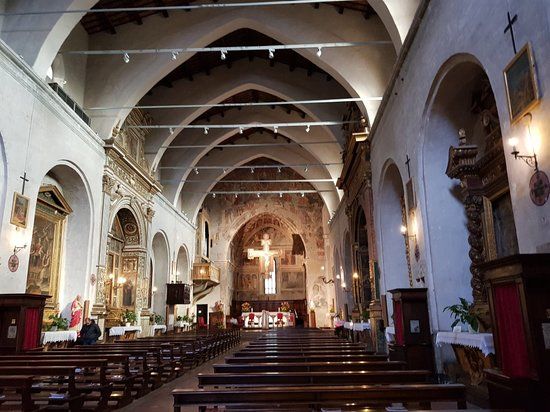
Chiesa dei Muratori, a significant church
Trekki profile photo

4.5 out of 5 starsHelpfulness

Trekki 2152 reviews
Chiesa dei Muratori, during Ceri time :)
4 more images

Later I will describe that Gubbio was a very important station in San Francesco’s life. Not only the basilica San Francesco at Piazza Quaranta Martiri and the little church Santa Maria della Vittorina in Gubbio’s southern outskirts tell about this. And then there is the story of the wolf the saint has tamed. The little church San Francesco della Pace was built on the site where this wolf had peacefully lived and died. Even if this is a legend, during renovations in 19th century a wolf skeleton was found here under a stone. The skeleton is now preserved in this little church and the stone serves as altar. But San Francesco della Pace is not only the church for the wolf, it is seat of the Università dei Muratori, the society of stonemansons, and the place where the statues of the three saints Sant’Ubaldo, San Grigorio and Sant'Antonio are being kept between the famous Ceri race and can be seen through the window. This is the place where church service is held in the morning of Ceri festival’s 15th of May. The church is not open to the public, but everyone can peek inside at the end of the Ceri days (May 15th, second last Sunday of May and June 2nd). It is here where the Ceri races end, when the statues of the saints are being brough back to town into a very atmospheric procession. In May 2010 when I was in Gubbio for all three Ceri festivals, I always took part of this evening procession. It was always very moving, especially the moment when the carriers of the saints moved around the corner and walked upstairs to the church. The little bells on top of the church were ringing and I could almost hear the bells welcoming the saints back home. But in case you would like to attend these evening masses after Ceri, please keep in mind that these days are the most important days in the locals’ life. Don’t insult them by being rude or pushing to get inside of the church. Thanks!!

The church is being called Chiesa dei Muratori today. Old guidebooks and maps might still show it under the old name, San Francesco della Pace. The coloured textiles on the balcony are only displayed during Ceri time. The three colours are prominent: blue for San Giorgio, yellow for Sant'Ubaldo and black for Sant'Antonio.

San Francesco della Pace (Chiesa dei Muratori) on Google Maps.

© Ingrid D., December 2010 (just in case, RS or others come along and think they can steal texts).

Updated Dec 27, 2010

Website: http://www.eugubininelmondo.it/en/MappaCitta.html#Francesco

Related to:
 Historical Travel
 Religious Travel
 Budget Travel

Was this review helpful?

Christmas forever, in chiesa di S. Agostino
Trekki profile photo

4.5 out of 5 starsHelpfulness

Trekki 2152 reviews
Presepe - nativity, in cloisters of Sant'Agostino
4 more images

Italians express their religious beliefs in many ways. One of these is the detailed attention to nativities, or presepe in Italian. I saw photos of beautiful ones in several cities like Roma and Orvieto and of course know how famous Napoli is for their “cribs”. Gubbio’s locals, especially the ones of quartiere San Martino, also held this tradition of displaying nativity scenes very high. Emphasis is given to scenes, because they not only show baby Jesus, Maria and Joseph but also every day life in the streets (that’s why crib is not the proper word). The ones in Gubbio are made with life size terracotta figures, dressed in medieval clothes and shown in medieval sceneries. You can see a butcher who is at work, or a cheese seller, women with babies chatting, fresh bread (well, paper maché) and market stalls. Have a look at a youtube video about presepe in Gubbio’s quartiere San Martino (7 min, music by Angelo Branduardi) to see what I mean. These are put up from early December until January 7.
But for all those who cannot come to Gubbio during Christmas time, one huge nativity scene is built in a room inside the cloisters of Sant’ Agostino church just outside of the city walls. It is really beautifully made, the figures approx. 15-20 cm, with landscape scenery, houses, people at work, shepherds, a little waterfall, pastures and even a volcano which puffs little clouds. I also liked that they simulate day and night: during “night”, the lights are put on in the houses and stars appear on the sky behind the volcano. But be careful when you step into the room. It is dark inside although the button for lightening the scenery is easy to find. Once pressed, it lasts for approx. 10 minutes (or 3x day and night). There is no entrance fee but it would be nice to leave a donation in the box. It shall be open all day long. I didn’t see any opening signs and was there around 3 p.m.

Presepe Permanente on Google Maps.

© Ingrid D., February 2009 (just in case, RS or others come along and think they can steal texts).

Updated Dec 27, 2010

Website: http://www.santagostino.net/presepe/presepe.htm

Related to:
 Arts and Culture
 Religious Travel
 Budget Travel

Was this review helpful?

Top 3 Hotels in Gubbio

Hotel Bosone Palace

 2 Reviews and 90 Opinions  My wife and I did not stay at the hotel but we did have a great lunch time meal in the hotel's... 

 Hotels in Gubbio

Hotel Gattapone

 1 Review and 99 Opinions  When I arrived in Gubbio in April 2008, I was a bit exhausted from the road traffic. It was late... 

 Hotels in Gubbio

Residenza di Via Piccardi

 2 Reviews and 0 Opinions  The best part about the stay is the hostess Federica Biagotti. She is warm, friendly, and someone... 

 Hotels in Gubbio

The Place

Reviews and photos of Gubbio attractions posted by real travelers and locals. The best tips for Gubbio sightseeing.

Experience Gubbio
  Share your Travels  
 

The People

4 Members Live Here
 
Our Members Say
 profile photo

 Italians express their religious beliefs in many ways. One of these is the detailed attention to nativities, or presepe in Italian. I saw photos of beautiful... 

4 members live in Gubbio


Questions and Answers

virginiasiegel profile photo

Q:  other then spend money on a driver to port me to gubbio, how do i arrive?? I am aware ther are no trains to this town. I also at... 

leics profile photo

A: You can take a train from Perugia to Fossato di Vico, and then take a bus (18 or so km). Or you can take a bus directly to Gubbio from Perugia Fontivegge railway... 

Read 12 Replies

postQuestion_button

Top Gubbio Writers

1

Gubbio: a very proud, very pure Umbrian town

Trekki profile photo

 I dedicate this page to my glorious society of balestrieri di Gubbio and to the people of quartiere Sant’Andrea. You all have a special place forever deep in my heart. I would like to thank you for...... 

2

Gubbio, where history lives

andy-g profile photo

 Gubbio, is one of those glorious towns in Italy that was much more important yesterday than today. It's builded on a hill in Umbria, not too far from Perugia. Founded by the "Umbri", an anchent... 

3

The ancient town of Gubbio

zlatiq profile photo

 Gubbio is a small quiet old town, with not much going on in everyday life. Although i liked it here, it was nothing too much... i found it similar to the atmosphere of bulgarian old towns, with the...... 

4

A Town with Great Character, History, Traditions

cmcard2 profile photo

 We arrived in Gubbio on Market Day. The square was alive, and we were hungry. A bit later we were enjoying fresh cheese, various salume, and breaded fish such as squid and calamari from the street... 

5

One of our favorite Umbrian Towns

poortrekkers profile photo

 What a delight it was exploring this town. We visited on an early May morning, and the town was virtually empty of tourists. What a pleasure this is when compared to the packed tourist traps of... 

View all rated pages

View newest pages

Build your own Gubbio page

Gubbio Members Meetings

May 27, 2012 
IT'S OUR MEET: Palio della Balestra in Gubbio

see all Gubbio member meetings