Favorite thing:
Umbria is one of the smallest regions of Italy (8456 sq.kms) and is the only one whose boundaries do not touch the sea. The population of Umbria is just over 800.000 inhabitants which is evenly distributed troughout the region. There are only two provincial capitals, Perugia and Terni, however, there are also many large towns and places of great artistic, urban and historical interest. These include Foligno, Spoleto, Gubbio, Assisi, Orvieto, Todi, Norcia and Citta di Castello.
The capital city of Umbria and of the Province, Perugia streches out on a hilly ridge situated between the basin of Trasimeno and the Valtiberina. The city is extremely important in artistic monumental and urban terms, and is the seat of major cultural institutions.
It is also very important Univerity centre with the wide world known University for Foreigners.
Fondest memory:
Very friendly people.
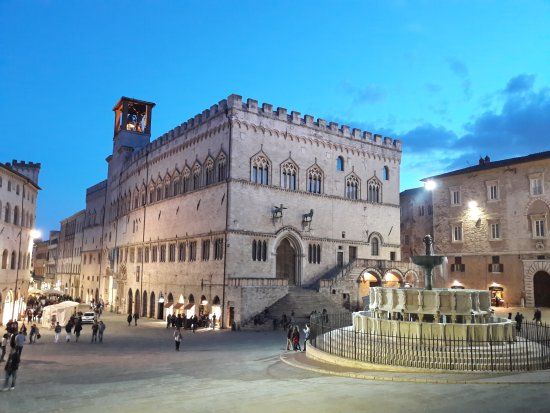
Favorite thing: One of the most impressive buildings in Perugia is the Palazzo dei Priori, the town hall built in medieval times. Construction began in the 13th century, and expansions were added in the 14th and 15th centuries. If you have the opportunity, go inside and take a gander at the spectacular Sala dei Notari, with its frescoes and murals.
Favorite thing:
Perugia was inhabited by the Umbrians and the Etruscans before it came under the control of Rome (c.310 B.C.). It became a Lombard duchy in the late 6th century A.D. In the 12th century it became independent. After that point in time, it gradually gained control over other Umbrian cities. Perugia was ruled by strong tyrants until 1540, when it was conquered by Pope Paul III, after a short uprising known as the "Salt War", which was quickly quelled. After that, Perugia was controlled by the Church for 300 years.
Perugia's population today is around 150,000 people, which makes it a fairly substantial city in Italy. It is the capital of Umbria and is situated on a hill overlooking the valley of the Tiber River. Its main industries are tourism, chocolates, textiles, pharmaceuticals, and machinery. It is known for its art and famous university.
Favorite thing:
Located in Piazza IV Novembre between the Piazza dei Priori and the Cathedral of San Lorenzo is the Fontana Maggiore. The fountain was recently restored and the sculptures and bas-reliefs are exquisite. The bas-reliefs are a religious portrayal of the history of man from Adam and Eve.
The Fontana Maggiore, or Main Fountain, was built to celebrate the construction of the aqueduct that brought water to Perugia from the springs of Paciano, a mountain about five miles from the city center. The aqueduct was completed in 1278.
I personally think the wrought iron fence around the fountain detracts from its beauty. Rumor has it that it was installed after Chevy Chase's "European Vacation" was released and too many copycat camera thieves duped tourists into standing in the fountain.
Favorite thing: After walking most of the day, my family is resting on the ancient aqueduct that was built to bring water to Perugia from the springs of Paciano, a mountain about five miles from the city center. The aqueduct was completed in 1278 and was a major engineering feat at the time. Today, thanks to modern plumbing, the old aqueduct serves as a pedestrian walkway, rather than a water source.
Favorite thing:
The cathedral faces to Piazza IV Novembre, where it is possible to note the characteristic geometrical decoration and statue of pope Giolio III.
La basilica si affaccia su piazza IV novembre, dove รจ possibile notare la caratteristica geometrica della decorazione e la statua di Papa Giulio III
Favorite thing:
Some cities instantly fills you with a good feeling, and Perugia was one of them. We parked our park in a green, spacious place outside the ancient core of the city, and enjoyed walking in the shade of the trees after driving so long in the heat.
I found Perugia a beautiful city, and the intense joy of lifting your eyes, just to find a beautiful fresco on the wall, is something that doesn't stop amazing me when in Italy.
Favorite thing:
This picture shows another view of the aqueduct built in the 13th century.
If Perugia ever wins the bid for the Winter Olympics, the aqueduct could work well as the bobsled run.
Sponsored Links
Sponsored Links
Comments