
The usual entrance to the church is on the feft side, from Stradone S. Fermo, where a staircase, covered by a massive porch, leads up to the door. There are a 13th century frescoes in the lunette, the one on the left by Fr. Morone, 1523.
The Main Door is flanked by two Porched tombs; left Monument to Aventino Fracastoro, doctor to the Scala family (the frescoes which used to decorated the tomb are now in the Castelvecchio Museum), and right the porched tomb of Giovanni da Talentino.
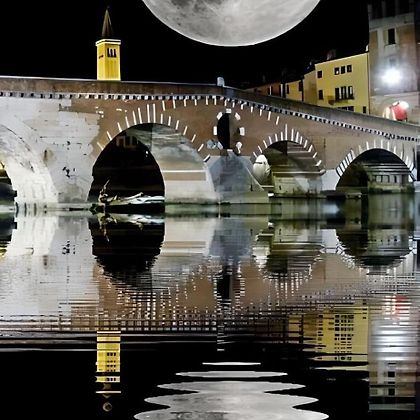
Just before Ponte Navi is the wonderful San Fermo Maggiore. A mixture of styles it seems due to numerous add-ons on top of the original romanesque structure. Head into the basicilia for some impressive sights. There is a lower church, reached by stairs, that is in the shape of a cross and has some impressive frescoes from the 16th and 17th centuries
Just like San Zeno Maggiore was built to house the remains of St. Zeno, the beautiful church of San Fermo is believed to have been built on the very site where the martyrs St. Firmus and St. Rusticus were tortured to death in 304. In 765, the bishop of Verona retrieved the two saints' bodies (they had been buried in Trieste) and brought them to the little church of San Fermo, which quicky proved to be too small to accommodate all the people coming to see the relics and pray. The present church dates back to the 12th century and it's made up of an upper and a lower section. The upper church was used for religious services, while the lower section was initially built especially to house the two saints' remains - they were eventually moved up to the upper level to avoid being flooded by the Adige River. Both sections are still in use today and are open to visitors.
Admission to San Fermo is included in the Verona Card.
In ancient times a small chapel stood on the banks of the river Adige, near the spot where St. Fermo and St. Rustico were martyred. It was rebuilt in the 8th century and in the 9th century the Benedictine Friars began work on a much larger structure in which, from the start, one of the two churches erected on the site, was intended to be built above the other. The lower church has conserved its early Romanesque style, while the upper part was transformed, first by the Benedictins in 1065, and than by Franciscans, who took over the complex after 1313. However, the present look dominate Ghotic style.
The two styles merge into each other harmoniously, thanks to the unity of the colour-scheme maintened throughout the complex.
The absidal sector of the upper church has delightful interwoven decorations and richly ornamented arches.
The side entrance of San Fermo is the one that is used most of the time. The stone staircase is topped by a porch that protects the wooden portal. In the middle of the portal, a statue I have been unable to identify.
The front of san Fermo has a very special look with alternate layers of white stone and of red bricks. It has an imposing Roman portal from the XIVth, a beautiful triforium, two side lodges. And a sepulcher that contains the remains of Aventino Fracastoro, doctor of the Scaligeri
San Fermo is one of the most beautiful churches in Verona. The first church was built in the VIIIth century but most important what was built by the Benedictins in the XIth. They built the lower and the upper church and the campanile, shown here, which was finished only in the XIIIth century.
The first traces of this church go back to the VIII century. The benedectine restructuring that took place in the XI century was particularly important. It apparently started in 1070. The façade is adorned with two loggias with several theories of arches, a beautiful three-mullioned window, an imposing XVI century romanesque portal and a burial court dating from 1300, which contains the remains of Aventino Fracastoro, the Della Scala family doctor.
Hours: 9.30-18.00
Holidays: 13.00-18.00
Closed on monday
entrance: 2 euros
The church is primarily famous for the quality and number of its 14th and 15th century frescoes. The most famous is the outstanding "Anunciation" by the great Pisanello. The figures of the "Almighty" and the "Archangels Raphael and Michael" are Pisanello's fresco masterpiece from his early period and the work of great importance in the study of northern Italian Gothic art.
Also, woth to see the Fourteenth century pulpit with frescoes by Martino da Verona and the funeral monument to Nicolo Brenzoni by Nanni di Bartolo.
Sponsored Links
Giulietta e Romeo Hotel Verona Verona
4 Reviews and 406 Opinions The Giulietta e Romeo Hotel was a great place to stay in Verona. We thought we might have a problem...
Accademia Verona
3 Reviews and 462 Opinions I stayed here for 3 nights on a city break to Verona and couldn't have wished for a more perfect...
Due Torri Hotel Baglioni Verona
4 Reviews and 114 Opinions The Hotel occupies a fourteenth century buildings (the Palazzo dell'Aquila), which formerly belonged...
Sponsored Links
Comments