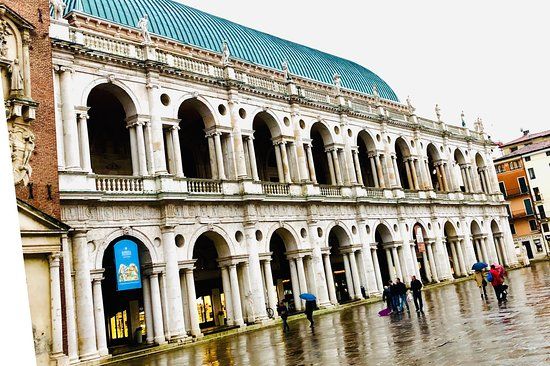
Favorite thing: A beautiful sight, whether from Mt. Berico, or right down in Piazza Signori. This is one of the key Vicenza landmarks. You can't miss it.
Fondest memory: When arriving here i drove around town on the first day, and was impressed by the small town charm Vicenza has. Although it isn't really a small town, compared to Naples, where I also lived for a while, it is tiny. Vicenza, and all of the Veneto, is home to many wealthy people, and is one of the wealthiest regions in Italy.
Updated May 18, 2010
Favorite thing: This UNESCO Heritage listed building is the Palladian Loggia of the Conti Valmarana.
Located in a corner of the Giardini Salvi it is invariably photographed reflected in the waters of the Seriola. The hexastyle Dorian loggia is crowned by a triangular pediment. It is an interesting example of a building by an artist who always followed the teaching of Andrea Palladio and, it appears, also of Leonardo Valmarana himself.
The Valmarana family, a wealthy lot from Venice, own other landmarks in Vicenza such as La Rotonda and the villa on the hill where Tiepolo's frescoes are.
Fondest memory: Right next to the park where this shot was taken is the entrance to the old town of VIcenza through the Porta Castello.
Updated Jan 9, 2010
Favorite thing: Consider for a moment. You are born and live in this house. It is 1519. Palladio hasn't designed anything yet. The world, as most people believe it, is flat. You live 100 kilometres from the sea yet you are about to set out on a trip of epic proportions.
Pigafetta belonged to a rich family of Vicenza.
In his youth he studied astronomy, geography and cartography. He served on board the ships of the Knights of Rhodes at the beginning of the 16th century. Until 1519, he accompanied the papal nuncio, Monsignor Chieregati.
The details of your destination are, at best, sketchy. Crude maps with huge areas blank or incorrectly drawn are all that you have to guide you.
Your name is Antonio Pigafetta, and you are about to embark with Ferdinand Magellan on an incredible voyage around a globe that doesn't exist.
You have to get to Spain but since your are an academic and supported by the church you manage this and wait for Magellan in Seville.
The astronauts of today know where they're going, have excellent visual knowledge of their destinations and high tech equipment yet you will set sail in a ship whose greatest asset is its sturdiness. What and where will you eat? Who will know if you are lost? Where would a rescue crew go to save you?
Put yourself in the picture, 500 years ago. I did. I found it extraordinary.
Fondest memory: Though couched in heroic terms the expedition was so nearly a complete disaster. Only 18 of the original 240 that departed survived. Magellan himself was killed in the Phillipines (read Off the Beaten Path for details) in a skirmish where Pigafetta was also injured.
On his return he wrote three accounts of the voyage but all were thought to be lost until a surviving copy emerged and was printed in full in the 18th century.
That's what I love about history. If you know about it, and you're on a key site, it comes alive. I hope for just a few moments you felt what I did. It would have been a special moment for you.
Updated Jan 3, 2010
Favorite thing: Andrea di Pietro della Gondola, known to history as "Palladio," was born in 1508 in Padua, a mainland possession of the island-based Republic of Venice. Apprenticed to a stonecutter in Padua when he was 13 years old, Andrea broke his contract after only 18 months and fled to the nearby town of Vicenza. In Vicenza he became an assistant in the leading workshop of stonecutters and masons.
Andrea's presumably settled life was transformed in 1537, when he was 30 years old. At that time he was engaged by Gian Giorgio Trissino, one of the period's leading scholars, to assist in executing new additions which Trissino had designed for his own villa at Cricoli just outside Vicenza. The association affected Andrea in at least three ways.
First, Trissino immediately assumed the role of Andrea's mentor and set about the task of introducing him to the principles of classical architecture and the other disciplines of Renaissance education. Second, Trissino introduced his protege to an ever widening circle of patrons, first in Vicenza, then in Padua, and finally in Venice itself. Third, Trissino bestowed upon Andrea the name by which he was to become famous: Palladio. Suggesting Pallas Athene, the Greek goddess of wisdom, the name was also used by Trissino for an angelic messenger in an epic poem which he composed during the same period.
Through their books, Palladio learned the principles of Vitruvius, the classical Roman architect whose treatise had been rediscovered in the prior century, and of the Renaissance commentator, Leon Battista Alberti. Through personal contact, he became acquainted with the ideas and works of pioneering architects of his own period, including Giulio Romano, Giovanni Maria Falconetto, Sebastiano Serlio and Michele Sanmicheli. Under Trissino's sponsorship, he received further introduction to classical Roman works and to early Renaissance works on visits to Padua and Venice (1538-9) and an initial visit to Rome (1541).
By 1538, probably aided by Trissino's influence, Palladio and his workshop had begun construction of Villa Godi, the first of a series of country villas and urban palaces designed by Palladio in the following years for patrons among the provincial nobility of Vicenza.
A decade later Palladio began receiving commissions for country villas from prominent and wealthy leaders of the nobility of Venice itself, such as Daniele and Marc'Antonio Barbaro and Giorgio Cornaro. The wealth and aspirations of these new patrons evoked from Palladio those grand and innovative creations of his middle period upon which his influence on all later Western architecture is based.
Finally, in 1560 Palladio received his first commission for a work in Venice itself: completion of the refectory for the Benedictine monastery of San Giorgio Maggiore. Other religious structures in Venice followed: the cloister of the monastery of S. M. della Carita (now the Accademia Museum) and the facade of the church of S. Francesco della Vigna. His Venetian works culminated in three magnificent churches which remain today: S. Giorgio Maggiore, Il Redentore and "Le Zitelle" (S. M. della Presentazione). (Another Palladian church, S. Lucia, was razed in the mid-19th century to make way for the railroad station.) Surprisingly, despite numerous efforts, Palladio never received any secular commissions in the city of Venice.
Palladio was an accomplished user of the new technology of movable type, then only about one hundred years old. His first book was a guide to the classical ruins of Rome, prompted presumably by his own frustrations in attempting to locate various monuments during his visits to that city. He also published, with his sons, a new translation of Caesar's Commentaries and contributed illustrations to Daniele Barbaro's annotated edition of Vitruvius' treatise on classical architecture.
Then, in 1570, following years of preparation, he published in Venice the masterwork that ensured his place in architectural history, I Quattro Libri dell' Architettura [The Four Books of Architecture]. The book set out his architectural principles as well as practical advice for builders. The most critical element, perhaps, was the set of meticulous woodcut illustrations drawn from his own works to illustrate the text. The work was subsequently translated into every European language and remains in print today both in paperback and hardcover.
Palladio died in his adopted town of Vicenza in 1580.
Fondest memory: I put his brief bio in here to help those who might be interested in enjoying what you might see in Vicenza and other places around the world where his legacy might be found.
Updated Jan 3, 2010
Favorite thing: Ah yes, by now I had found Palladio but Tiepolo, in real form, eluded me. The scenes inside in which the Olympian Gods rest on clouds while watching scenes from Homerian and Virgilian epics were to be denied me. It was "chiuso", like the rest of Italy.
Still, I got to see the "nani" or dwarfs after which the building is named. They are in this picture, if you look closely, perched on the fence line designed by Antonio Muttoni in 1688.
(see also Things to Do tips for my second visit)
Updated Jan 2, 2010
Favorite thing: This beautiful garden was opened to the public in 1522 and then closed for two centuries. In 1909 was opened again.
There are several beautiful statues and two loggias there. One of these is the so called Loggia Valmarana. It was probably built at the end of the XVI century by a scholar of Palladio.
The Seriola river runs through this garden
Updated Nov 1, 2009
Favorite thing: Building attributed to Giacomo and Giovanni from Porlezza and constructed to the beginning of the 1500's which, as you will have noticed, precedes Palladio. The facade is characterized from two logge advanced and the bugnato one that joins the two buildings.
Fondest memory: This detail is set in between the balconies and clearly is dedicated to Francisco Molino. Now, if you check the internet all you get is that a man by that name was a famous musician. A lone one hinted however, that he may have been a governor.
Beneath the four statues are the words "Forti, Prudeti, Iusto and Eperato" Now, I asked many Italians for a translation and the best anyone would come up with was "Strength, Prudence, Correctness" and no-one had a suggestion for the last one.
Never being one to quit easily I pursued the matter via the local (very helpful) tourist office via email and discovered the following:
Francesco Molino was the governor of Creta and a member of the Senato in the Serenissima Republic of Venice (this explains the classical objects around the statue of Molino); the word "Iusto" means, in latin, good man regarding justice; "Eperato" means expert.
Today it is center of the Order of the lawyers and is located at Piazzetta Gualdi 7.
Updated Oct 31, 2009
Favorite thing: This square was probably built on the site of an ancient Roman Forum.
Here we see the Basilica, also called Palazzo della Ragione. Originally this was a Gothic structure that was built in the mid 15th century. Palladio designed the two storey loggia around the building a hundred years later. This building was finished in 1614. The Basilica was not built as a church, but as a gathering place for the leaders of the town. Today it is used as an exibition centre and it also houses some shops.
A 82 meters high and slim clock tower stands near the Basilica. This was originally built in the 12th century.
Another building you can see in this square is the Loggia del Capitaniato. This also was designed by Palladio.
At Piazza dei Signori there are some cafes, shops and the tourist office.
Updated Sep 22, 2009
Favorite thing: Yes, there he was, in the surprisingly-named Piazza Palladio, adjacent to one of his larger works, the two storied "Basilica", built over the old Palazzo della Ragione.
Its main frontage is on the Piazza dei Signori but it's nice to see he was remembered somewhere.
This building was Palladio's first public commission and dates from 1549.
The Palazzo Chiericati is a rectangular building enfronting a piazza. Designed as a house for an important Vincenza citizen, it makes a very public front to the square with open loggias on both the ground floor and the piano nobile. The first floor loggia, raised five feet above the piazza, runs the entire length of the facade in eleven bays. The central five bays project slightly and are separated from the side bays by columns. Clusters of four columns at each corner of this projection support the main room of the piano nobile, which projects to the facade, making two loggias, one on each of its sides, at this level. In contrast to the front, the ends of the loggias at the sides of the palazzo are walled, with arched openings flanked by pilasters. Doric and ionic capitals, entablatures with metopes of disks alternating with bulls' heads, and deep coffered ceilings richly ornament the loggias. The figures and urns above the cornice were added in the seventeenth century.
The main entrance is centered in the ground floor and leads to a rectangular room which links to minor rooms symmetrically arranged at each side. These rooms shift in proportion from rectangle to square to rectangle and diminish in size. Directly behind the central entrance room, a vestibule, off of which stairs on each side lead to the piano nobile, opens to the rectangular courtyard in the back.
The Creator's Words
"This fabric has in the part below a loggia forwards, that takes in the whole front: the pavement of the first order rises above ground five foot; which has been done not only to put the cellars and other places underneath, that belong to the conveniency of the house, which would not have succeeded if they had been made entirely under ground, because the river is not far from it; but also that the order above might the better enjoy the beautiful situation forwards. The larger have rooms the height of their vaults, according to the first method for the height of vaults: the middle-sized are with groined vaults, and their vaults as high as those of the larger. The small rooms are also vaulted, and are divided off. All these vaults are adorned with most excellent compartments of stucco . . . and paintings. . . . The hall is above in the middle of the front, and takes up the middle part of the loggia below. Its height is up to the roof; and because it projects forward a little, it has under the angles double columns. From one part to the other of this hall, there are two loggia's, that is, on each side one; which have their soffites or ceiling adorned with very beautiful pictures, and afford a most agreeable sight. The first order of the front is Dorick, and the second Ionick."
Fondest memory: He's on the extreme right of the pic. If you blow the photo up Palladio's statue becomes immediately apparent.
Updated Sep 19, 2009
Favorite thing: The most economical way to see the tourist sites is to purchase a Vicenza card. It saves a lot of money. WE got one that is for three days for 11 Euro. They can be obtained at the tourist office right next to Teatro Olimpia. We tried to purchase ahead of time on line, but to no success.
Written Jun 9, 2008
Sponsored Links
1 Review and 61 Opinions We stayed here for 4 nights in the Suites that they offer. For our family of 4, this was a great...
2 Reviews and 32 Opinions In a world of indentikit hotels - in the 3-star category above all - the Due Mori is a bit special....
1 Review and 222 Opinions Hotel Continental, with three stars, is a place where I would definitely stay twice. I spent two...
Reviews and photos of Vicenza attractions posted by real travelers and locals. The best tips for Vicenza sightseeing.

The most economical way to see the tourist sites is to purchase a Vicenza card. It saves a lot of money. WE got one that is for three days for 11 Euro. They can...
61 members live in Vicenza
Q: I'm still deciding whether to stay a couple of nights in Vicenza, (and use the train to visit Verona for a day as well,) or stay...

A: According to the Italian railway site there is a luggage storage in Vicenza,...
Read 2 Replies
1
VICENZA - Andrea Palladio's town

In 49 B.C. Vicentia, as it was known, became a Roman municipium. In early Cristian times the city became a diocese under the patriarchate of the Bishop of Milan, and later in the 5th century of...
2
Build Well with Palladio touch

This is one piazza called Piazza Signori which connects with Piazza Erbe to make one big piazza. There are long and elegant buildings in these squares. Basillica Pallidiana is the main feature,...
3
Vicenza - "Venezia on terra firma"

Everything in Vicenza is about Palladio. You cannot even mention the name of the town and not say that, due to this great architect, Vicenza probably has more monumental buildings per inhabitant than...
4
Hello Palladio, looking for Tiepolo, and finding!

As usual, I got lost trying to find my accommodation. The night, the rainy weather, the traffic, all served to confuse me. The fact I'd passed within 50 metres of it at least four times was...
5

Vicenza is a nice size town, and without a doubt filled with some of the best examples of Italian Renaissance architecture. The force behind the architectural importance of Vicenza is a fellow by the...
Build your own Vicenza page
Sponsored Links