Svyturys is a popular beer brand especially on the Curonian Spit as it is brewed in nearby Klaipeda. The brewery was established in 1784 and produces various sorts of beer like wheat beer (Baltas), dark beer (Baltijos) and of course lager beer (Ekstra).
Nowadays Svyturys is owned by Baltic Beverages Holding which is controlled by the Carlsberg breweries.
On my trip through Lithuania I tried a few Lithuanian beers and I must admit that Svyturys Ekstra was among my favourites.
There is coat of arms of Siauliai put on a wall at Gaidzio Laikrosio Square. There is the date 1236 given below.
The coat of arms includes:
1. The sun which symbolizes the battle of Saule (which means the Sun), which was fought in the vicinity of Siauliai in 1236 - that time the name Siauliai was first mentioned: pagan Samogitians defeated Livonian Brothers of the Sword (a military order of German "warrior monks"); the remnants of the Livonian Brothers accepted incorporation into the Teutonic Order in 1237.
2. The figure of the black bear which was taken from the coat of arms of Samogitia and symbolises the victory of the Samogitians over the Teutonic Order.
3. The bull - I have no idea what it symbolises.
What is Samogitia? (Zmudz in Polish, Zemaitija in Lithuanian, Niederlitauen in German)
It's a historical region, once a principality of the Grand Duchy of Lithuania (part of the Polish-Lithuanian Commonwealth), today western part of Lithuania including Palanga (but not Klaipeda) and Siauliai as its largest city.
The people of Samogitia speak Samogitian, a dialect of Lithuanian. However, nowadays, it's almost extinct dialect. The region is almost totally Lithuanian (in contrast to larger Polish and Russian minorities in other parts of Lithunia: Poles in Vilnius region, Rusians in cities of Klaipeda and Vilnius) and mostly Roman catholic. I was told that Samogitians always tend to oppose any anti-Lithuanian restrictions. During and after WWII many of them ended up in Soviet concentration camps in Siberia and Far East.
I strolled around downtown Siauliai a bit but not much as I didn't like typical, Soviet-style, grey, monotonous and simply ugly buildings lined the town streets. Keep in mind that 85% of the town was ruined during World War II. When Soviet occupation started in 1944, the new industrial city was put up in Soviet style along with the biggest Soviet military airport in Eastern Europe. The grey colour still ruled in Siauliai in 2004.
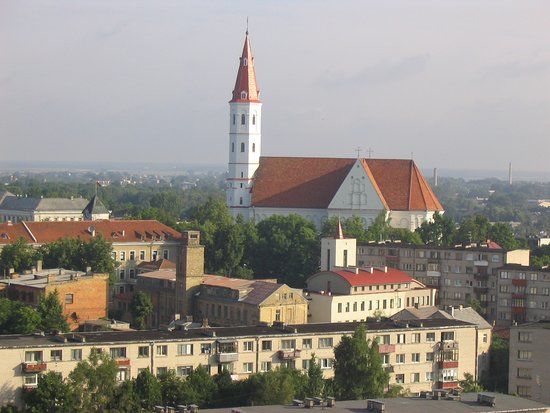
Whenever you visit the cathedral, take a look at the 3-storey apartment building behind trees. It's a typical structure of the Soviet times, easy to find in over half of our globe ruled by the Soviet Union in not so old past: from former eastern Germany to the Russian Far East, and from Estonia to Georgia. These poor quality buildings were put up from pre-fabricated, pre-stressed concrete elements produced in so called factories of houses. They are called in different way in various countries: "khrushchyovka" in Russian, "wielka plyta" in Poland, "panelak" in Slovakia and Czech Republic or "plattenbau" in Germany. This technology was stopped in early 1970' in the Western Europe. But in the area ruled by the Soviet Union they were built not only just past WWII for millions of homeless people in a ruined by war country, but tenths years later as well (till 1990'). They are full of very small apartments and are common in my hometown, too. Well, a few windows in that neglected building behind the cathedral were covered by wood or paper (why?).
The grey building at the main town square (see picture 2) is equipped in handles for flying flags between each two windows. Once there were red flags flying there during communist celebrations and holidays, I am sure.
The main pedestrian street (pictures 3-5) was designed in 1970' and was the first pedestrian street in Lithuania - modern in Soviet style that time. In 2004 most of Siauliai downtown reminded me Poish, Bulgarian or Ukrainian industrial cities of 1970' or 1980'.
Although Lithuania joined the European Union (EU) on the 1st of May 2004, they don't have the Euro as currency. Lithuania's currency is still the Litas.
1 Litas is divided into 100 Centai. You can get your money with your credit or debit card from cash points or just by exchanging your local money at one of the bureaux de change.
I've seen the ceremony of baptism in Roman catholic Siauliai's cathedral. Well, I couldn't understand the words of priest but it looked identical like in my region of Poland. This religious act of purification by water was practised by pouring water over the head of a kid. The only difference was that the kid was older than usually in Poland when parents used to baptize a few weeks old babies. Catholics believe that baptism is necessary for the cleansing of the taint of original sin, and for that reason infant baptism is a common practice. After the ceremony the family pictures were taken in front of the cathedral.
In Lithuania I was told that during Soviet occupation that's until 1990 priests often had to baptize kids at night at their homes not to be persecuted by authorities. The baptism was usually kept in secret by parents, children not to be vulnerable to persecutions. Did it really work that way?
There is more and more bright colours added to grey Siauliai downtown by various restaurants, bars, cafes and stores which have been established since communism collapse. The state-owned "businesses" have become private and have started to operate in real market economy. Competiton - the therm unknown in Soviet economy of pure absurd - eventually forced them to look attractive for their consumers.
However, in comparison to other cities I visited in Lithuania, the changes in Siauliai seems to come slower. Well, being industrial city of mostly "wrong" industry for new times of market economy it has to take some time to switch to new products and technologies. But Siauliai with great location on crossroads of main highways and railways, qualified labour market, local university and free economic zone established on the area of former Soviet military air force base should develop very fast soon, I am sure. So, you may no longer see grey Vilniaus street and downtown.
I was surprised to read the writing in Russian displayed at local florist's in Vilniaus Street. It's said: "giving a flower to a woman you prove that you love her." There is also the same writing in Lithuanian.
As I know, giving a flower to woman as a sign of love or just respect is a local custom not only in Siauliai but at least in what is called Eastern Europe. Indeed, I have seen a young guy with a cut flower in hand waiting probably for a woman under the Cockerel Clock - popular, easy to find and centrally located place for a date or meeting.
The elderly women in Siauliai used to wear black-grey clothes and a bright, colorful kerchief in 2004. Well, I have never seen any young woman in kerchief over her neck amd head. I have also seen quite numerous old women carrying heavy shoppings in plastic bags.
Well, in old traditional family a woman does and carry shoppings unless she has a car and driving licence to drive for shopping. I have seen very few women driving a car in Lithuania. And as a price for gas/fuel is the same as in Western Europe (that means some double US price) and salaries are a few times lower driving a car seems to be expensive.
We were talking a bit with very friendly young Lithuanians in Siauliai. I've got to know that there is an university in town. That's why I could see quite many young people on streets.
I didn't know what to visit except the cathedral as my three travel books to Lithuania almost completely skipped Siauliai. First I asked two women sitting by the next table in Kapitonas Morganas restauranas. They were very nice visitors from Vilnius but didn't know anything except of the nearby Hill of Crosses they were going to visit. Later on, before leaving the town we met one woman and three guys - students of local university - in Presto cafe. They all could speak English and after some talks and good laugh two of them offered us one hour walking tour around town. Well, couldn't we meet them earlier? Unfortunately we had to leave to the Hill of Crosses that time. Anyway, we exchanged our e-mails and I surely talked them about VT, haha.
if you ever come to Lithuania, try to learn some useful phrases.
hello=labas
good morning= labas rytas
good evening=labas vakaras
good night=labos nakties
how are you= kaip tu?
i am fine= as gerai
yes=taip
no=ne
i want.....=as noriu
i want to drink= as noriu gerti
i want to eat= as noriu valgyti
where is the bus station= kur yra autobusu stotis?
where is the police office = kur yra policijos ofisas?
where could i exchange the currency=kur as galeciau pasikeisti valiuta?
whats the time= koks laikas?
i need to find a hote =man reikia viesbucio !
how much cost the night = kiek kainuoja naktis?
nice words for men who wants to "hunt" a lithuanian here :
you are very beautiful= tu labai grazi
i like you a lot= tu man patinki.
would you like to be my g'f = ar noretum buti mano mergina?
I am a very good man= as labai geras vyras.
I want to make you my queen= noriu padaryti tave savo karaliene :)
good bye= viso gero
good luck= sekmes
kiss=buckis
hugs= apkabinu
Sponsored Links
Sponsored Links
Comments