


























Begijnhof - The Wooden House, Amsterdam

4.5 out of 5 stars4.5 Stars - 60 Reviews

  Courtyard and Dwellings
by mickeyboy07
 
  • Courtyard and Dwellings
      Courtyard and Dwellings
    by mickeyboy07
  • Inside the Chapel
      Inside the Chapel
    by mickeyboy07
  • Begijnhof
      Begijnhof
    by Twan
  • Begijnhof
      Begijnhof
    by Twan
  • Begijnhof
      Begijnhof
    by Twan
  • Begijnhof
      Begijnhof
    by Twan
  • Begijnhof
      Begijnhof
    by Twan
  • Gateway to court
      Gateway to court
    by mickeyboy07
  • English Church
      English Church
    by mickeyboy07
 
  • mickeyboy07's Profile Photo

    Begijnhof

    by mickeyboy07 Written Mar 27, 2012 605 reviews

    3.5 out of 5 starsHelpfulness

    Gateway to court
    4 more images

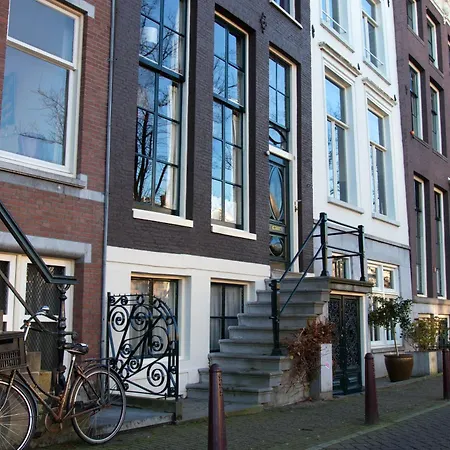
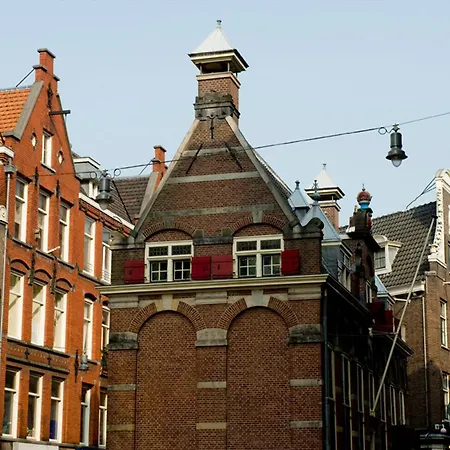
    The Begijnhof is one of the oldest inner courts in Amsterdam,a group of historic buildings,mostly private dwellings,centre on it.As the name suggests it was originally a Beguinage.Today it is also the site of the English Reformed Church.
    The court was founded during the Middle Ages,and therefore lies within the 'Singel'-the inner most canal of Amsterdam's circular canal system.The Begijnhof differs from the usual Amsterdam patricians court in that this old peoples home was not founded by private persons.It bore closer resemblence to a convent,although the Beguines enjoyed greater freedom than nuns in a convent.While Beguines took a vow of chastity and considered themselves obliged to attend Holy Mass and pray daily they were free to leave the court any time to get married.The last Beguine 'Sister Antonia' died in May 1971 at the age of 84.There is an original wooden house which dates from 1528(the oldest wooden house in the city)and the Begijnhof Chapel to visit as well as the English Church.Entry to Begijnhof is free,you can make donations in the Chapel.

    Related to:
    • Historical Travel
    • Religious Travel
    • Architecture
    Was this review helpful?
  • Twan's Profile Photo

    Begijnhof

    by Twan Written Feb 18, 2012 525 reviews
    Begijnhof
    4 more images

    The beguinage in Amsterdam is the only medieval almshouses founded in Amsterdam, located within the Singel. The courtyard is almost a meter lower than the rest of the city, the medieval street level. It is unclear when the Beguine was founded. The nuns still lived in 1346 in a house (in a document of that year speaks of a "beghynhuys"). Only in 1389 for the first time spoken of a court (in a letter of privilege). Originally the Beguine completely enclosed by water (the Damrak, the Spui and Begijnensloot) with the only access to a gate Begijnensteeg (with a bridge over the Begijnensloot). The rear walls were thus in the water. The entrance to the Spui existed only since the 19th century.

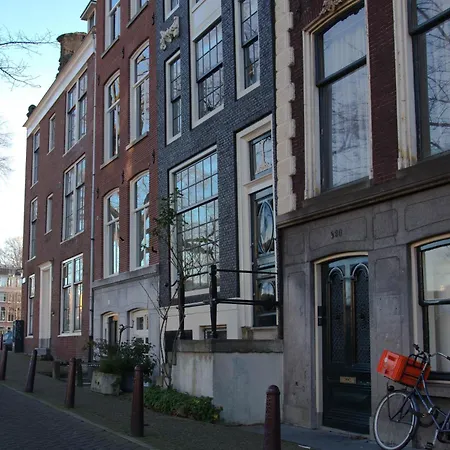
    The Beguine is no ordinary court, because no old age pensions was founded by individuals. It was more like a monastery, although the nuns had more freedom than nuns in a convent, the nuns put a vow of chastity but if at any time the court leave to marry. Moreover, there are high, specifically Amsterdam city halls (the Beguine is the only courtyard which houses the name and address of the courthouse themselves), which more or less private nature of the court in the eye. Here no aaneengerijde woninkjes as usual and characteristic of most courts. There are 47 ordinary town houses with individual respect, most with facades from the 17th and 18th century, but the houses are usually older: 18 houses still have a gothic wooden skeleton.
    The Wooden Huys, Beguine 34

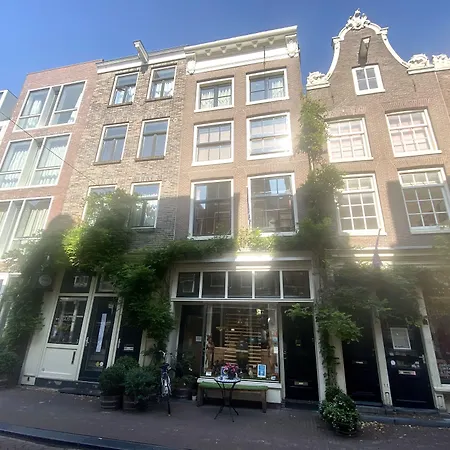
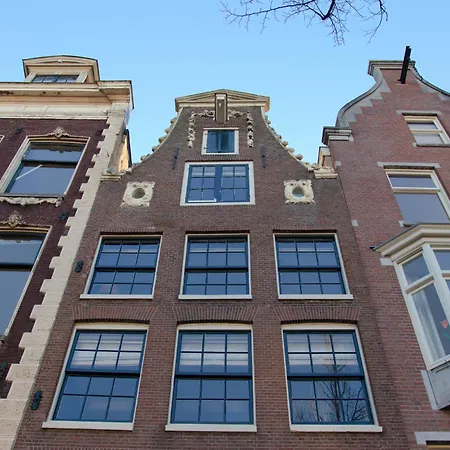
    Famous is the restored wooden house Beguine 34. In Amsterdam there are only two medieval wooden houses (the other wooden house is Zeedijk 1). This house is circa 1528 and is probably the oldest surviving wooden house in the Netherlands.

    The court has two fields with the pale Beguinage Chapel between. The old gate in 1907 restored the Begijnensloot, dates from 1574 and has a stone on which St. Ursula has shown, the patroness of Amsterdam Beguines. The gate on the side of the Spui, from about 1725, in the 19th century instead of the gatehouse that stands there now. The Begijnhof contains many plaques, most clearly Catholic character.

    The Begijnhof was the only Catholic institution after the Alteration of 1578 persisted; other Catholic churches and institutions were violently forced to move to the Protestant faith. Namely the Beguine houses were privately owned by the nuns themselves. However, had the Catholic chapel on the English Presbyterians (reformed Protestants) are abandoned under pressure from the Protestant authorities. Since then this church called the Church of England. Opposite the entrance of the chapel were in 1671 by architect Philip Vingboons two houses converted to Roman Catholic church shelter: the HH John and Ursula Church (the patron saints of the Beguine). After the Chapel at the Holy Place in 1908, this church was officially broken the miracle church.

    The most famous in the history of Beguine the Beguine is Cornelia Arens, deceased on October 14, 1654 (date of birth unknown, date of profession July 6, 1621). Her last will was to be buried in the gutter instead of the "profane" chapel. According to legend, she was still buried in the chapel but the next day her coffin lay in the gutter next to the chapel (which was repeated twice). She was then still buried in the gutter. According to another variant of the legend could find no rest her soul and she wandered at night on the court, after which they are installed in the gutter was buried.

    On May 23, 1971 died at age 84 the last Beguine, "Sister Antonia", actually Agatha Kaptein (born on 13 april 1887 Akersloot). On May 26 she was buried at the Tomb of the Sister Roman Catholic Cemetery St. Barbara in Amsterdam.

    The Beguine had the renovation in 1979 140 homes (of which approximately 110 one bedroom and about 25 two-room dwellings) occupied by an equal number of inmates. After the renovation, there are only two and three bedroom homes. The number of inmates has since become constant, namely 105.

    The Beguine is one of the oldest Amsterdam canal gardens of the city (still) rich.

    Related to:
    • Arts and Culture
    • Historical Travel
    • Architecture
    Was this review helpful?
  • von.otter's Profile Photo

    The Begijnhof’s English Church

    by von.otter Updated Feb 6, 2012 1169 reviews
    The English Church, Amsterdam, May 2011
    4 more images

    “Tomorrow morning I’ll go to the little English church you know, it lies there so peacefully in the evening in that quiet Begijnhof between the thorn-hedges, and seems to be saying ‘In loco este dabo pacem’, that is ‘in this place will I give peace,’ saith the Lord. Amen, be it so.

    “The yard is a pleasant sight in the mornings, now that it only gets light so late in the dark days before Christmas and the workers don’t come until 7 o’clock. It’s blowing a storm outside, we have wind and rain aplenty these days.”
    — from a 25.November.1877 letter written by Vincent van Gogh to his brother Theo

    A PLEASANT SIGHT, INDEED While living in, Vincent van Gogh attended the English Reformed Church in the Begijnhof on Sundays.

    This church building was Roman Catholic before 1578’s bloodless revolution, turning Amsterdam from a Catholic city to a Protestant one. Destroyed by fire, a 1390 private chapel served as the first church in the Begijnhof; it was rebuilt in 1492. Following the Reformation it was closed and went unused for 20 years, when it was given to Amsterdam’s English-speaking worshipers in 1607.

    The altars in the English Church and in the Begijnhof Chapel (see von.otter’s Amsterdam Tip ‘The Begijnhof Chapel’) are a study in contrast. The stained glass windows, too, are noticeably different between the English Church and the Chapel. One of the most noticeable windows celebrates the English Pilgrims (see photo #3); they settled first in Amsterdam before sailing for America. The presence of this stained glass window is very amusing because the Pilgrims opposed the use of such decoration in their places of worship.

    Related to:
    • Arts and Culture
    • Historical Travel
    • Architecture
    Was this review helpful?
  • von.otter's Profile Photo

    The Begijnhof Chapel

    by von.otter Updated Feb 3, 2012 1169 reviews
    Begijnhof Chapel, Amsterdam, May 2011
    4 more images

    “When I have a terrible need of, shall I say the word religion, then I go out and paint the stars.”
    — Vincent van Gogh (1853-1890)

    IN NEED Taking van Gogh at his word, his painting entitled Starry Night can be viewed as a religious experience!

    Following the bloodless revolution of 1578, known as the Alteration, when the Catholic city turned Protestant, the Begijnhof was the only Catholic institution remaining because the houses were the beguines’ private property. Also the beguines were not part of a religious order.

    In 1607 the beguines were forced to surrender their chapel; it was given to the English Reformed Church of Amsterdam, which still holds services there. Meanwhile, the beguines continued to worship in the chapel’s sacristy, until that was taken from them. They then used the houses surrounding the courtyard, worshiping at a different house each Sunday.

    In 1665, two houses in the Begijnhof, nos. 29 and 30 (see photo #1), were bought, joined together, and in 1671 converted into a new chapel. The city approved the building plans provided the chapel’s exterior did not look like a church. The first service was held in 1682 and they continue today.

    Related to:
    • Historical Travel
    • Museum Visits
    • Architecture
    Was this review helpful?
  • von.otter's Profile Photo

    Wooden and Old

    by von.otter Updated Jan 20, 2012 1169 reviews
    Houten Huys, Amsterdam, May 2011
    3 more images

    “You turn from the Kalverstraat down the Begijnen-Steeg, pass under an old gateway, and you are in a court surrounded by quaint old buildings, each with its screen of trees.”
    — from “The Spell of Holland: the Story of a Pilgrimage to the Land of Dykes and Windmills,” 1911 by Burton Egbert Stevenson

    One of the main attractions in the Begijnhof is the Wooden House, Houten Huys, at Begijnhof 34. It is located in the area accessible to all and it is one of two wooden houses still standing in Amsterdam. In 1521 Amsterdam outlawed building in wood after a series of catastrophic fires.

    The facade of Houten Huys dates to the 1470s, and it is also believed to be the oldest wooden house in the Netherlands.

    To see the old gateway that Mr. Stevenson talks about see photo #4.

    Related to:
    • Arts and Culture
    • Historical Travel
    • Architecture
    Was this review helpful?
  • von.otter's Profile Photo

    A Hidden Gem

    by von.otter Written Jan 20, 2012 1169 reviews

    2.5 out of 5 starsHelpfulness

    Begijnhof, Amsterdam, May 2011
    4 more images

    “The enclosure is called The Begijnenhof, or Court of the Begijnen, a little sisterhood named after St. Begga, daughter of Pipinus, Duke of Brabant—a saint who lived at the end of the seventh century and whose day in the Roman Catholic Calendar is December 17.”
    — from “A Wanderer in Holland,” 1906, by Edward Verrall Lucas (1868-1938)

    Tucked away in the middle of Amsterdam is a courtyard known as the Begijnhof. Surrounding the tranquil grassy courtyard — originally used for bleaching clothes in the sun and drying clothes — are neatly maintained houses, including Amsterdam’s oldest wooden house found at Begijnen #34. The houses’ façades are 17th and 18th century but their frames date from the Middle Ages.

    Founded in the 14th century, the Begijnhof was home to the beguines, a Catholic sisterhood who cared for Amsterdam’s sick. They were not nuns because they did not take vows, nor did they enter a convent, and they were free to leave the order if they wished to marry. Continuing the tradition, today these houses are home to single women, but secular in nature.

    In the 13th and 14th centuries Beguines — and their male counterparts called Beghards — had set up communities in France, Belgium, the Netherlands, Western and Northwestern Germany. Amsterdam’s Begijnhof is not the only inner courtyard so called.

    Admission is free and the hours are 08:00 to 17:00.

    Related to:
    • Architecture
    • Arts and Culture
    • Historical Travel
    Was this review helpful?
  • breughel's Profile Photo

    Begijnhof - Many alterations?

    by breughel Updated Apr 23, 2011 1464 reviews

    5 out of 5 starsHelpfulness

    Begijnhof Amsterdam.
    1 more image

    The Begijnhof - Beguinage in Amsterdam is certainly a pleasant and quiet part of the old city but as a beguinage I felt surprised by the architectural heterogeneity of this ensemble!
    Maybe I am too much accustomed to Belgian begijnhoven-beguinages (there are a dozen only in Flanders) with their great architectural homogeneity.
    In Amsterdam I found a number of certainly charming old houses but all different from each other. Compare with the beguinages of Leuven, Brugge or Lier (photo 2) in Belgium and you will understand why I was surprised and somewhat disapointed.
    It seems that this change came first from the confiscation of all Catholic churches, monasteries and convents by the Orangist Calvinists authorities in 1578.
    In the 17th and 18th alterations were made to the houses in the Begijnhof; and wooden façades were changed. At the restoration of the Begijnhof (1984-1987), the courtyard was renovated and some houses enlarged.
    Al this explains probably why this "Begijnhof" in Amsterdam has lost its architectural homogeneity characteristic of beguinages in other countries.

    Anyway, the place was quiet and that is an essential characteristic of a begijnhof - beguinage.

    Related to:
    • Historical Travel
    • Architecture
    Was this review helpful?
  • dila's Profile Photo

    begijnhof

    by dila Updated Apr 11, 2011 949 reviews

    2.5 out of 5 starsHelpfulness

    gate
    1 more image

    this is a picture of the gate to the begijnhof.
    1 may 2003
    the people who live here complained about the noise the visitors made. the other half of the inhabitants wanted the begijnhof to be opened again.
    a lot of tourists are dissapointed because they will be for a closed gate. i hope it will be opened soon if so respect the people who live here and dont make noise. respect the rules
    it is not aloud to make pictures anymore. The people who live here complained because the visitors of begijnhof went into the gardens of the houses and make also a lot of noise.

    the wooden house (het houten huys 1528 )is here.
    roman catholic church mon. 13.00-18.00, tue-fri. 09.00-18.30, sat. and sun 09.00-18.30.
    the english church for services only.
    most of the homes around the courtyard were built in the 15th century but were altered throughout the 16th and 18th centuries.
    have respect for the people who live here.

    19th july 2008 was here again. you cant walk here a lot no more because of the residents.
    second picture what you can see now.

    2011 Begijnhof is open 9.00 - 17.00

    Related to:
    • Budget Travel
    • Historical Travel
    • Architecture
    Was this review helpful?
  • dila's Profile Photo

    Begijnhofchapel

    by dila Written Apr 11, 2011 949 reviews

    Roman Catholic Church ‘Begijnhofkapel’
    Open
    Monday: 13.00 - 18.30
    Tuesday to Friday: 09.00 - 18.30
    Saturday and Sunday: 09.00 - 18.00

    The Beguinage and its chapel are open every day from 9.00 - 17.00. After 17.00 you can reach the chapel via the gate at the Spui.

    Related to:
    • Religious Travel
    Was this review helpful?
  • dila's Profile Photo

    the wooden house (het houten huys)

    by dila Updated Apr 11, 2011 949 reviews

    2.5 out of 5 starsHelpfulness

    wooden house

    1 may 2003
    This is one of the two wooden houses, still existing in Amsterdam; it has been built between 1450 and 1500. (Since 2010 they think its from 1528 )It has a tilted front and a gothic wooden frame. The original entrance is vaguely visible. It is the spot above the present door, exactly on the place of the 'lacking' window.
    you can get some information inside or buy a flyer or a postcard. i had a great conversation with the man who work here. real nice and helpfull.
    the flyer with information was i think about 25 cents if i remember correctly.
    you can ask if you can make a picture of the wooden huys. when i was here there where almost no people. but on a sign it said no pictures, no noise and more.
    so again have respect for the people who live here dont make noise and dont go into there gardens.
    The Beguinage and its chapel are open every day from 9.00 - 17.00. After 17.00 you can reach the chapel via the gate at the Spui but thats not for tourists but for people who live there or for the church.

    Related to:
    • Architecture
    • Historical Travel
    • Archeology
    Was this review helpful?

Comments

Top 3 Hotels in Amsterdam

Banks Mansion Hotel  Amsterdam

 5 Reviews and 802 Opinions  “But New Amsterdam remained comparatively intact. The tongues of nearly every European nation were... 

 Hotels in Amsterdam

Show Prices

Ambassade Hotel  Amsterdam

 4 Reviews and 337 Opinions  My son and grandmother shared a room at the Ambassade, where we were greeted by a very friendly and... 

 Hotels in Amsterdam

Show Prices

Seven Bridges Hotel  Amsterdam

 4 Reviews and 523 Opinions  We almost stayed here. Looked like a charming hotel, although we didn’t see the rooms. It’s in a... 

 Hotels in Amsterdam

Hotels Near Begijnhof - The Wooden House
4.0 out of 5 stars
612 Opinions
0.1 miles away
Show Prices
4.5 out of 5 stars
1249 Opinions
0.1 miles away
Show Prices
2.5 out of 5 stars
137 Opinions
0.1 miles away
Show Prices

Amsterdam Members Meetings

Sep 13, 2013 
First Heritageweekend
Sep 14, 2013 
First Heritageweekend
Sep 15, 2013 
First Heritageweekend

see all Amsterdam member meetings