





























































This was unexpected; I could not imagine a church with 2500 gravestones, often real works of art.
With age (*) I developed some interest for gravestones, monumental tombs and especially what we call "gisants" and "pleurants" in French.
The Oude Kerk was built on a cemetery; presently more than 10000 persons are buried in the church. The gravestones have been registered in grave books since 1523 till 1865.
Many gravestones show text mostly in Dutch - a difference from southern countries using Latin inscriptions - but most show just a number.
There were two types of gravestones: "Kerkgraven" (church graves) that were cheaper and are marked with the sign K and "Familiegraven" for whole families showing special marks called "huismerk".
All these gravestones underwent a restoration process and for most of them it is known who is buried beneath.
Most famous, at least for tourists, is gravestone nr 29 in the "Weitkoperskapel" of Saskia van Uylernburgh wife of painter Rembrandt. I was more impressed by the grave 50 - 51 in the choir from Gerrit Hooft a "burgemeester" mayor of Amsterdam and collector of paintings and Jacob Boelens, grave 33-34, another burgemeester.
Moving is that of Agata De Bruynne who died at 24 year old.
There are also a few monuments; famous is the one of Jacob van Heemskerck in the Snijderskapel. He was in 1607 the admiral who won the sea battle of Gibraltar against the Spaniards but died hit by a cannonball. His suit of armor - minus a thigh plate shattered by the fatal cannonball - is in the Rijksmuseum in Amsterdam.
I staid one hour just looking at the gravestones and got help from the attendant to find the Saskia gravestone (the advantage of speaking Dutch in Holland!).
(*) It seems that I look younger than my age; the TE for London found incredible that I experienced WW II !?!
The "Oude Kerk", indeed the oldest church of Amsterdam, is only a church on Sunday; the other days it is an exhibition hall (the church stands in the "Wallen" the brothel district proposed by this website as Nr 1 to visit in Amsterdam, before The Anne Franck house and Rijksmuseum ! ).
On my visit there was an exhibition of photos "World Press Photo 2013", not really what I came for.
I paid to enter, but I hate having to pay for entering a church, makes me think of Jesus driving the merchants out of the temple.
What interested me from an architectural point of view is that this church is a "Hallenkerk" a hall church with nave and side aisles of approximately equal height, often united under a single immense roof; the first "Hallenkerk" to be built in Holland.
The Oude Kerk is an example of Dutch brick Gothic. The construction is light, because the piles on which the church stands do not have much supporting capacity. Therefore the church has a wooden vault and large windows to spare heavy masonry. The surface of the church is large, in comparison to its height.
The ship models hanging at the vaults remember that this church was once (before the Calvinist iconoclasts) the church of the seamen.
I have nothing to say about the tower. I did not climb to the top. It is possible from April till September on Thursdays, Fridays and Saturdays between 13 and 17 h (price 6€).
The view on the tower is rather limited from the streets of the neighborhood.
Actually I staid more than one hour in the church just to look at the gravestones (being an old man I'm developing some interest for gravestones).
“I was disgusted with the nakedness and meanness of the Protestant churches of Holland.”
— an August 1815 entry from “Diary, Reminiscences, and Correspondence” 1869 by Henry Crabb Robinson (1775-1867)
The Old Church is in the heart of Amsterdam, right on the ramparts. It is the oldest building in the city, founded by fishermen on the River Amstel. Sadly we could not see what Mr. Robinson was complaining about for the church was closed when we passed by.
The Bishop of Utrecht consecrated the church to Saint Nicholas, patron saint of sailors, on 17.September.1306. A hundred years later Amsterdam’s population had grown; a new church was built on the Dam: The New Church. St. Nicholas Church came to be called The Old Church.
In addition to religious services, Saint Nicholas Church was also used for worldly things. The fishermen repaired their nets and sails here. It was a lively meeting place for residents and merchants, where they exchanged views and walking around during an organ concert. Because of these different functions, the church was nicknamed the “Living Room of Amsterdam.”
After the Protestant Reformation, when there was an iconoclastic cleansing of the church, little remained in the church that recalled the Roman Catholic faith, but the church building itself. Icons were smashed, altars removed, murals painted over ,the ceremonial silver was looted or melted down. The Reformed Dutch faith was now the state religion and Catholics were forced to hold services in secret churches.
Rembrandt’s marriage to Saskia van Uylenburgh took place in the Old Church.
Oudekerk the tower is the oldest tower in the city. Climbing the tower is made under the guidance of an experienced guide. The tower is open for visits from April to September, Thursday, Friday and Saturday 13:00 - 17:00 (every half hour will start a climb). Admission price is € 7 per person.
In the Netherlands religion was not exempt of humor, until the "beeldstormers" iconoclasts started their destruction of religious works of art. The "koorbanken" misericords of the Oude Kerk have been for most of them preserved from destruction and they are one of the things to see of the church and are part of the guided tours. There is also a leaflet (in Dutch) detailing the 34 misericords of the Oude Kerk also called "zittertjes" small seats.
A misericord is a small wooden shelf on the underside of a folding seat in a church, installed to provide a degree of comfort for persons who had to stand during long periods of prayer.
These misericords were probably made around 1480 according to the style of the clothes and survived the iconoclasts.
The iconoclast fury, mainly under influence of the Calvinists, started in the north of France in 1566 and moved to the north through Flanders, Brabant, Antwerp and finally reached Amsterdam.
A terrible destruction of art! The interior of more than 100 catholic churches, abbeys, convents was destroyed as well as their libraries.
This resulted in the Eighty Years' War, or Dutch War of Independence, (1568–1648), began as a revolt of the Seventeen Provinces against Philip II of Spain, the sovereign of the Habsburg Netherlands.
In the choir of the Oude Kerk 34 misericords reached us. The carver is unknown. Most show proverbs or humoristic even obscene scenes of daily life:
"Een varken die aan het spinnen is" A pig that is spinning. Photo 2.
I tried to find the meaning of this. It seems it has something to do with the work of women ("Spinnende Eva"). But in Dutch of the Middle Ages a "spinrokken" = distaff had also an erotic meaning. Here I will stop my search.
Another misericord (photo 3) needs no explanation.
This one (photo 4) is that of the proverb "sitting between two chairs".
De Oude Kerk or Old Church is the oldest Amsterdam monument. It dates back to 1275.
The church was devoted to Saint Nicolas, the bisshop of Myra by Guy van Avesnes, bisshop of Utrecht. Through the ages the church was known as the St. NIcolas church until the new St. Nicolas church was build in 1884-1887.
The building started as a wooden church, but soon was replaced by a stone building that was expanded through the centuries.
In the last quarter of the 20th centyry the church was renovated completely.
In september 2006 the church was 700 years in sevrice and this celebrated in a big way.
In the floor of the church there are many gravestones of famous Dutchmen.
Rembrandt married in this church in the so-called Spiegelzaal (mirror room).
Opening hours:
Mo-Sa: 11AM - 5PM
Su: 1PM - 5PM
Admission: € 8,00 (adult)
The Oude Kerk is Amsterdam's oldest parish church,consecrated in 1306 by the Bishop of Utecht with Saint Nicolas as its patron saint.It stands in 'De Wallen'now Amsterdam's Red Light District.the square surrounding the church is the 'Oudekerkssplein'.
Rembrandt was a frequent visitor to the church as his children were all christened here.it is the only building in Amsterdam that remains in its original state since Rembrandt walked in its halls.In the Holy Sepulchre is a small Rembrandt exhibition,a shrine to his wife 'Saskia van Uylenburgh'who was buried here in 1782.The church covers an area of some 3,300 metres.The foundations were set on an artificial mound,thought to be the most solid ground of the settlement in this marshy province.The roof is the largest medieval wooden vault in Europe,the Estonian planks date back to 1390 and boast some ofthe best acoustics in Europe.
Opening times for visitors:Mon-Sat-11.00 till 17.00,Sun-13.00 till 17.00.
Entry is 5 Euros per Adult,Students 4 Euros,Children under 12 is free.
I'm giving these special mention as they're virtually unknown in my young country and a welcome bit of whimsy in an otherwise austere environment.
In European medieval times, Catholic church services were frequent and lengthy and the clergy were required to remain on their feet for long periods of time. This was difficult for the old and/or infirm and this device came about to make all that standing a little less punishing.
Seats, usually in the choir (quire), were made with hinges so that they could be flipped up and a carved ledge was attached to the underside which provided a perch to rest the backside on. What's so appealing about them is that because of the rather undignified part of the person they served, the imagery worked into these "acts of mercy" was seldom of religious nature. Themes include fables, mythical beasts, floral decoration, parables or just scenes from everyday life. Their secular subject matter is sometimes the reason they thankfully survived the stripping of sacred iconography during reformational eras.
Based on the clothing style portrayed on human figures, the misericords of Oude Kerk are thought to be late 15th century (pre-Alteration) and are delightfully funny, irreverent and a fascinating peek at life of that time.
Click on this link for a look at the complete collection and the meanings they convey. The church also provides an on-site guide that you can use during your visit.
There has been a church on this site since the 13th century, but most of the current building is from the 14th century when it became a place of pilgrimage following stories of a miracle. The story was that a dying man regurgitated the host that he had taken at communion in this church earlier that day and when it was thrown upon the fire it wouldn't burn. So naturally this was made a medieval tourist attraction by the church and people flocked to see the unburnable vomit and provided the money to build the current church. The relic itself has long since gone after being lost during the reformation.
The location of the church in the middle of Amsterdam's red light district is a little perculiar with an information centre about prostitution just over the road! The church is attractive outside but much more evocative inside. Thanks to the reformation the church is not over decorated and in fact much of the interior is pretty sparce on ornamentation, which enables you to enjoy the space inside and appreciate the arches and construction of the design. There are some excellent stained glass windows and climbing the tower provides good views over - well, the red light district.
While not very religious myself, I love to visit old churches for their architecture, art, and details which often reflect customs or important historical events. Oude Kerk is not just the most ancient of the city's churches but also the oldest building in Amsterdam. Here in the area where the city was founded, construction began on what was originally a Catholic chapel dedicated to St Nicolas in the late 1200's and greatly expanded over many centuries. And like many Catholic churches in England, France and other countries that were transformed during periods of religious reformation, this one was stripped of statuary, relics and other iconic representations during the Alteration movement of 1578.
But they didn't get ALL of that so what remains is austere but not completely sterile. Above your head arcs an enormous 15th-century wooden barrel vault with images of saints liberated from an overcoat of blue paint and supported by 42 ornamented columns once faux-painted to look as if covered in expensive brocade: you can see a scrap of that on the pillar on the right in my second shot. Several beautiful 16th century windows survived in the Lady Chapel, and an amusing collection of late 1400's misericords liven up the choir.
Under the worn stones at your feet are the remains of 10,000 people in 2,500 tombs stretching as far back as the church's consecration in 1306. Rembrandt van Rijn of the marvelous paintings you'll see at the Rijksmuseum was married here, and his young wife, Saskia van Uylenburgh, is buried about midway down the left aisle in the Weitkoperskapel. The Master himself had to sell her tomb to pay off some debt so he lies in an unmarked grave in the Westerkerk.
Good to know:
Ouke Kerk is an active member of the Protestant Church of the Netherlands: a group formed in 2004 from the Reformed Churches in the Netherlands, Netherlands Reformed Church, and Evangelical Lutheran Church. See website for services - the second link below translates the Dutch site into English.
Visitors are welcome Mon.- Sat. from 11:00 - 5:00, Sundays 1:00 - 5:00.
Entrance fees are € 5.00 adult, € 4.00 student and over age 65, under 13 free. Admittance is free with an I Amsterdam Pass.
NOTE: the church makes ends meet by hiring out for special events so entry fees could be higher if they are hosting an art show.
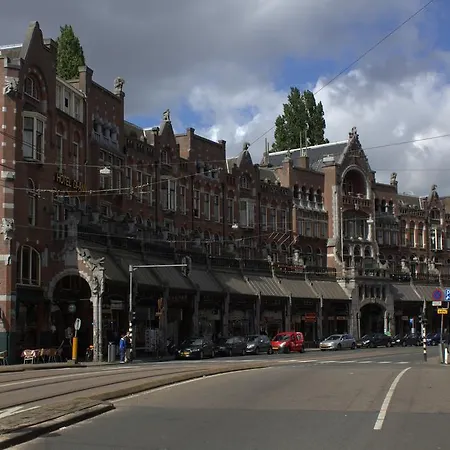
The Oude Kerk is located in the historic heart of Amsterdam, in the middle of the famous red light district. The origins of the Oude Kerk in Amsterdam back to the thirteenth century, when its place was a wooden church. Its current structure dates from the fourteenth century, a Gothic building with tall windows. This church is the oldest in the city, although its present appearance has changed over the years, with subsequent renewals and extensions.
La Oude Kerk se encuentra en el centro histórico de Ámsterdam, en medio del famoso barrio rojo. Los orígenes de la Oude Kerk de Ámsterdam se remontan al siglo XIII, cuando en su lugar había una iglesia de madera. Su estructura actual data del siglo XIV, un edificio de estilo gótico con altos ventanales. Esta iglesia es la más antigua de la ciudad, aunque su aspecto actual ha ido cambiando a lo largo de los años, con sucesivas renovaciones y ampliaciones.
Sponsored Links
Ambassade Hotel Amsterdam
4 Reviews and 352 Opinions My son and grandmother shared a room at the Ambassade, where we were greeted by a very friendly and...
Banks Mansion Hotel Amsterdam
5 Reviews and 817 Opinions “But New Amsterdam remained comparatively intact. The tongues of nearly every European nation were...
Seven Bridges Hotel Amsterdam
4 Reviews and 526 Opinions We almost stayed here. Looked like a charming hotel, although we didn’t see the rooms. It’s in a...
see all Amsterdam member meetings
Sponsored Links
Comments