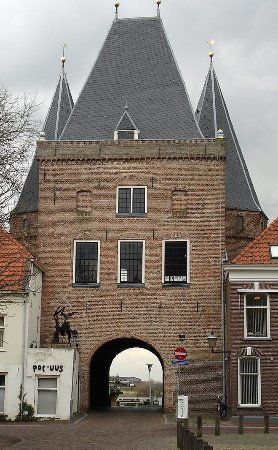
The Broederpoort is one of three surviving city gates. It dates from 1465-1468 and has four towers. The towers on the town side are round, while those facing off the town are octagonal. In 1615 the gate lost its defensive function, after which it was altered in Manneristic early-Renaissance style. Behind the gate is a big park.
Updated Jan 27, 2004
The Kamper Kogge is a ship which is build accordign historical information during the time Kampen has trade partners in Germany and Denmark and so on.
This type of ships was used for transportation of the goods.
The ship is built on the koggewerf with original techniques.
On www.kamper-kogge.nl you can see more information about this ship.
in 2004 it is planned to travel with the kogge the original route to the east sea. This route is called the 'ommelander vaart'.
Written May 1, 2003
Website: http://www.kamper-kogge.nl
During the summer Kampen has a lot of activities. the famous Kamper ui(t)-dagen are one of them.
During july and august these days are organised by the local people.
There is a big market into city centre and several activities around it.
The name kamper ui(t)-dagen has historical value. A 'Kamper ui' is a funny story about the people of Kampen. One of these stories was the suggestion to bring a cow up to the tower of Kampen because there was growing grass. The cow didn't survive, and Kampen became another laughable story. During the summer time a fake-cow is hanging at the tower.
Written May 1, 2003
Address: it's all over the place!
The Onze Lieve Vrouwe Kerk ('Church of Our Lady'), also known as Buitenkerk, is a Gothic church dating from the 14th century. It replaced a chapel which at that time still stood outside (Dutch: 'buiten', hence the name) the walls of the town. After having been protestant property for more than two centuries this church was returned to the catholics in 1809. Since then the outside skin of natural stone has been gradually replaced by bricks completely.
Updated Mar 12, 2003
The Broederenkerk was the church of the Franciscan monastery ('Broederen' or 'brothers' refers to monks) and dates from the first half of the 14th century. In 1578 the new protestant rulers forced the monks to leave Kampen, after which the church was adapted for protestant use. The church consists of two aisles of equal height and width and is extremely long.
Updated Mar 12, 2003
The Nieuwe Toren ('new tower') was built between 1649 and 1663. It's main function was to house a big carillon of 35 bells. The upper part of the tower was designed by Philip Vingboons and originally was part of his design for a new town hall in Amsterdam.
Vingboons design was not accepted for several reasons, one of which was the fact that he was a catholic. Thankfully Kampen was a more tolerant place.
Written Feb 25, 2003
The Bovenkerk or St. Nicolaas as its former catholic name is, is a big Gothic church that since 1580 has been Kampen's major protestant church. During several restorations most of the church's outside skin has been replaced, resulting in a rather new look. Thankfully the tower has been spared from this fate.
Written Feb 25, 2003
Another gate is the Koornmarktspoort ('grain market gate'), which dates from ca. 1380. It constitutes of a rectangular gate building and two big round towers facing the river. In the 19th century the gate was painted white, as can be seen on many older pictures including postcards. A few years ago the paint was removed.
Written Feb 25, 2003
The town hall consists of two parts. The oldest part is in Gothic style and was built between 1345 and 1350. In 1543 a fire destroyed it, leaving only the walls standing. Repairs were made using Renaissance influences. The other part is from the 19th century and is in neo-Classical style.
Written Feb 25, 2003
A house in Gothic style, hence its name Gotisch huis. It dates from ca. 1500, when it was built as the house of a merchant. Behind this facade is a house of 65 metres long. In 1906-1907 P.J.H. Cuypers restored the house, which included the reconstruction of the upper part of the gable. The house is now a museum.
Written Feb 25, 2003
Sponsored Links
Sponsored Links
Comments