The Meermansburg hof is situated at the Hekkensteeg. It is the biggest court and was constructed from 1680 till 1683. It was build on order of Maarten Meerman and his wife Helena Verburg.
Original the hof had 28 small houses; in 1780 3 more were added.
The houses were for widows of at least 40 years of age.
In 1625 the Roman Catholic priest Pauwels van de Velde founded the Sint Salvatorhof at the Steenstraat 17 The hof has 14 small houses for housing of women.
The Hof was renovated in 1978 – 1979.
Nowadays students of the Leiden University live in the houses.
In 1687 Catharina Geschier, widow of merchant Jean Michielsz, founded the Jean Michelhof at the Pieterskerkstraat 10. The hof has 12 small houses.
Jean and Catharina lived at the Herengracht and before he died Jean already had bought some houses at tje Pieterkerkstraat. After his dead his widow bought a number of adjacent houses. After the dead of Catharina the 12 houses were constructed; partly making use of the existing houses. Four houses wre ment for couples and the remaining eight for woman.
The occupants had to be member of the Waals Reformed church.
The hof was maintained from the interest of the legacy of the founders.
Nowadays the occupants are students of the University of Leiden.
The Mierennesthof has a long history, It all started in 1386 when near this location the Sint Pancrasbegijnhof was founded by Katrijne Jacobsdochter in a house at the Hooglandse Kerksteeg. The local priest was in charge of running the hof.
In 1402 the housing was moved to the present location at
East side of the Hooglandse Kerkgracht.
In 1437 Diederik van Leyden Willem founded the Mierennesthof, a.k.a. Miereveltshofjeat the Kerkgracht 38 The hof has 5 small houses.
The name Mierennest (Ants nest) was caused by the crowded family living in the 17th century. A part of the houses were sold in the 18th century to make room for the new Remonstrantse kerk (Remostrant Church).
In 1977 the hof was sold to the Stichting Diogenes Leiden and in 1981-1982 the houses were renovated.
The hof is not open to the public.
In 1645 Pieter Gerritse van der Spek -a bailiff of the Leiden churches- founded the Pieter Gerritz. van der Speckhof, a.k.a. St. Pietershof or as Van der Spekhofje at Pieterskerkhof 42. The hof had 8 small houses of which nowadays 4 are left.
Four houses were for widows and four for older couples.
The financing of this hof was troublesome. The planned management room at the gate never was build and until 1823 maintaining the hof was difficult. Luckely a new legacy by
Mejuffrouw du Pon improved the situation.
In 1977 the hof was renovated and transformed into housing for young people.
In 1487 Willem Aerntsz. van Tettrode -a local brewer- and Christina Arentsdr founded the Sint Stevenshof, a.k.a. the Convent van Tetterode at the Haarlemmerstraat 50 The hof has 15 small houses. Sint Steven is the patron saint of the brewers. Already in 1484 Willem had bought his neighbours house at the Haarlemmerstraat and three years later he went to the notary to record his plans in a legal manner.
Housing for 13 couples was foreseen under the condition, that the occupants attended the Holy Mass on Fridays and prayed for the founders of the hof.
The costs of maintaining the hof was covered by the profits on the output of the Stevenshofjespolder, a farm land SW of Leiden. Also more legacies were devoted to the hof like the one of Cornelis Floris van Tettrode of 1634. One of the condition from this legacy was that the people were to be given white buns on October 3, the remembrance date of the Liberation of Leiden.
Another condition of the housing terms was the widow regulation. Until 1761 it was the rule, that when a man died, his widow had to vacant the house in the hof.
In 1777 the hof was renewed completely.
Through the two rows of houses the tower of the Sint Elisabethsgasthuis can be seen.
This lovely guy lives in the Pieterskerk in a lovely glass encasement outside the nave. Apparently he's a bit of a mystery as no one knows who he was and he was buried there after they stopped burying dead there. (Insert creepy music here...)
Check out the website link here if you'd like to read a little more about it.
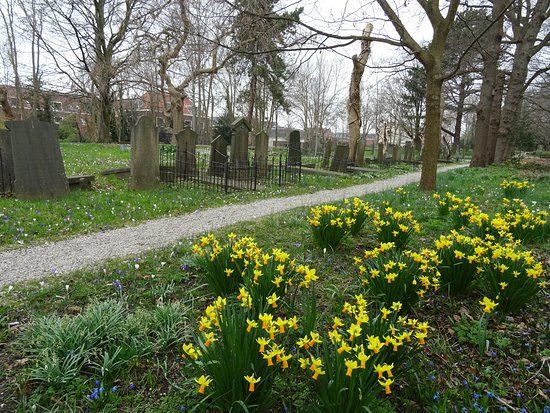
While the old catholic cemetary next to the Zijlpoort is still in use, the Groenesteeg cemetary is no longer. It is now popular with amateur painters and photographers but is also a lovely quiet place to stroll around. The cemetary dates from 1827 and was in use until 1975. In 1993 the old cemetary was restored to it's present state.
The place is especially pretty in spring when all the flowers are in bloom, but as you can see from the pictures, it's worth a visit any other time of year, too!
Groenesteeg cemetary website (Never mind if you can't read Dutch - just click on the last 4 links to go the the photoalbums!)
Opening hours are 9:00 - 16:00 hrs november-march and 9:00 - 17:00 april-october.
The pretty aula is open every first sunday of the month from april-october from 13:00 - 16:00 hours. There will be someone present who can provide more information about the cemetary and maybe even a guided tour, if you like.
Entrance is free!
How to reach it:
Halfway down the Hooigracht is the Groenesteeg (it's the alley with the restaurant 'De Hooikist' on the corner). Just follow the Groenesteeg right down until the end - keep walking! Through the big iron gates and you're there.
You will enjoy a beautiful view from the topfloor of the department store V&D ( Vroom en Dreesman) in the centre, you will find there a restaurant 'La Place' with fresh food ( friendly priced, self service) and enjoy the beautiful panorama. In summer you can even sit outside!
Enjoy the canals , Koornbrug , historic buildings etc.
Hij maakte de mens open
Hij maakte de vogel open
Vergeleek en zag dat het niet kon
En toch; tule, riet, papier, taf,
gaas, bombazijn dat door zijn vingers glijdt
zijn vingers die een schaduw
laten vliegen op de muur
Sponsored Links
Sponsored Links
Comments