



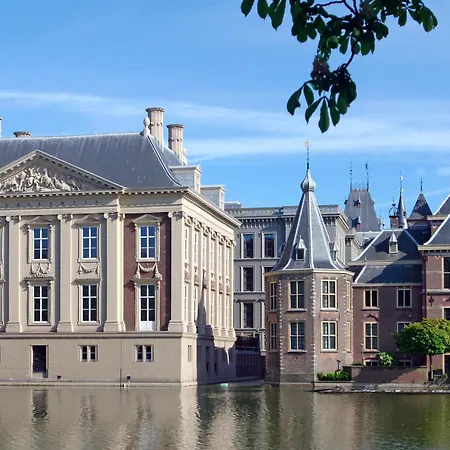














The Mauritshuis Museum (€10,50) is worth a visit. The 18th century interiors are the finest examples of classic Dutch baroque, which is also home to the Royal Picture Gallery. You can rent headphones for an educational tour (well worth it for art enthusiasts).
But the famous paintings of the Dutch Golden Age is not all that I saw. The interesting collection also offers an overview of Dutch and Flemish painting from 1400 to 1800. The masterpieces on display include work by Rogier van der Weyden, Hans Memling, Rubens, Van Dyck, Cornelis Troost and Adriaen Coorte. Moreover, the museum owns several top-notch works by the 16th-century German artists Lucas Cranach the Elder and Hans Holbein the Younger. Inetresting detail is that this collection has been housed for nearly 200 years in the Mauritshuis.
So, whenever you're interested in beautiful paintings, some Dutch history lessons and exiting surroundings ... the Mauritshuis is definitely the place to be. And now I can say that I have been inside and can pass it by without any remorse the next time I visit The Hague.
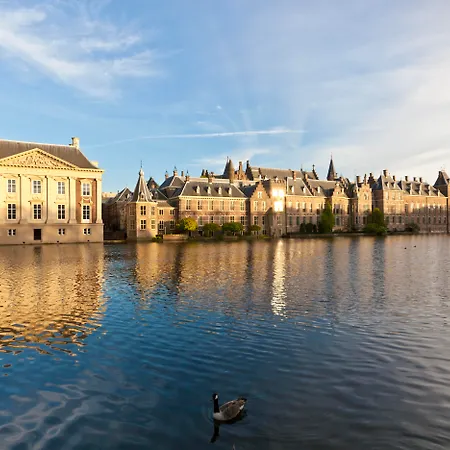
The Mauritshuis has quite some histroy (like most of the buildings in The Hague). In a folder we were handed out we read that "in 1631, army officer John Maurice, Prince of Nassau (1604–1679), bought a plot bordering the Binnenhof and the adjacent pond named Hofvijver. The Mauritshuis was named after this Prince John Maurice and was built between 1636 and 1641, the period when he was the governor of Dutch Brazil. The Dutch Classicist building was designed by the Dutch architects Jacob van Campen and Pieter Post. The two-storey building is strictly symmetrical contained four apartments and a great hall. Each apartment was designed with an antechamber, a chamber, a cabinet, and a cloakroom. Originally, the building had a cupola, which was destroyed in a fire in 1704."
More than enough history lessons? LOL! Anyway, walking through the museum is quite joyful. I saw some paintings of famous Dutch painters from the Dutch Golden Age, including top-quality work by Vermeer, Rembrandt, Jan Steen and Frans Hals.
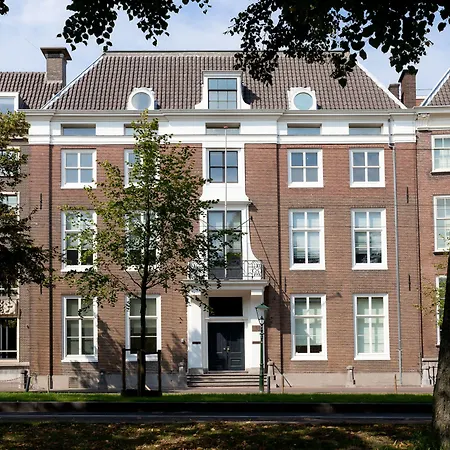
Like I have said before, I have been to The Hague many times and is one of my favorite Dutch cities to visit. Still it took me several visits to actually visit the Mauritshuis by netering the museum. I have passed it many times, taken lots of pictures of the beautiful facade and finally entered it ... I wasn't sorry for it. The Royal Picture Gallery Mauritshuis is an art museum in. Previously the residence of count John Maurice of Nassau, it now has a large art collection, including paintings by Dutch painters such as Johannes Vermeer, Rembrandt van Rijn, Jan Steen, Paulus Potter and Frans Hals and works of the German painter Hans Holbein the Younger.
You could easily spend a day here, but a morning or afternoon provides a powerful impression of the wealth and breadth of a great art tradition. So, don't just walk by it, but do enter it ... it is worth while!
On the second floor of this rather small museum is a room which contains two of the most beautiful paintings in the world.
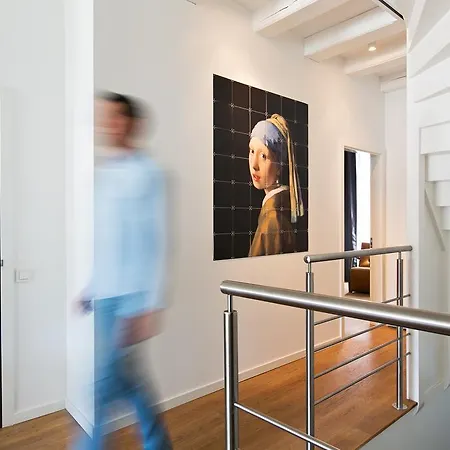
On one of the walls hangs the "Het meisje met de parel - Girl with the pearl earring" (1666) on the opposite wall the "View of Delft" both by Johannes Vermeer.
If you stand in the middle of this small room you have just to turn around to go from one marvel, from one wonder of the world of art to another.
When I visited this museum I happened to be alone in the Vermeer room.
A Dutch art critic wrote: "Why is the Girl with the pearl earring Vermeer’s best-loved painting? It must have something to do with the fact that the girl looks over her shoulder, as though hoping to see who is standing behind her. This draws the viewer into the picture, suggesting that he is the one who has made the girl turn her head."
That's what I felt. A magic moment, but who is she? Nobody knows.
The "View of Delft" is the most renowned townscape of 17th-century Dutch art of the "Gouden Eeuw". It is the only townscape of Vermeer (with the exception of the "Little street" which is centred on a detail of a town). A cloudy sky so typical of the Low Lands (remember Jacques Brel and his song "Le Plat Pays"), the reflections in the water, the quietness. A look on Delft four centuries ago.
Open: Tuesday - Saturday 10 - 17 h; Sunday 11 - 17 h. Closed: Monday.
Price: 10,50 or 12 €; Free 18 yr.
Visit the Mauritshuis with its wonderful art collection.
Johan Maurits of Nassau ordered this house built, it was completed in 1644. It was built by Pieter Post in the North Dutch Classical style but has italian Renaissance influences. It commands a lovely view over the Hofvijver. After Maurits died in 1679 the house passsed into state hands and became the home of the Royal painting collection in 1822. The collection is not large but it does have a very good collection of superior Old Masters and more are being added.
There are three floors of paintings and the collection changes regularly so you can go back again and again.
I especially love the Vermeer painting of the Girl with the Pearl Earring and Rembrandt's Anatomy Lesson, but my favourites are the Jan Steens with the lovely comical details. I could look at them for hours.
In the same room as the two famous Vermeer I discovered a small painting made by Carel Fabritius "The goldfinch" (het puttertje or distelvink) birds which were popular house pets. The painting is conceived as a trompe-l'oeil to hang high on the wall. Viewers could think that a real bird was there.
From Fabritius (a pupil of Rembrandt) only 15 works are known. He died tragically young in the explosion of the Delft powder magazine (1654) which destroyed two hundred houses of the city of Delft and probably a large part of his works.
Open: Tuesday - Saturday 10 - 17 h; Sunday 11 - 17 h. Closed: Monday.
Price: 10,50 or 12 €; Free 18 yr.
The Mauritshuis is one of the first and most beautiful examples of the Dutch classicist baroque, characterised by pilasters which run the full length of the facade and by frontons with various carvings. The Mauritshuis was built for Johan Maurits van Nassau, Governor of Dutch-Brasil. After a fire in 1704 the Mauritshuis was refurbished and in 1822 it became the 'Royal Cabinet of Paintings'. During extensive restoration work carried out between 1982 and 1987 a cellar was constructed under the forecourt, which houses the library and the storerooms. Artist Ger Lataster painted modern paintings on the ceiling of the upper hall. The colours he used are reminiscent of 18th-century ceiling paintings.
Originally the residence of Prins Johan Maurits van Nassau-Siegen (Prince John Maurice of Nassau), this 17th century palace is now the Mauritshuis museum. Although very small, the quality of the paintings by old Dutch masters (Rembrant, Vermeer, Potter) is high.
Rembrandt was at first very successful financially in his painting, but more and more he followed his own unique view of painterly expression and subject matter, partly shaped by his innovations in etching. He carried the observing mind of the viewer one step further than his scene arranging contemporaries. He portrayed a specific moment in time, rigorously expressing the thought at that instant. This did not appeal to the "crowd". But he still had understanding admirers (and students). Among them was the Stadtholder and so there are many Rembrandt works here (more than a dozen).
Sponsored Links
Hotel Des Indes, a Luxury Collection Hotel The Hague
6 Reviews and 191 Opinions Although I did not stay at the hotel (I used my date of experience instead) I am going to warn...
Paleis Hotel The Hague
4 Reviews and 70 Opinions Even though I live in The Hague, I've stayed in this hotel once and it was lovely. It is in a great...
Mercure Den Haag Central Hotel The Hague
4 Reviews and 134 Opinions Superior service and a great staff. Breakfast included was an unexpected surprise. Very clean and...
Sponsored Links
Comments