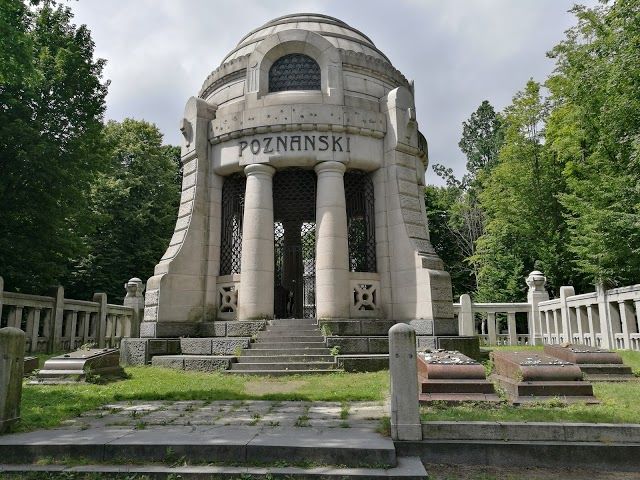
Visit Lodz's Jewish cemetry on Bracka street. It is said that it is the largest of its kind and has over 250,000 graves of jews including Lodz's Poznanski. Furthermore, you can visit this trip on the part of a ghetto tour of the city. You can find more information at the tourist information or at this website. Entrance to the cemetry is four zlotys.
Updated Apr 4, 2011
Lodz has many old mills that are currently being regenerated to create more galleries and shopping complexes. This one is near Poznanski's Palace and is the sie of the new Manufaktura complex, which will be open in late 2005. This complex will consist of a hotel, museums and a huge shopping centre. The foreign investment will help the city develop. Check out the web link for further information on one of Europe's largest projects. English version coming soon
Updated Jun 16, 2005
Website: http://www.manufaktura.lodz.pl/
Lagiewniki Woods is Lodz's essential lungs to the city. It has lots of square miles for people to go cross-country skiing, ride paddle boats, or just simply relax. If you come to lodz, then Lagiewniki woods is an absolute must for those who need a breath of fresh air.
You can get here by the Number 3 tram from Zachodnia Street, heading north. Ask the tourist info for more information.
Updated Jun 8, 2005
Visit the Jewish cemetery on ul. Bracka and ul. Zmienna, the largest Jewish cemetery in Europe. It was created in 1892 when residents of the nearby neighbourhood refused to allow the expansion of the old cemetery on ul. Wesola. The Lodz textile industrialist Izrael Poznanski donated the first 10.5 hectares of land towards the establishment of a new cemetery.
The first people buried there were the victims of the Cholera outbreak in 1892.
During the First World War, the cemetery was badly damaged, but renovation was started at the beginning of the 1920's when Poland regained independence.
During the Holocaust, Lodz had the largest Jewish ghetto after Warsaw and the cemetery was situated in the eastern part of the ghetto. By 1944, approximately 43,000 Jews were buried in what is now called the 'Ghetto Field' part of the cemetery.
The cemetery is open 9am-3pm every day except Saturday. Men need a head cover.
If you take tram no. 1 from ul. Kilinskiego, get off at ul. Strykowska. The cemetery entrance on ul. Zmienna is a short walk from there.
Written Aug 26, 2002
KALISZ. The Old Town in Kalisz seen from the Town Hall. This is a very ancient town. It was mentioned by Claudius Ptolemy about 147 AD. Kalisz was a very important amber route between the Baltic Sea and Rome.
Written Aug 26, 2002
Many of these parks provide leisure activities.
You can go horse back riding in the Lagiewniki Forest. Zdrowie offers the thrills of the amusement park. A mountain biking course is situated in Park ks. Poniatowskiego (picture).
Written Aug 26, 2002
Many people think that Lodz is grey. That's not true. Lodz has many beautiful parks like Park Julianowski, Zdrowie, Sienkiewicza, Helenow, ks. Poniatowskiego (pictured here) and the Poland's largest forest within the city limits, Lagiewniki.
Written Aug 26, 2002
Pabianice: You can go to this suburb of Lodz to admire a 16th century castle in the Renaissance style. Inside the castle there is a museum, placed there quite fittingly, for the town is the oldest settlement in the region.
Written Aug 25, 2002
The LODZ GHETTO - see it with your mind's eyes while walking about.
164,000 Lodz Jews were forcibly packed in the ghetto when the Germans sealed it off on April 30, 1940 and non-Jews were not permitted entry. Segregating Jews into ghettos was an intermediary stage in the Nazi programme to eliminate the Jews of Europe completely.
For more information see the travelogue.
Written Aug 24, 2002
The largest JEWISH NECROPOLIS in Europe (and probably the largest in the world).
The Jewish cemetery in Bracka Street was established in 1892. It covers the area of 43 hectares and contains the graves of 180,000 who either lived in Lodz or were destined to make Lodz their final resting place. Some 60,000 tombstones were traditional tombstones called the mazevahs (many of them have remained and are now regarded historical monuments).
The Jews contributed much to the growth of the city. Many of the industrial enterprises were founded by Jews (the most successful Jewish industrialist of Lodz was Izrael Poznanski), and more than 50 % of the Jewish population derived their livelihood from industry. A Jewish proletariat thus came into being - something unknown elsewhere and that accounted for much of the Lodz Jewish community's unique character.
In 1827 the population of Lodz was 2,800 of whom 400 were Jews. As the city grew rapidly as a result of the development of textile industry, so did the Jewish population. On the eve of World War II the population of Lodz amounted to 665 thousand , of which 34 percent (223 thousand) were Jews.
On September 8, 1939, the Germans occupied Lodz and shortly after annexed it to the Reich. From the very beginning Jews were subject to expulsions and a Jewish ghetto was established. Lodz' Jewish community was virtually wiped out in the Shoah. Only several thousand survived (830 in the ghetto itself).
Updated Aug 24, 2002
Sponsored Links
112 Opinions
44 Opinions
31 Opinions
Reviews and photos of Lodz attractions posted by real travelers and locals. The best tips for Lodz sightseeing.

The largest JEWISH NECROPOLIS in Europe (and probably the largest in the world).The Jewish cemetery in Bracka Street was established in 1892. It covers the area...
83 members live in Lodz
Q: I am travelling to Lodz for 3 - 4 days during July. what are the option to go for a run. I will be staying in the Centre of Lodz...

A: Hi, could you specify if you want to jog or just travel by foot? Jogging is not very popular in Lodz so there are not many routes I suppose. If you want to do some...
Read 3 Replies
1

I have just completed my first trip to Lodz. It was an unusual trip for a number of reasons. A nation was in mourning after the death of their president and his wife. An ash cloud from Iceland caused...
2

Piotrkowska Street is the main street in Lodz where most things happen. Yet many people claim that there is only one street in Lodz worth seeing, and that backpackers shouldn't venture away from the...
3

Lodz has many attributes - the "Polish Manchester" or the "promised land". It used to be the heart of Polish textile industry in 19th century, and nowadays it´s a vivid nightlife spot, full of art...
4

I've got some interesting experiences in Lodz. I'd love to share with you the 8 tips I've written, the 31 photos uploaded, and 0 travelogues I've created.
5

Lodz, pronounced "woodge", is the largest urban centre after Warasw. It is a young city; not a building oder than 200 years, and known for its Art Nouveau. Lodz is responsible for half of Poland's...
Build your own Lodz page
Sponsored Links