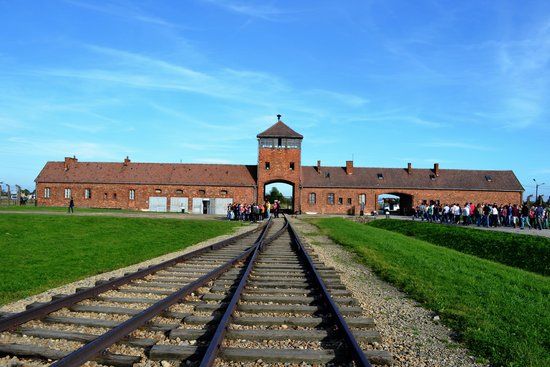
There are 2 main sites: -
Auschwitz I - located in the town of Oświęcim.
Auschwitz II (Birkenau) - located in the village of Brzezinka.
Ideally, both should be seen together to get a true understanding of the place in general. Id recommend a full day at least, depending on how much you want to see; a lot of time will be spent just processing everything you experience. Some people argue it can be seen in a few hours, but they are kinda missing the whole point in my opinion...
More info on my travel page: http://members.virtualtourist.com/m/15be8c/757cc/
Updated Jan 8, 2012
Phone: (+48) 33 844 81 00 [bookings]
Website: http://en.auschwitz.org.pl
If you are well aware of what happened under the Nazi regime in the countries invaded by Germany you might opt for an individual visit.
Just buy a small booklet with the maps of the blocks-barracks to visit in Auschwitz I and in Birkenau. The summary description of this 24 pages guide is sufficient and is completed by a large number of signs explaining the most important places, objects, and events. All the signs are in Polish and English.
On my two visits to Auschwitz and Birkenau I made the choice of an individual visit because as a child I "saw" WWII with the occupation of my country. After the war I had for neighbour a woman whose arm was tattooed with her concentration camp number.
For me it was essential to be alone with my thoughts during my visit. For many visitors having lost members of their family during WW II, Auschwitz-Birkenau is first of all a place of remembrance and not a museum.
To commune with the millions of victims becoming individuals when you see their photos or their abandoned suitcase with their name is in my opinion only possible after 15.00 h at Auschwitz I (museum) when the groups are gone. At Birkenau the camp is so large that groups can easily be avoided.
Best is to start your visit around 13 h first with Birkenau and after 15.00 h enter Auschwitz I. (Stays open till 17 h, 18 h and 19 h in June, July and August). Doing so you will avoid the bumping of groups of visitors in blocks 4, 5, 6, 7, and 11.
If you are less aware of WW II German concentration camps then a guided visit is indicated. During the period from April 1 to October 31, visits are exclusively on a guided, group basis from 10.00 h to 15.00 h (for Auschwitz I). It appears that because of a large number of visitors (1.4 million in 2011) guides should be reserved at least two weeks before a planned visit.
For details and prices see the official website http://en.auschwitz.org.pl/z/
Updated Jan 6, 2012
From the 28 one store brick buildings five have been transformed in museums with a permanent exhibition with photographs, photocopies of documents, historical exhibits including prisoner garments, bunks and other furnishings from prisoner rooms, and items seized from Jewish deportees such as suitcases, shoes, spectacles, prosthesis, brushes, hair.
The themes of the permanent exhibition at KL Auschwitz I are the following:
Block 4 – Extermination
Block 5 – Physical evidence of crime
Block 6 – The life of the prisoners
Block 7 – Living and sanitary conditions
Block 11 – The death block
The Death Wall (reconstruction)
Crematorium I and the first gas chamber.
These are the blocks visited by the general guided tour. You can imagine that when there are many visitors (summer), groups are waiting after each other to move on (1.4 million visitors in 2011). They leave no time for reflection.
That's why I visited these blocks 4 - 11 well after 15 h on an individual visit when the groups are gone. I prefer to be alone because I can not control my emotion when I see all the shoes of children or that photo of a skeletal Belgian young woman weighing only 35 Kg.
After Auschwitz I the general tour goes to Birkenau (Auschwitz II) to see some residential barracks nearly as they were, the unloading ramp, the ruins of gas chambers and the ruins of crematoria II and III.
This "General Tour" takes 3 1/2 hours.
There are also one-day study tours (6 hours) and two-day study tours (8 hours).
It should be noted that Blocks 13 - 21 at Auschwitz I contain interesting national exhibitions. I will come back on them.
Updated Jan 6, 2012
The Auschwitz (Oswiecim) Concentration Camp is definitely one of the most impressive, chilling and thought provoking sites you can imagine.
Auschwitz-1 was a forced-labor concentration camp, where sadistic "medical experiments" in human prisoners were also performed. It is very well preserved.
Auschwitz-2 (Birkenau) was the notorious death camp with a super-"efficient" Nazi extermination machine, which you can follow from the railway tracks bringing the victims to the camp through the "selection" process to the "showers" where the victims were gassed to death.
Written Aug 12, 2011
Website: en.auschwitz.org.pl/m/
Aside from the permanent exhibitions there are in blocks 13 - 21 & 27 at KL Auschwitz I permanent displays known as the national exhibitions.
These are from countries occupied by the Germans whose citizens were deported and died in Auschwitz. These exhibitions show the history of invasion and occupation, the fate of the citizens and the story of the resistance movement.
We visited block 20 shared by France (ground floor) and Belgium on the upper floor. It was not without emotion that I saw photos of kids from my age embarked for the deadly trip to Birkenau.
We also visited block 21 with Holland where are shown photos from Anne Franck and her family before the invasion.
Most terrible was block 15 for Poland. From all occupied countries Poland is the one that suffered most from the Nazis who considered the Poles as slaves. Six millions Poles, 18% of the population were killed during WWII ("They lived under the nazis" by Laurence Rees).
What is unbelievable is the fact that the SS took so many photos of their own crimes. I can't forget that photo of a German soldier shooting in the head of a woman keeping a child in her arms.
The exhibition in block 27 on The Martyrdom, Struggle, and Destruction of the Jews, 1933-1945 was installed by Poland.
Written Jun 24, 2011
From the official website:
"Taking pictures on the grounds of the State Museum Auschwitz-Birkenau in Oœwiêcim for own purposes, without use of a flash and stands, is allowed for exceptions of hall with the hairs of Victims (block nr 4) and the basements of block nr 11."
That are the official rules but there are also decency rules.
I was shocked when I saw at the wall of executions between block 10 and 11 at Auschwitz I a woman (about 40) and her daughter asking another visitor to take a photo of them posing and smiling before the Death Wall where thousands prisoners were shot by the SS.
How can some tourists be so stupid to confuse Auschwitz with Disneyland!
Written Jun 24, 2011
All concentration camps in Poland where build and ruled by the Germans so that it came as a shock for Poland (and lead to a international petition* of protest with 230000 signatures) when in the U.S.A. some news media used the historically erroneous terms "Polish concentration camp" and "Polish death camp" !
The official and correct name is "German concentration camp in Nazi-occupied Poland,"
The first victims of Auschwitz Concentration Camp (Konzentrationslager) were the Poles starting in 1940. Poland had been invaded by the Germans in September 1939. One-sixth of the population of Poland was killed in the war.
In 1941 already, over 26 thousand people were registered in Auschwitz: about 15 thousand Poles, 10 thousand Soviet POWs, and more than 1 thousand Jews. The mass deportation and extermination of the Jews started in 1942.
Historians estimate that between 1 and 1.5 million people perished in Auschwitz during the less than 5 years of its existence. The majority, from 1 to 1.35 million people, were Jews. The second most numerous group, from 70 to 75 thousand, were Poles, and the third most numerous, about 20 thousand, the Gypsies. About 15 thousand Soviet prisoners of war and 10 to 15 thousand prisoners of other ethnic backgrounds also died there.
*For details about this "Petition on German Concentration Camps" see "Kosciuszko Foundation".
Written Jun 24, 2011
At Auschwitz I people died in their thousands, at Auschwitz II Birkenau people died in their millions. Most visitor travel to Auschwitz I unaware that the real horror of the Nazis' final solution took place at Auschwitz II Birkenau, which is located 3km away. This was the largest of the concentration camps covering 425 acres and containing 300 buildings. At it peak the camp housed 100,000 prisoners. Over 1 million people arrived at the camp and were immediately sent to their death in the gas chambers on the pretext that the were to take a shower, the vast majority being Jews.
After the recent changes to the way you are allowed to visit Auschwitz I, unrestricted visiting is still allowed at Auschwitz Birkenau. I could be wrong but there seem to be twice as many parked vehicles as when I last visited. This may have been caused by the changes to individual visits at Auschwitz I, with visitors going to Birkenau first and then going to Auschwitz I later. There were so many vehicles, mainly taxis, indiscriminately parked that the view along the disused railway tracks to the entrance of Birkenau was blocked.
Updated May 1, 2011
Phone: +48 033 844 81 02
The camp was originally an army barracks consisting of 20 buildings, 14 were a single storey and 6 had a second floor. Between 1941-42, 8 more buildings were constructed and a second storey was added to the single storey buildings. The inmates were used to construct the buildings. The camp normally held between 13,000 & 16,000 inmates though at one stage during 1942 it peaked at 20,000. A change to the way you can visit Auschwitz I will occur between 01 April 2011 and 31 October 2011. Between the hours of 1000 and 1500 hours you will only be allowed in Auschwitz I if you pay to go on an organised tour either as a member of a group or an individual. You will still be able to visit between 0800 and 1000 hours or after 1500 hours till closing time on your own and without paying a fee. This has come about because of the continuing rise in the number of visitors each year and is designed to raise funds.
Updated May 1, 2011
Address: ul. Wiezniow Oswiecimia 20, 32-603 Oswiecim
Phone: +48 033 844 81 02
Website: http://www.auschwitz.org.pl/
Auschwitz Museum as it is called, is a very moving place to visit. You go here and think of the horrible tragedies these people endured......it makes you think of the people......and their suffering. The museum is very well organized and really, no tour is needed. I took a Museum tour but realized i didnt need it about 1/3 way through because the signs are all self explanatory on all the buildings and exhibits.
Updated Apr 4, 2011
Sponsored Links
1 Review and 59 Opinions very nice hotel,staff..easy to find even if for me it was more difficult because i arrived at 3...
4 Reviews and 6 Opinions There´s absolutely no need to sleep in Oswiecim to visit the camp. The town is easily accessed by...
2 Reviews and 6 Opinions If you want to stay in Oswiecim, the pickings are slim. I'll give you some of the choices below:...
Reviews and photos of Oswiecim attractions posted by real travelers and locals. The best tips for Oswiecim sightseeing.

Auschwitz Museum as it is called, is a very moving place to visit. You go here and think of the horrible tragedies these people endured......it makes you think...
2 members live in Oswiecim
Q: I am visiting Poland in July this year,primarily to watch a football match in Wroclaw. My flight lands in Krakow and i want to try...

A: I think the easiest option may be to simply take a minibus to the camp from the bus station adjoining Krakow Glowny station and to return there. Alternatively, you...
Read 3 Replies
1

This page depicts picture, anecdotes and information on one of the most gruesome places I’ve seen in my life: the infamous Auschwitz concentration camp. It lies within an hour of Krakow in the town of...
2

located about 30 miles west of krakow is the infamous concentration camp auschwitz-birkenau. auschwitz-birkenau is a symbol of the horror of the holocaust. located near the town of oswiecim...
3

I am a huge history buff, especially with the WWII era. So, obviously, one of the most important places I wanted to visit was Auschwitz and Birkenau. Though I have seen Hollywood reproductions, read...
4

WIELICZKA<<<<<OSWIECIM>>>>>BRZEZINKA POLANDSunday 19th May 2002 I remember on that day; Even long before I reached Auschwitz, I would know what to expect from this...
5

You have come to Oswiecim for just one reason and that is to visit the concentration camps of Auschwitz-Birkenau and to homage to nearly 2,000,000 people who were murdered here by the Nazi regime....
Build your own Oswiecim page
Sponsored Links