Cetinje monastery is very important religious and historical center of Montenegro.
The Monastery was dedicated to the Nativity of Virgin Mary (Holly Mary).
This famous temple was built by John Crnojević 1484. In that period Monastery was became the seat of the Bishopric of Zeta. After the 1493rd Bishop of the bishopric were called "the Montenegrin seaside."
The monastery was demolished 1692nd by the Turks, and restored him to Bishop Daniel, the place near the original location. On this occasion the new monastery was built from old stones, and transferred to the plate with the crest Crnojević and dedication of John Crnojević. Before the 1714th the monastery was burned down and rebuilt it around the 1743rd by Montenegrin Metropolitan Sava Ivanović Njegoš. Over time he built, and its current appearance dates from 1927. year.
Cetinje monastery was first mentioned in the work of Marijan Bolić, "Description of Sandzak Skadar" from the 1614th , where Bolić observes that "Signor Prince Ivan Crnojević built a small but beautiful Monastery."
The monastery owns the relics of priceless value. First of all, in church was a preserve a relics of St. Petar of Cetinje (Petar Petrović Njegoš) and in the his grave is small box that contain the hand of St. John the Baptist. Here is also and particles of the Holy Cross.
In museum is epitrahelj Saint Sava (part of vestment of Orthodox priests and bishops under the felon, that under rice; long as wide, crosses embroidered ribbon with cutout for the head is placed around the neck and provides up to down) from the thirteenth century, the founders of the Serbian Orthodox Church. It contain also crown of Serbian king Stefan of Dečani, the dynasty Nemanjić of the fourteenth century, which was identical to the crown of the Montenegrin King Nikola I Petrovic, whom he crowned 1910th. There is also all sorts of old church banners (including dubious authenticity Bosko Jugovic, one of heroes of famous Battle of Kosovo (1389).
Updated Jun 30, 2012
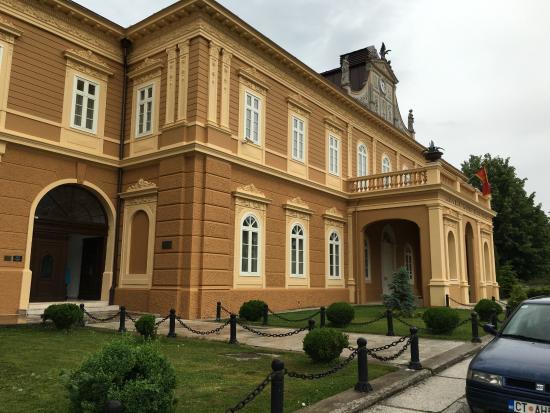
The Palace of King Nikola I (the last king of Montenegro) is also the home of a small museum. The palace was completed in 1867 and was added to in 1871 and 1910.
In the palace, you will see original pieces of furniture and artifacts and the house as it was during the reign of King Nikola, along with several portraits of the ruling family.
In the museum at the entrance, you will see some of Montenegro's most important treasures, such as many Turkish banners that were captured in battle, military uniforms and weapons of the royal family, gifts to Montenegro from other countries, and works of art.
Admission is charged. Hours are 9am-5pm daily in season and 9am-3pm Monday-Friday off season.
Updated Apr 4, 2011
The king's palace is now the National Museum of Montenegro... don't worry. it has changed name but not content... it is still the building where King Nikola I Petrovic lived and reigned.
This palace is a simple home on two floors and two added wings... it's more like a residential home than a real Royal Palace. Inside, on a guided visit, you can see how this royal family lived, since most of the original furniture has been retained.
There are many clothes, jewels and paintings to be seen, as well as family photos. The guides are really informative, so it's a good place to learn about Montenegro - past and present.
Updated Oct 7, 2006
Address: Novice Cerovica bb.
Phone: +381 86 231 477
Website: www.mnmuseum.org
The old Monastery is the Crnojevic monastery built by Ivan the Black, although it is now gone... In 1692 the Monastery was destroyed by the Turkish conquerors (the Skadar Pasha Sulejman Busatilja).
Apparently the Monastery was a huge complex of 1400 square metres which included several monastic residences and two churches: the small church of St. Petar and the large Church of the Nativity of the Mother of God.
As you can see from the picture, only the small church has survived.
Updated Oct 7, 2006
The statue Ivan I Crnojević, known generally as Ivan the Black, is right outside the Royal palace. It is dedicated to the Montenegrin ruler of the medieval country of Zeta between 1465 and 1490.
Why did he deserve a statue, albeit not a too nice one? Because it is him who, for defensive reasons against the Turks, first used Cetinje as a capital city. He built his court here in 1482, and in 1484 he built a monastery, the Monastery of Crnojević. T
Updated Oct 7, 2006
Since Montenegro has become independent again (2006) a new parliament has opened in Cetinje - however I have no idea if this is the state parliament's or just a regional one.
You will not recognise it by the building, although it is nice (if I understood correctly there was once an embassy in this building), but by the Montenegrin flag glying outside and the red carpet.
Of course, like most other parliaments, it is guarded by the guards - which, in all fairness, look more decorative than useful, considering the peacefulness of the new republic.
Updated Oct 6, 2006
Address: bajikova br 2
Phone: 086 231 755
The French Embassy is a remnant of Cetinjie's past as a capital city, together with other embassies. It's no longer a functional one, like the hoters, but it is one of the most impressive "illustrious" buildigns left.
It was built in 1910 and designed by the French architects Paul Gaudet and August Perret. What makes this buildign stand out is the fact that its facade is cmpletely covered with polychrome ceramic tiles.
Today the Embassy has become the home of the Department of Old and Rare Books of the Central National Library of Montenegro.
Updated Oct 6, 2006
Address: niegoseva 100
The Monastery of Cetinje is called the Monastery od Saint Peter (Sveti Petar Cetinjski) and was built in 1701 by Vladika Danilo Petrovic, who happened to be the founder of the Petrovic dynasty. It was destroyed 4 times and 4 times it was rebuilt.
The monastery aòsp doubles as a family mausoleum for the Petrovic dynasty: you can find the graves of Prince Danilo Petrovic, of the Grand Duke Mirko Petrovic and of the Bishop Sava Petrovic.
Inside the monastery there are many treasures to see, including a large collection of sacred books: even the Bishop-Prince and poet Petar Petrovic Njegos operated a printing press from here. It is not surprising, therefore, that this monastery served as the country's cultural centre.
Updated Oct 5, 2006
Address: cetinje
In 1903 a building of the Russian consulate was built according to the project of Italian architect Corradini. This luxurious building consists of the ground floor, first floor and the beautiful attic decorated with rich Baroque ornaments with various fantastic motives and wreaths. That’s why it is considered to be one of the most beautiful buildings at Cetinje. Today, it houses the Faculty of Arts.
Updated Jan 16, 2005
The Artistic Museum of Montenegro was established in 1950, originally as the Artistic Gallery of Montenegro. It is situated in the premises of Vladin dom. Its parent part, respectively National Gallery, is composed of five collections: Collection of Arts of Yugoslav Nations and Ethnic Groups, Collection of Icons, Collection of Montenegrin Fine Art, Milica Saric-Vukmanovic Memorial Collection and Collection of Copies of Frescoes.
Written Jan 13, 2005
Sponsored Links
Sponsored Links
Comments