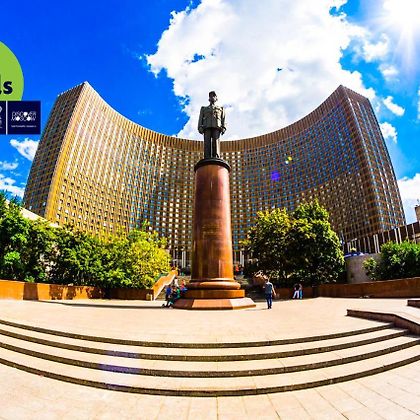

























Emperor Alexander II has cancelled the serfdom in 1861, changed judicial and military reforms, has finished long-term Caucasian war, has released Russian people from the Osmansky yoke.
This monument is near to the Temple of the Christ of the savior.
Updated Mar 1, 2012
In 1995 near to place of temple of the Christ of the Savior the wooden tent temple-chapel of an icon of Bozhiej of Mother "Majestic" has been constructed ! In a temple regular divine services at once have begun, the prayer about the prompt revival of the Temple of the Christ of the Savior, a prayer for builders and philanthropists was constantly made.
Written Mar 1, 2012
The original of a temple was will erect in gratitude to God for rescue of Russia from Napoleonic invasion. The temple has been constructed under the project of architect Konstantin Tona. Building proceeded almost 44 years: the temple has been put on September, 23rd, 1839, consecrated — on May, 26th, 1883.
On December, 5th, 1931 the building of a temple has been destroyed. It is anew built up on a former place in 1994-1997.
Something about the first Temple. The general view of a building reminded the ancient Russian temples constructed on the sample of the Byzantian architecture. On furnish of external walls of a temple and manufacturing of relief images white marble from an open-cast mine near village Protopopova of the Kolomna district has been used.The basis of a temple represented equivalent a cross with ledges in corners. The height of a building made 48,5 sazhen (nearby 103,5), the space occupied with a temple together with porches made 1500 square sazhen. Capacity of a temple made to 7200 persons.
External walls of a temple have been decorated by high reliefs on religious and historical themes plots for which have been chosen by metropolitan Philaret.
Updated Dec 13, 2011
Website: http://www.xxc.ru
I was so impressed at how many churches, cathedrals and places of worship existed in Moscow. After 70 years of Communism, religion is back and back with a vengeance!
Please note: There is normally a no photograph policy.
Written Oct 2, 2011
Website: http://www.mospat.ru/en/the_patriarch/
The tallest orthodox church in the world!
Stalin ordered the demolition of the original Cathedral in 1931 in order to build a monument to the new order - the Palace of the Soviets. However it was discovered _after_ the demolition that the land wasn't capable of taking the weight of the planned, massive, construction, and that, lack of funds, and the outbreak of WWII meant that land remained unoccupied, other than a flooded foundation hole which later became the Moskva Pool (the world's largest open air swimming pool - they must have really liked having these titles!).
Construction of the new cathedral began in 1994 and was completed in 2000.
Written Aug 8, 2011
The city was once known as 'sorok-sorokov' ('forty-times-forty'), in reference to the many Orthodox onion domes making up the city's skyline.
The look of the city was changed drastically during Soviet times, mostly due to Stalin, who oversaw a large scale effort to modernize the city by, on the one hand, introducing very broad avenues and roadways, some of them over ten lanes wide, and on the other, destroying a great number of historically significant architectural works such as the Sukharev Tower and numerous mansions and stores lining the major streets, and various works of religious architecture, such as the Christ the Saviour Cathedral.
The latter was demolished to make way for a huge skyscraper that was never built, and reconstructed in the mid to late 90s.
On photo: The Church of Saint Gregory of Neocaesarea in Polyanka.
Originally built in 1445, present-day building completed in 1679.
This Church was closed in 1939 and reopened in 1992.
Updated Mar 13, 2011
Address: 29a, Polyanka, Moscow
Phone: 959-00-11
Architect Vladimir Shukhov was responsible for building several of Moscow's landmarks during early Soviet Russia. The Shukhov Tower, just one of many hyperboloid towers designed by Shukhov, was built between 1919 and 1922 as a transmission tower for a Russian broadcasting company. Shukhov also left a lasting legacy to the Constructivist architecture of early Soviet Russia. He designed spacious elongated shop galleries, most notably the Upper Trade Rows (GUM) on Red Square, bridged with innovative metal-and-glass vaults.
Written Dec 1, 2010
The temple was constructed on a vow given by sovereign Alexander I in gratitude for saving fatherland "from the Gauls invasion". The temple was supposed to be built on Vorobyovy mountains under the project of architect Vitberg. Subsequently "on intrigues against the builder" the project of a temple and a place of construction were changed. The new place was chosen not so close to the Kremlin, so that the temple was dissonant to its ensemble, but at the same time so that connection of the temple with ancient constructions of the Kremlin and the Red Square was felt.
September, 10, 1839 the solemn laying of the present temple in Russian-Byzantian style took place. It was constructed under the project of architect K.A.Ton, at the expense of treasury with attraction of people's donations. Two cemeteries and mammoth remnants were found during digging a foundation ditch. The temple was consecrated in April, 10, 1883 during the days of crowning of the emperor Nikolay I. Side - chapels were consecrated later: in June, 12 - the side-chapel of St.Nikolay Chudotvorets and in July, 8 - of St. Alexander Nevsky. K.A.Ton has created the project of a five-domed temple with big central and four angular turrets with 14 bells.
The banners and keys of the conquered cities were transferred to the temple. 640 candlesticks were built in a dome for illumination, and 600 more around the lattice on choruses. First electric street lamps in Moscow appeared on the square in front of the temple. The height of the temple was 103 m. In December, 5 1931. the temple was blown up. Subsequently the foundation ditch was used for the construction of swimming - pool Moscow . In 1994 the pool was closed. In January, 1995, the solemn laying of the revived temple took place. Now the construction is completed. The temple has active museum, excursions are held and the viewing platform is arranged.
Updated Nov 26, 2010
Address: 15-17 Volhonka, Moscow
Website: http://www.xxc.ru/english/index.htm
We went on a long walk around the Kremlin and along the Moscow River. We passed the ‘Cathedral of Christ the Saviour’ with a very turbulent history. The cathedral was originally built in 1839, but demolished in 1931 to create room for the ‘Palace of Soviets’, which was to be a kind of big socialist monumentbuilding.
However, because of bad economy, problems with flooding, and war, the palace was never built. For years the foundation hole served as a swimming pool - the largest the world had ever seen.
With the end of the Soviet rule, the cathedral was rebuilt and inaugurated in August 2000. We didn’t go inside the cathedral, but just admired the highest Orthodox cathedral in the world from the outside.
Updated May 1, 2010
The Cathedral of Christ the Saviour is the largest orthodox church in the world.
The original cathedral was built between 1839 and 1883, but destroyed by Stalin in 1933.
His idea was to build a massive Palace of Soviets topped by a Lenin statue on this site, which in fact was never built as the ground wasn't stable enough.
An open air swimming pool was constructed instead.
Between 1995 and 1998 the Cathedral was rebuilt. Nowadays it also houses a free museum which exhibits many photos about the interesting history of the Cathedral.
Directions:
The Cathedral of Christ the Saviour is located on the northern bank of the Moskva River just in the city centre (Metro: Kropotkinskaya).
Updated Sep 20, 2009
Sponsored Links
Radisson Royal Hotel Moscow Moscow
4 Reviews and 68 Opinions This is the biggest hotel I have ever stayed at! Unlike Lotte Moscow, the Radisson Royal doesn't...
Marriott Moscow Grand Hotel Moscow
7 Reviews and 145 Opinions A beautiful hotel, ideally located close to the city centre, a very good choice for business or...
Marriott Moscow Royal Moscow
6 Reviews and 128 Opinions The hotel has a great location, all the central attractions are very close. But the hotel is not...
Christ the Saviour & other churches tips and photos posted by real travelers and Moscow locals.
Write a Review
The Cathedral of Christ the Saviour is the largest orthodox church in the world. The original cathedral was built between 1839 and 1883, but destroyed by Stalin...
1,523 members live in Moscow

Q: Has anyone rode this train? Is there any wifi hot spots at station along the way?

A: No idea, but you may want to contact Russian Railways - they have an English site http://eng.rzd.ru/
Read 4 Replies
1

"What is there to compare with the Kremlin, with its girdle or crenulated walls, with the golden domes of its cathedrals reclining on its high hill like the crown on the brow of a terrible...
2

Moscow has been in existance for eight and a half centuries. From a small settlement that dwelt among woods and rivers it has grown into the capital city of a huge country. The first chronicle record...
3

My mother and I visited Moscow in May of 2003, for eight days and nights. We had just spent an equal amount of time in St. Petersburg, Russia's younger, once-capital, city. St. Petersburg teems with...
4

I lived in Moscow between September 2003 and May 2004. However, I have also been there on business very many times. I work for a Russian company in Cyprus as well. I have mostly visited Moscow on......
5

The star-spangled blue and golden domes of Moscow's churches are a wonderful metaphor for this amazing city. After decades of neglect for all but a few, they are being restored to their former glory,...
Build your own Moscow page
Sponsored Links