


Favorite thing:
Hermitage Museum - I did the cruise ship visit to St Petersburg last month. We visted Catherine's Palace in Pushkin first in the morning so we arrived to the Hermitage in the afternoon. The cruise ships have tour guides so the cruise ship visitors do not wait in the ticket lines.
Most cruise ships stop running the Northern Europe route the end of September so there will be fewer tourists as that point.
As fas as I am aware, there is only one ticket for the whole main Hermitage museum. The additional buildings across the river would be a separate cost.
Fondest memory:
The beauty of the buildings. Restoration has done a great job.
Be ready to spend lots of time there! I want to go back in the winter where I can spend alot more time on my own.
Favorite thing:
Hi Milton,
If you haven't chosen a guide, I would strongly suggest going to www.guide-petersburg.com
We used Gennadiy a year ago. He is fantastic. He will pick you up and has a world of knowledge. He rates are really reasonable. We have also used DenRus for small group in the past, they were also good. I would definitely use Gennadiy for a personal guide. St. Petersburg is wonderful. Enjoy!
Favorite thing: In the UK we are used to free admission to most museums, but in St Petersburg not so. The Hermitage 400 RUR ,Church spilled Blood 320 RUR . Some have no restritions on taking photos, but the Hermitage a charge of 200RUR. But you have probally travelled a long way, so pay up and smile.
Favorite thing:
I am not a museum expert but I have been in many of the worlds best museums.
Without a doubt and in my openion, the Hermatage Museum in St. Petersburg Russia, ranks at the top of the list. The collections are world first class and the architecture and interior decor are outstanding. Don't miss the Hermatage if you are making a trip to Russia.
Favorite thing:
Museums in St. Petersburg
St. Petersburg is not without reason referred to by local residents as the gorod muzei or "city of museums."
Academy of Fine Arts Museum - On the bank of the northern bank of the Neva River behind the imported and ancient Egyptian sphinxes.
The Applied Art Museum - One of the more underrated museums in the city, the historic Applied Art Museum boasts permanent exhibits of about 3000 original items .
Beloselsky-Belozersky Palace - This mid-19th century era palace houses the City Cultural Center and has a varied cultural program.
Central Railway Museum - Established in 1813, the museum has more than in-house 50,000 exhibits, which depict the development of the railways in Russia.
The Cottage Palace in Peterhof / Petrodvorets - 30 km west of St. Petersburg on the Gulf of Finland, is the cottage where Peter the Great was quartered while building an estate called Petrodvorets or Peter's Palace.
Cruiser Aurora - Famous for firing the first shot in the Bolshevik Revolution of 1917, the cruiser has been turned into a floating museum.
Dostoyevsky Memorial Museum - The museum opened in 1971 to celebrate the 150th anniversary of the birth of the great Russian novelist. He spent the last years of his life here writing "The Brothers Karamazov" here.
The Hermitage Museum - A world-class museum founded in 1764.
The Marble Palace - A branch of the Russian Museum.
The Mikhailovsky (St. Michael's) Castle - A branch of the Russian Museum
Fondest memory:
The Central Navy Museum - Founding on Peter the Great's decree in 1709, the museum is one of the oldest in the city. The museum is dedicated to Russian naval history.
Peter and Paul Fortress - This is the oldest building in St. Petersburg. Be sure to visit the baroque interior of the SS Peter & Paul cathedral with its landmark golden needle spire.
Alexander Pushkin Museum and Memorial Apartment - The museum honoring the great Russian writer and poet opened in 1949 to celebrate the 150th anniversary of Pushkin's birth and is the oldest literary museum in Russia.
Russian Ethnography Museum - Houses an exhibit of the culture and life of the more than 150 peoples of Russia including various adornments, cut objects, embroidery, folk costumes, furs and weapons.
The Russian Museum - Founded in 1898, this is the largest and most complete museum of Russian art. The museum's collection of art is housed in the Mikhailovsky Palace
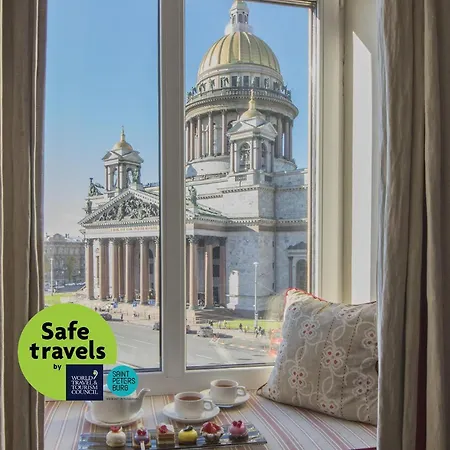
St Isaac's Cathedral - The lavish interior of the grandiose and skyline-dominating cathedral completed in 1858 and designed by French architect Ricard de Montferrand
The Stroganov Palace - The palace is currently being restored
The Summer Palace Of Emperor Peter The Great - houses a permanent collection of Peter the Great's personal belongings
The Yelagin Palace - Completed in 1822 and designed by renowned architect Karl Rossi, the palace was the summer home of Empress Maria Fedorovna.
The Yusupov Palace - A marvel of 18th and 19th century architecture and home to one of the wealthiest and powerful pre-Revolutionary Russian families, the palace is also famous as the site where Gregory Rasputin was murdered in 1916.
Zoological Museum - The museum has an impressive display of over 40,000 exhibits of fauna from every continent and climate.
Favorite thing:
Originaire de France, Louis Jules BENOIS (1770-1822), fondateur de la fameuse dynastie artistique de Saint-Pétersbourg, est né dans une famille de paysans. Il acquit sa gloire exclusivement dans les arts culinaires et, après son arrivée à Saint-Pétersbourg, occupa le poste du Maître d’hôtel près la Cour de l’empereur Paul I er. Plus tard, il continua à occuper ce poste près l’impératrice veuve. Ses 11 enfants devinrent fondateurs de tout un clan BENOIS dont les plus connus sont l’architecte Nicolas BENOIS et ses deux enfants Alexandre et Leontiï.
Fondest memory:
Original of France, Louis Jules BENOIS (1770-1822), founding of the famous artistic dynasty of St-Petersburg, is born in a family of peasants. He acquired his glory exclusively in the culinary arts and, after his arrival in St.-Petersburg, occupied the station of the Mr. of hotel near the Court of the emperor Paul I st. Later, he continued to occupy this station near the widowed empress. His 11 children became founders of a whole BENOIS clan of which most known are architect Nicolas BENOIS and his two childrens Alexander and Leontiïs.
Favorite thing:
Pierre-Dominique BAZAINE, officier du génie, membre correspondant et membre d’honneur de l’Académie des Sciences de Saint-Pétersbourg, fut envoyé en 1810 en Russie par Napoléon I pour y créer un Institut d’ingénieurs de voies de communication et devint en 1824 son Directeur. BAZAINE fut l’auteur de beaucoup de ponts de Saint-Pétersbourg et ses faubourgs. Il est toujours aussi plaisant de contempler les légers petits ponts métalliques très élégants près du jardin d’Été.
C’est lui qui a conçu les constructions des planchers du Palais d’Hiver, du Théâtre Alexandrinski et de la Cathédrale de la Sainte-Trinité. Il dirigea les travaux de construction du canal Obvodni, les bâtiments Sénat et Synode des écluses de Shlisselbourg, des constructions hydrauliques de l’Usine Okhtinski. C’est toujours lui qui élabora le premier projet de protection de Saint-Pétersbourg contre les inondations. Il écrit plusieurs traités sur les mathématiques, le transport et le génie civil.
Fondest memory:
Pierre-Dominique BAZAINE, officer of the genius, corresponding member and member of honor of the academy of the Sciences of St.-Petersburg, were sent in 1810 in Russia by Napoléon I to create an Institute of engineers of communication ways there and became in 1824 his Director. BAZAINE was the author of a lot of bridges of St.-Petersburg and his outskirts. It is always as pleasing to contemplate the light small very elegant metallic bridges close to the garden of summer.
It is he that conceived the constructions of the floors of the Palace of winter, the Theater Alexandrinski and the Cathedral of the St.-Trinidad. He directed the works of construction of the Obvodni channel, the buildings Senate and Synod of the sluices of Shlisselbourg, of the hydraulic constructions of the Okhtinski factory. It is always he that elaborated the first protective project of St.-Petersburg against the floodings. He writes several treaties on mathematics, the transportation and the civil genius.
Favorite thing: Pushkin died in this house by the Moyka River in 1837, after a duel with French soldier of fortune Baron d'Anthes who had been publicly chasing Pushkin's beautiful wife, Natalia. The affair was widely seen as a put-up job by Tsar Nicholas I, who disliked the famed poet's radical politics - and who, rumour has it, may have been the one really after Natalia. The museum includes a Russian-language tour (English tours can be arranged in advance). The apartment has been reconstructed to look exactly as it did in the poet's last days. For the morbid among you, on display are his death mask, a lock of his hair, and the waistcoat he wore when he died.
Favorite thing:
St Petersburg's largest island lies wedged like a plug in the mouth of the Neva. The main points of interest are clustered on its eastern 'nose', just across the river from the Admiralty. They include maritime buildings, the city's university, a clutch of museums, and some of the best views of the city. The island's nostrils are adorned with the Rostral Columns, navigation beacons shaped like ship's prows which today spurt forth gas-fuelled fire on holidays.
Museums include the Central Naval Museum, Museum of Zoology, Museum of Anthropology & Ethnography or Kunstkammer (with its creepy collection of genetic freaks) and the Academy of Arts. The Geological Museum is home to a map of the Soviet Union that's over 26 sq m (85 sq ft) and made entirely of precious gems including amethysts, diamonds and rubies. There's also the Sigmund Freud Museum of Dreams, a unique and innovative exhibit housed by the Psychoanalytic Institute and a must for dreamers and shrink junkies.
Favorite thing: Often overlooked by visitors in favour of the Hermitage, the extensive Russian Museum is a must for anyone interested in Russian art and culture. It's housed in the former Mikhailovsky palace, which was designed by Carlo Rossi and built in 1819-25 for Grand Duke Mikhail (brother of Tsars Alexander I and Nicholas I) as compensation for not getting a go on the throne. The museum was founded in 1895 under Nicholas II, and opened three years later. The building is most impressively viewed from the back, during a late-night stroll through the pleasant Mikhailovsky Gardens behind it. The illuminated palace by night makes a great spot for romantic holiday snaps.
Sponsored Links
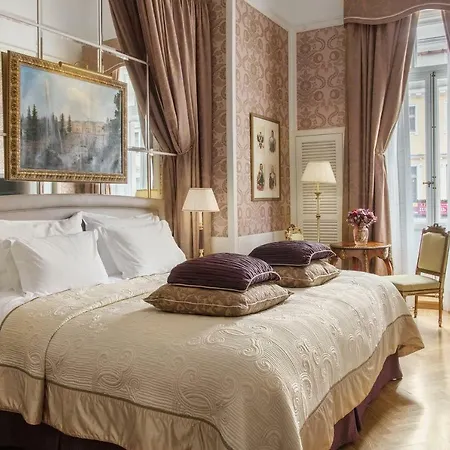
Hotel Astoria Saint Petersburg
11 Reviews and 185 Opinions Five star accommodation caters to the foreign visitor. For regular tourist it also has some...
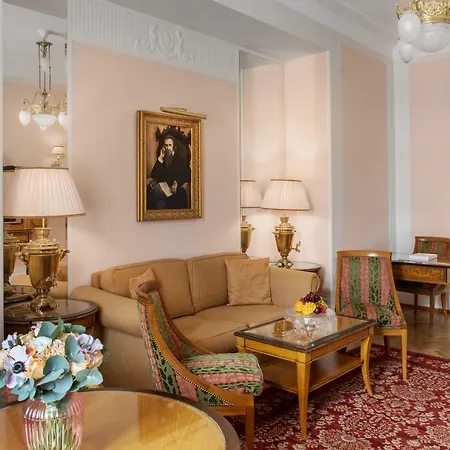
Grand Hotel Europe Saint Petersburg
11 Reviews and 281 Opinions I wish I could have described my stay here, but I only passed by almost every night. The building is...
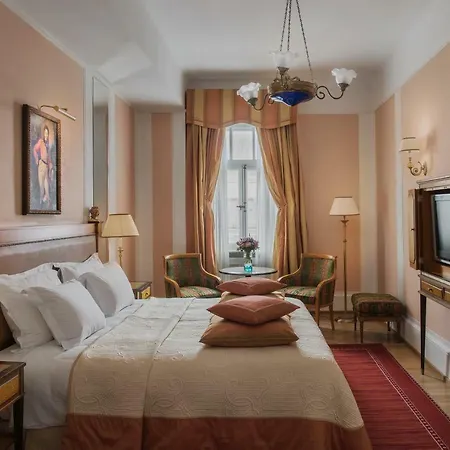
Casa Leto Saint Petersburg
1 Review and 57 Opinions Fiver spacious rooms with big windows right in the center near St. Isaac and Palace Square Old...
Sponsored Links
Comments