























Moscow’s Triumphal Gate or “Moskovskiye Triumfalniye Vorota” was built in 1838 according to project of famous Russian architect Vasiliy Petrovich Stasov. It took place during the rule of the Emperor Nicholas I who had the nicknames Emperor the Soldier or just Father the Commander. That’s why it was the time when the youth born in the noble families dreamed about the military service and war exploits. This gate was built to commemorate glorious victories of Russian Imperial Army in three military campaigns fought during the first six years of Nicolas I rule. These were the Russo-Turkish war of 1826-1829, Russo-Persian War of 1826-1828 and Pacification of Polish Insurrection of 1830-1831. There is the inscription in Russian “To Victorious Russian troops in remembrance of the exploits in Persia and Turkey and during pacification of Poland in 1826, 1827, 1828, 1829, 1830 and 1831”. There is the same inscription on the other side of the Arch but in Latin. The Arch decorated by the very fashionable in Russian Empire of XIX century elements of arms and armor in Neo Ancient Romano-Byzantine style. Angels hold the shields with the coats of arms of different provinces and cities of Russian Empire. This Triumphal Gate as the excellent example of classical military monument.
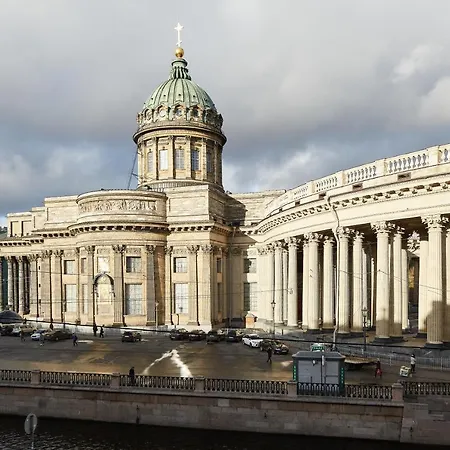
In front of the Kazan Cathedral is situated the monument dedicated to the heroe of Patriotic War of 1812: M.I.Kutuzov (1745-1813). Kutuzov M.I. - Grand duke Smolensky. an outstanding Russian military leader. General Field-Marshal, Suvorov's disciple, participant of Russian-Turkish wars. Under Otchakov Siege was dangerously shot through (from temple to temple behind both eyes). During the Patriotic War of 1812 was taking up a post of Supreme Commander-in-Chief of Russian army, which inflicted a defeat on Napoleon's army. Was buried in the Kazan Cathedral. The monument was opened on 25 of December 1837.
Rumyantzev an outstanding Russian military leader, count, General - Field Marshal. Took part in Seven-years war and seized the fortress Kolberg. In Russian-Turkish war won the battles under Ryabaya Mogiia. Larga and Kagul. The prominent military theorist. The architects Brenna V.I. and Rossi K.I. immortalized his victories: at first the monument was installed in 1799 on the Mars Field, and in 1818 transferred to Vasilyevsky Island. At the bronze plate in applied letters is written: "To Rumyantzev Victories".
This monument was created by the sculptor K. Izenberg and unveiled in 1911. The monument commemorates the heroic exploits of two sailors from the torpedo boat "Steregushchy" during the Russian-Japanese War. Even when sorrounded by the enemy navy, the sailors still prefered death to captivity: they went down to the hold and scutled the ship.
This monument to Catherine the Great was unveiled in 1873. The Empress was adored by the people of St. Petersburg for all her efforts to improve the life and education provided by the city and her reign has long seen been known as the "golden age" of Russia. The statue of Catherine is surrounded by delicately carved figures of the most prominent individuals of her reign: politicians and poets, military men and courtiers. The monument is located in the middle of a small, grass-covered square, just off Nevsky Prospekt, which is lined by the Anichkov Palace, the Alexandrinsky Drama Theater and the Russian National Library. As one of the country's most enlightened monarchs, Catherine could not have chosen a better spot herself.
The monument was designed by the Russian artist M.O. Mikeshin and created by the best sculptors and architects of the day. Catherine the Great is dressed in her official gown and holds a scepter in her right hand and an olive wreath in her left hand. The pedestal is decorated with the symbols of royal power.
Ostrovskiy square - the square in the Central District of St. Petersburg in the historic city centre. Here converge Nevskiy avenue, Zodchiy Rossi street, Malaya Sadovaya street, Krylov lane. The square is an architectural ensemble, which was made according to the project of the architect Carlo Rossi in the 19th century. There are historical and cultural monuments of federal significance on the square: Alexandrinskiy theatre, National Library, Anichkov Palace, the monument to Catherine ÉÉ, the building of the Ministry of Education and the building of the Directorate of Imperial Theatres in Zodchiy Rossi Street, the building of the St. Petersburg Municipal Credit Society. Despite the fact that Rossi failed to embody the whole concept, the ensemble of Ostrovskiy Square remains one of the highest achievements of Russian architectural art. As part of the historic buildings in the downtown of St. Petersburg the square is included in the World Heritage List.
Since perestroika by the fence of Ekaterininskiy Garden (from outside) - mainly in the area along Nevskiy avenue - St. Petersburg artists have exhibited and sold their work, and also painted portraits of those who desire (including friendly jests). By the entrance in the garden, photographers invite visitors and guests to take a picture at the foot of the monument, together with costumed characters in the aspect of Catherine ÉÉ and one of her favorites. Ekaterininskiy gardens, “Katya’s garden” - a meeting place for gays since imperial times. They meet in front of the monument to Catherine. There are chess-lovers gather on the benches in the park around the monument.
Memorial sign "Moscow Gate" (Russian: Памятный знак "Московская Застава") is interesting sign/monument near Moscow Triumphal gate.
Authors was architect V. M. Rivlin and sculptor J. J. Neumann. This monument was officially revealed to public on 27th May 2003.
Many cities in former Soviet Union had statues and monuments of Vladimir Ilyich Ulyanov, the revolutionary and leader of the Russian SFSR. After ideology changes with dissolution of huge country 1991, many of them were remouved. This happened even earlier in the European post-Communist states and in the Baltic states. However, in many of the former Soviet Republics (namely Russia, Belarus and Ukraine) many remain, and some new ones have been erected. One of them is this statue near Victory square.
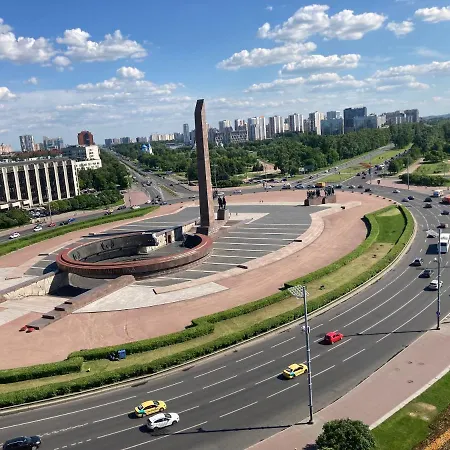
Monument to the Heroic Defenders of Leningrad (Russian: Памятник героическим защитникам Ленинграда) is located on Victory square. In the center of square and commemorative complex is a 48m-high granite obelisk also and its most dominated part. The obelisk is surrounding with several sculptural ensemble of bronze statues of soldiers, workers and civilians symbolizing the resistance during 900 days Siege of City (from 8th September 1941 till 27th January 1944). On the obelisk is Inscription 1941-1945 in gold and two 7m high sculptural group called "The Victors" on granite pedestal and symbolizing the inseparable ties between the army and the people.
Behind the large obelisk, into the center of the center of inside circle smaller monument to civilians symbolizing the breaking of the siege. Quiet music plays in this part of the monument, setting the ambiance - it was Holy War and Shostakovich's Seventh Symphony .
The Blockade Museum, with its interesting mosaic walls is located underneath the square.
There’s quite a bit of Soviet legend attached to this station. It was here that Lenin returned from exile in April, 1917, in a sealed carriage drawn by a train that was a gift from Finland. The train is displayed here in a glass pavilion. Out front, there is a majestic statue of Lenin pointing the way to a radiant future. On April 01 2009 vandals used TNT to blow a great big hole through the back of his coat, but he's since been repaired and is back to the good ol' stoic optimism. At the entrance to the adjacent metro stop there is also an impressive mosaic of Lenin.
The Moscow Triumphal Gates (1834-38) were erected in the memory of the Russian victory in the Russo-Turkish war of 1828. At first, city leaders planned to place the triumphal gates by Obvodny Canal but as the city limits expanded further to the south the site for the gates was moved to the intersection of the Moscow highway and the Ligovsky Canal. In this way, the gates not only became a triumphal structure but also an impressive gateway into the Imperial capital.
Two guard posts, which served as posts for century guards were also erected on both sides of the highway at the entrance to the city.
Famous Russian classical architect Vasily Stasov designed the Moscow Triumphal Gates. In fact, he originally developed two different designs for the gates before a life-size model of one of the designs was erected, and the project was confirmed on September 14, 1834. In the following year, Russian classical sculptor Boris Orlovskiy who also created the Kutuzov and Barclay de Tolly monuments in St. Petersburg between 1828-36, developed models of the sculpture details of the gates including war trophies and figures of geniuses.
Cast iron was selected as the chief material to be used in building the gates. The castings for the ends of the columns and walls located above the cornices, the forging from the sheets of copper sculpture details including the figures of geniuses, trophies and upper parts of the columns were produced at a local factory. The cast iron blocks for the columns were also cast in another local factory.
Each column was comprised of nine separate blocks together with the trunks and upper units of the columns. In fact, all 12 columns weighed approximately a combined 450 tons. The first column was erected on July 14, 1836. The gates were opened two years later on October 16, 1838. At that time, the Moscow Gates were the largest structure in the world made of cast iron.
The monumental portico made of powerful columns symbolized the greatness and glory of the Russian army. The war victory theme was further underlined with the sculpture compositions of war trophies of signs and weapons.
Moreover, the use of a frieze of 30 sculptural figures of genius made from copper sheets according to seven different models in the Moscow Triumphal Gates was considered an architectural innovation of the day.
Perhaps echoing the essence of the Russian army victory itself, the main concept behind the gates was raw and simple power. This concept is also inherent in most of Stasov's designs in St. Petersburg including the Lenenergo building (1817-21), the Trinity (1827-29) and Troitsky (1828-35) cathedrals and the Narva Triumphal Gates (1827-34).
Due in part to the artificially raised foundation, the Moscow Triumphal Gates tower over the immediate surrounding area, and their strict and concise silhouette can be seen from a great distance.
On a par with the high art meaning of the architectural concept, one can also see the great talent of Stasov in the monument. Indeed, he managed a very difficult task in creating the unique memorial, which also bore witness to the high level of Russian construction techniques and casting at the time.
The Moscow Triumphal Gates fate has been uniquely tied to the history of the city. In the period of Stalin's concentration of power over the Leningrad leadership, the historic and symbolic gates were dismantled in 1936. And in 1941 when the Nazi's approached the outskirts of Leningrad, in a testament to the city's great resourcefulness the cast iron blocks of the gates were used in creating an anti-tank defensive structure near the southern border of the city which would help repel the Nazi's during the blockade. Finally, after the war had been won and the city was rebuilding, the gates were restored to their previous grandeur in the period 1958-60. A group of restorers led by architect I. Kaptsyug managed to replace most of the lost sculptural details of the monument. Moreover, the new columns, friezes and cornices were cast anew at the local Kirov factory.
Sponsored Links
Hotel Astoria Saint Petersburg
11 Reviews and 186 Opinions Five star accommodation caters to the foreign visitor. For regular tourist it also has some...
Grand Hotel Europe Saint Petersburg
11 Reviews and 283 Opinions I wish I could have described my stay here, but I only passed by almost every night. The building is...
Casa Leto Saint Petersburg
1 Review and 58 Opinions Fiver spacious rooms with big windows right in the center near St. Isaac and Palace Square Old...
Sponsored Links
Comments