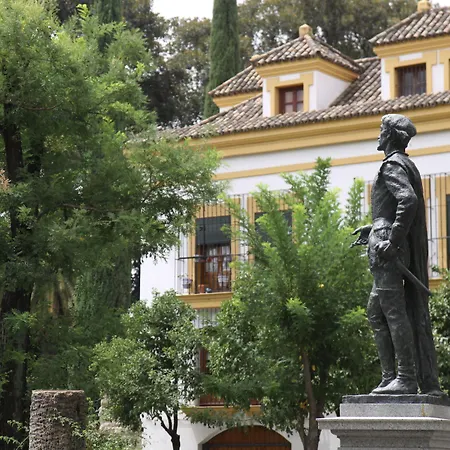
If there's one thing the Spanish know how to create it is beautiful parks, and the María Luisa park is no exception to this.
Even though it is located next to a busy street, as soon as you enter it you feel completely at peace. It has several beautiful buildings as well as a small island of birds where you can see a few birds, including peacocks. They even sit in the trees.
This park is huge and one of the most beautiful in Europe. We spent quite a few pleasant hours here exploring the buildings and gardens.
Originally it belonged to the Palace of San Telmo and was donated to the city by the Duchess of Montpensier, the Princess Maria Luisa Fernanda de Orleans in 1893. The park wasn't really incorporated to the city until Seville took the management of the Iberoamerican Exhibition of 1929.
The Plaza de España is one of the park’s most popular attractions and was the centerpiece of the expo. There is a moat that has four bridges across it. The palace has two large towers and there are sections with benches with beautiful tile work (azulejos) that represent each of the provinces of Spain. In the center of the plaza is a very large and beautiful fountain. The Spanish like to be photographed at the benches of their provinces.
At another end of the park is the Plaza de America, which is also called the Plaza de las Palomas (Plaza of the Doves) because of the many doves that live there. It has many fountains, ponds, and gardens. There is a beautiful Mudejar building called the Pabellon Mudejar, which contains the Museum of Popular Arts and Customs. Across from it is a neo-Renaissance building, which now contains the Archaeological Museum, famous for its Roman statues and remains from Italica, the museum being one of the best in the country. The museum also has the Phoenician statue of Astarte-Tanit, the virgin goddess.
Plaza de América, located in Parque de María Luisa, was also site of the Iberoamerican Exhibition of 1929.
Some pavilions were built in the park by Aníbal González:
Pabellón Real (Royal Pavilion), inspired in the Gothic style (pic 1).
Pabellón de Bellas Artes (Fine Arts Pavilion). Today it houses the Provincial Archaeological Museum (pics 2 & 3).
Pabellón Mudéjar, which houses now the Museum of Arts and Traditions (Museo de Artes y Costumbres Populares) (pic 4).
There are also other pavilions along the Paseo de las Delicias.
This park was donated to the city by Infanta María Luisa* in 1893. The terrain was part of the private garden of Palacio de San Telmo.
The park has an extension of 400,000 m2. Luxuriant vegetation and intimate arbors make a very pleasant place to walk.
The park was site of the Iberoamerican Exhibition of 1929. Plaza de España and Plaza de América are part of the park and were also sites of the Exhibition.
*Infanta Maria Luisa Fernanda de Orleans, Duchess of Montpensier, was the youngest daughter of Fernando VII and Maria Cristina de Borbón-Dos Sicilias. Her sister was Queen Isabel II. María Luisa married Antonio de Orleans, duke of Montpensier and son of King Louis Philippe of France. Antonio was elevated to the rank of Infante de España.
After some days in the city, it is nice to be surrounded by a bit of greenery - easy walking distance from Plaza de Espagna is the Parc Maria Louisa.
A large green area with lakes, trees, water fountains and birds the Parc is a very popular place filled with local families and tourists alike.
Both the Museum of Archeology and the Costume Museum are nearby on the Plaza de America. Both are worth a visit.
Good map here: http://photos-seville.com/south-east.php
Donated partly by Princess María Luisa de Orleans in 1893, her namesake park was previously the gardens of her palace of San Telmo. The large green area was landscaped by Jean-Claude Forestier, director of Bois de Boulogne in Paris, for the 1929 Ibero-American Exposition. Meanwhile, the various countries involved - Latin American and other associated nations, such as Morocco and Portugal - each built a "pavilion" for their exhibitions. Most built an edifice based on local architectural heritage, resulting in an amazing collection beautiful buildings. Seville itself built several edifices, including Plaza de España in a barroco-sevillano style, the Hotel Alfonso XIII and the Pabellón Mudéjar, both in a mudéjar revival style. The Expo of 1929 was meant to promote Seville and Andalucía and to bring them back on the global map. While the Expo was somewhat a success, it coincided with the Great Depression, which meant that its effect was mitigated in the years that followed. Still, Seville was left with an amazing collection of buildings now used either as consulates or museums. Attached is a photo of Pabellón de Portugal, built in the Macau-Portuguese style, and now used as the Portuguese consulate.
This stunning building was built for the 1929 Ibero-American Expo, a world fair which was held in Seville. It was built by Martin S. Noel in what is described a ‘Hispanish-American Neo-Baroque’ style. After the Expo the building was used as a high school and today is houses a dance school.
Parque Maria Luisia was named after Princess Maria Luisa (Duchess of Monpensier) who donated part of the grounds of her home, the Palacio de San Telmo, to the city in 1893 to be used as a park. The grounds are made up of half a mile of Art Deco buildings, ponds and lakes, leafy shade trees, pretty flower beds and statues. The magnificent Plaza de Espana is in feature of the park. The white pigeons that you see were a gift by the Philippine peple for the 1929 Iberoamerican expo held in Seville.
Souvenir Sellers can be found around the park especially at the entrance near the Plaza de Espana.
This is a huge park close to the Plaza de Espana, and filled with trees, hills, fountains, statues, gazebos, etc. It's a great place to chill out and relax. Also, sometimes there are markets and events going on there - I went to a Medieval-themed market in the park.
We find this beautiful fountain in the centre of Maria Luisa park, by far my favourite park in Seville. It's made in ceramics, as almost everything in this historical park. It's a round fountain, with nice ceramics froggies sat down on the edge and a duck over a tortoise in the centre. This fountain comes from 1914, when the park was donated to Seville by the Montpensier family.
Encontramos esta bonita fuente en el centro del parque de María Luisa, con mucho mi preferido en Sevilla. Está hecha de cerámica, como casi todo en este histórico parque. Es una fuente redonda, con unas simpáticas ranitas de cerámica sentadas en el borde y un pato sobre una tortuga en el centro. La fuente es del año 1914, cuando el parque fue donado a Sevilla por la familia Montpensier.
Sponsored Links
Hotel Amadeus Sevilla
4 Reviews and 857 Opinions The location was stellar - maybe a 10-minute walk to Sevilla Cathedral. The hotel has a rooftop...
Alfonso XIII Hotel Seville Sevilla
19 Reviews and 438 Opinions No, we didn't stay there, but the classic beauty of the building and its perfect location make it,...
Melia Sevilla Sevilla
4 Reviews and 197 Opinions Great location to catch all the major sights of Madrid. Huge bathroom with his & her sinks...
Sponsored Links
Comments