
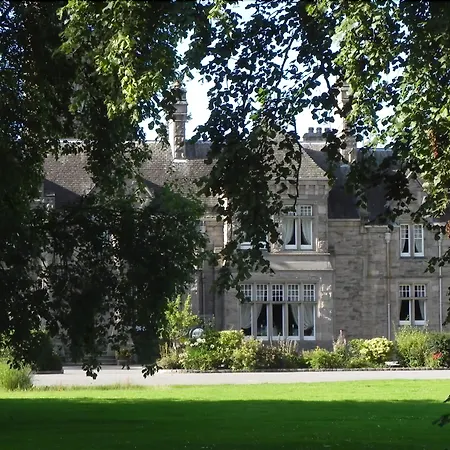
The cathedral is 13th century, and guide books describe it as one of Scotland's architectural triumphs. It was once know as the lantern of the north.
Badly damaged by fire in 1390, deliberately started by the Wolf of Badenoch as retaliation for him being excommunicated by the Bishop of Moray. Then the lead roof was stripped in 1576.
Take in the visitor centre.
Elgin Cathedral was first build in the early thirteenth century it was as is now a cross shaped building although much smaller. The fifteenth and sixteenth centuries saw rebuilding and extentions after the burning by the "Wolf of Badenoch" - Alexander Stewart - Earl of Buchan. The Earl was excommunicated by Bishop Bur and took revenge on the 17th. June 1390 when his band of 'Wyld Wykkyd Helendmen' decended on Elgin and burnt the Cathedral along with eighteen residencies of the Cannons and Chaplains. The Cathedral's final demise came with the Reformation of Parliament in 1560 when Catholic Mass was banned and the Pope's authority over the Scottish Church was rejected. Although some Cathedrals survived because they were also used as a Parish Church sadly Elgin was not so today all we see of "The Lantern of the North" is a magnificent ruin. Today the Cathedral is owned and managed by the National Trust for Scotland who restore and maintain this elegant ruined Cathedral.Click here to listen to the haunting tune of Highland Cathedral complete with lots of great views
Opening times 1st. April - 30th. September Monday - Sunday 9.30 - 17.30
1st. October - 31st. March Saturday - Wednesday 9.30 - 16.30 closed Thursday and Friday.
Quarry Woods is a perfect place to enjoy fresh air and nature, here there are miles of paths and trails for bikers and dog walkers. Lorna and I took the kids and the dogs through the spectacular Autumn colours, what a fantastic feeling walking on soft fallen leaves. The late, low afternoon sun provided some magic when it shone through the tall pines casting golden colours on the paths. Yes all would agree walking for us adults - cyclling for the kids and two dogs running around trying to see who could sniff the most trees!!
Johnstons of Elgin was established in 1797 by Alexander Johnson who by coincidence was born on a farm near to my house. He pioneered in the manufacture of tweed used for camouflage clothing for deer hunters. The original mill is still used today for manufacturing cashmere. To celebrate the mills 210th. Birthday in Autumn of this year Johnstons opened a Heritage Centre with a home and garden shop included. The centre is very interesting and educational, it tells the story of Johnston's history and its proud tradition on the manufacturing process of cashmere. The company aquire the cashmere from China and Mongolia where it is hand combed from the under belly of the goats by Nomads in spring time with each goat only producing 125g = Now I know why Johnstons woolens are so pricey but still world renowned. The home and garden shop is also worth a look = we just laughed at some of the prices especially the DEER Stag to grace your garden but you need a brace to make them look good!! You can also enjoy a coffee with homebakes too!
Elgin's town centre is a small pedestrian area, the High Street is split and runs along both sides with the middle area taken up by the triplets of the street. Some of the old architecture is interesting if you could view it without the shop signs such as 'The Tower' with its fine frontage. The middle section has a victorian water fountain and a war memorial. The classical building dominating the centre is Saint Giles Church built to replace the Cathedral in 1825 -8 - built on the site of the muckle kirk, it is the town's Parish Church, so different in style to any other churches in Scotland. Here in the High Street, you will find an assortment of shops, bars restaurants and cafes. A pleasant place to sit and watch the world go by.
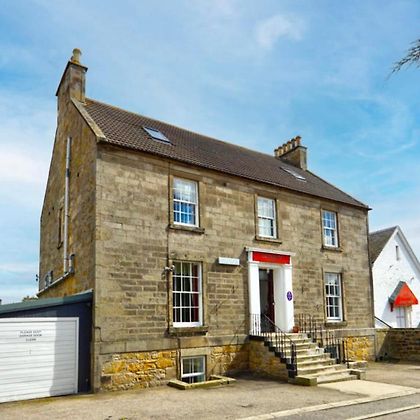
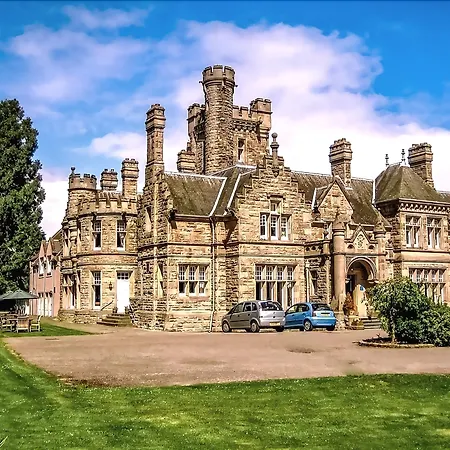
The Cathedral was ringed along King Street with eighteen houses used by the Bishop and Clergy back through the centuries. The so called Bishop's House is the only surviving building left here. The house probably survived the Reformation's destruction because it was not the Bishop's House but was the residence of a precentor, the dignitory in charge of Cathedral music. The gabled side of the building is stepped - the number of steps denoted the wealth of the person who had the house built. This building is owned and cared for by the National Trust for Scotland they plan for the future to turn it into a museum.
We parked the car in Cooper Park as the streets around the Cathedral were busy with tour buses. The weather was not good to say the least - frequent rain showers seemed to follow us around. When visiting with children stops at the public toilets are usually called for but this one in the park held a small surprise! The cost for your comfort stop is twenty pence - not a King's ransom - but when the barrier didn't work and we had to crawl under to gain access this caused much laughter all round when we realised we could have got in for free! Cooper Park is a well established wooded area with fine lawns and a pretty boating lake - a good place for a stroll or to let the kids run off some steam. I will be back here sometime and hopefully the weather will be kinder to let us enjoy all the park has to offer.
The Biblical Garden is set in three acres of parkland and was the first one of this type of garden to be established in Scotland. There are one hundred and ten different plants, trees and shrubs planted around a central path shaped in the design of a Celtic Cross. All the plants have been choosen because the are mentioned in the Bible. Continuing on the Biblical theme there are many statues and sculptures depicting the parables of the Bible. While we were in the garden the summer torrent of rain decided to join us - there is a small shelter here but it had a leaky roof - the kids enjoyed this part of our visit dancing around trying to get as wet as possible while we tried avoiding the rain drops. The garden is open May to September 10.00 till 19.00 entrance is free.
There's lots of history around Elgin other than the museum and the Cathedral. One can't help but notice the prominent column on Ladyhill erected in 1839 in memory of George, the 5th Duke of Gordon, but down in the town, aided by the excellent town guide from the tourist centre, the first thing that hits you is that building and a few others beside it that were the recipients of the first restoration project of the Elgin Fund in 1975.
Other highlights are Dr. Gray's Hospital, built with money accrued from the East India Company, the Thunderton Hotel, all that remains of what was once a Royal residence, 42-46 High Street show examples of the arcaded buildings for which Elgin is famous while over in Cooper park you can see the wonderful manor called Grant Lodge.
The Biblical Garden in situated on King Street, Elgin, just around the corner from the entrance to the Cathedral. The garden is open from May to September, between the hours of 10am and 7pm, daily and admission is free.
Nestling in a quiet corner of Cooper Park, close to the centre of Elgin and adjacent to the Cathedral, lies a piece of ground, some three acres in size, upon which has been established a biblical garden.
The creation of the garden, the first of its kind in Scotland, is appropriate on this site as Moray has, for over fourteen centuries played an important role in the development and changing fortunes of the church.
Whilst using the Bible as its reference point and including all one hundred and ten plants mentioned therein, together with sculptures depicting the parables, it is clearly intended that this garden as well as being of considerable interest to those who study the scriptures, will also encourage anyone who enjoys gardens and gardening, to visit.
Made possible by and reliant upon the generosity and goodwill of the people of Moray and its many visitors, the Biblical Garden provides a haven from the city.
Some ninety trees and shrubs, donated by school groups throughout Moray, have been planted within the garden. A desert area has been created depicting Mount Sinai and the cave of the resurrection and a marsh area has been included within the garden.
An impressive central walkway, requiring over one thousand textured paving slabs, has been laid in the shape of a Celtic cross. The garden, planted around the central cross with every species of plant mentioned in the Bible, also includes a number of life-size sculptures depicting various parables including the Good Shepherd and the Prodigal Son.
The backdrop to the garden features a striking trellis, which mirrors the design of the nearby cathedral and is covered in yellow, white and red roses. The plants are all cross-referenced to a particular passage in the Bible and an indication of their use in biblical times
Sponsored Links
Sponsored Links
Comments