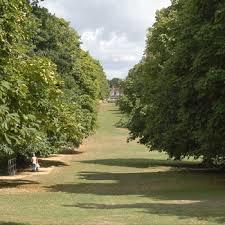
Broadway Gardens is a huge open space in the heart of Letchworth, with landscaped views down towards the station and out to the town edges, a rather lovely fountain, brick 'pagodas', neatly-trimmed box trees, a paved area for community events, oodles of space for picnics and for children learning to ride their bikes (or their scooters, or just learning to walk!).
The area was restored back to its original 100-year-old 'garden city' plan in 2003. Prior to that time the area had been called 'Kennedy Gardens' (presumably after President Kennedy) but I'm very pleased that centenary funding allowed it to be put back to what had originally been intended.
The original red-brick Town Hall (now out of use) looks out over Broadway Gardens.
You can read about the development of Letchworth as the world's first 'garden city' (and home to the world's first traffic roundabout!) on the Wiki page linked below.
Broadway gardens deserves a visit
Written Dec 24, 2012
Address: Broadway
Website: http://en.wikipedia.org/wiki/Letchworth
The famous Spirella corset factory building, built between 1912 and 1920, was way ahead of its time in the facilities if offered its employees: baths, showers, library, free eye tests.even bicycle repairs.
It's a listed building and has been well restored, now housing offices, a cafe and a fitness centre. The wonderful ballroom (a ballroom in a factory??) is hired out for weddings etc.
Updated Apr 4, 2011
Address: Bridge Road
This lovely thatched building was originally designed as the Letchworth Office for architects and planners Barry Parker and Raymond Unwin, by Barry Parker in 1906. Between 1907 and 1937 this building was the scene of much discussion and activity as the Garden City developed and grew. In 1937 Barry Parker added a new wing to form living accommodation for himself and his wife. In 1974 the house and garden were bought by Letchworth Garden City Corporation, and an extension on the South end was built as an exhibition gallery. In 1977 the building was leased to North Herts District Council and opened as the First Garden City Museum. The museum is home to an exhibition of photographs, maps, drawings and plans as well as objects of memorabilia relating to the early development of the Garden City and the Garden City Movement.
Open: 10am-5pm Mondays to Saturdays. Admission: 50p for Letchworth residents, £1 for non-residents.
Written May 21, 2009
Address: 296 Norton Way South
Designed and crafted by W.H. Cowlishaw in 1905/07 this unique building stood on its own in the fields until the residential housing spread this far in the 1920's. It was designed for and by Miss Annie Jane Lawrence as an open air school, for Theosophical Meditation. It was later used for outdoor concerts until the outbreak of the 2nd World War. After her death in 1953 the Cloisters was managed by a trust, and is presently the North Herts Masonic Lodge.
Written May 21, 2009
Address: Cloisters Rd
Innovation in Letchworth was not confined just to the design of buildings. During January 2005 "Sollershott Circus" (to give it its formal name) in Letchworth was recognised as having the first roundabout on a public road in the United Kingdom, dating from circa 1909 (there are two signs on the roundabout saying "UK's First Roundabout Built circa 1909"). This was probably inspired by the traffic system at the Arc de Triomphe in Paris, a city which was familiar to the town’s main architects, Parker and Unwin. When first built traffic could circulate around the central island in both directions. The more familiar rules of the road for roundabouts were not adopted until the 1920s.
Written May 21, 2009
This is Letchworth's most impressive building, located just over the railway line from the town centre. It was built between 1912 and 1920 for two Americans who were attracted to Letchworth by the Garden City Movement. This building was built for the Spirella corset company and offered its employees facilities such as baths and showers, gymnastics classes, a library. ballroom, free eye tests and bicycle repairs which were way ahead of their time. At one time in the 1950s the factory was selling thousands of corsets a day and employed 2000 people, and had customers as famous as Marilyn Monroe and Mae West. During the 2nd World War the factory was used by local firms Irvin Aerospace (parachutes) and British Tabulator as extra space for manufacture. The company closed in 1986 and after being sublet as small office and industrial units for a time, was restored for modern office space and a fitness centre.
Written May 21, 2009
Norton Common is located just to the north of the town centre over the railway line and lies to the west of Norton village - one of the three original villages which were absorbed into Letchworth Garden City. The 25 hectare (63 acres) common was designated as a 'People's Park' in the early plans for the town. Keep an eye out for the famous "wild" residents - the black squirrel, a genetic variety of the imported grey, first spotted in 1944.
Written May 21, 2009
This building was once Letchworth's famous Skittles Inn which was opened in 1907. It was famous for not actually selling any beer and became known as the 'pub with no beer'. Instead it offered 'fellowship, rest and recreation' for workers but all drink served at the bar was non-alcoholic, in response to the wishes of the majority of Letchworth residents. In 1925, The Skittles Inn became The Settlement, a centre for adult education and local activities.
Written May 21, 2009
The church hall for The Free church was built by the congregation in 1905. Before this they met in member’s homes or vacant workmen’s huts. The Hitchin Free Church Council encouraged the new residents of Letchworth to raise money for a hall and a site was found and secured. Many of the new arrivals being in the building trade volunteered their spare time to construct the first Church Hall of The Free Church, with very little funding. Starting with the stone laying ceremony by Rev F B Meyer and Ebenezer Howard on August 5th 1905, it held its opening service on October 17th 1905.
Written May 21, 2009
This building was the first public building in Letchworth, built in 1906, and was paid for by public subscription in memory of Ebenezer Howard's first wife Elizabeth, who died in 1904. It was first used for all social events and meetings before being extended to accommodate a girls club in 1907. The building housed the first Letchworth Parish Council Meetings, and then from 1919 until 1934 the Letchworth Urban District Council used the hall for many of its meetings. In 1983 the building was still in use for meetings, and a variety of youth and community oriented projects were based there.
Written May 21, 2009
Sponsored Links
1 Review and 53 Opinions There is only one hotel in Letchworth itself, and it's the Broadway. It is situated in the town...
Sponsored Links
Comments