The majestic Corinthian columns of the pronaos (front portico) of the Cella of the Temple of Artemis are the iconic symbol of Jerash. Twelve 16-metre columns topped by intricately carved Corinthian columns once held up the non-extant pediment of the temple, and all but one of these twelve columns are still standing, while two are missing their capitals. Unfortunately, none of the remaining columns that encircled the Cella remain. Those that are left standing, however, are enough to impress even in their current ruined state, but would have been much more astonishing, especially as the worshipper walked up the monumental steps leading to the temple. Interestingly, one of these columns can be found thousands of kilometres away, in the Flushing Meadows park in Queens in New York City! It was donated by Jordan to the USA in 1965 at the World's Fair.
The Cella (inner sanctuary) of the Temple of Artemis was built on a raised platform, towards the western end of the courtyard Temenos, with steps leading into the pronaos and the interior. It contains the iconic symbol of Jerash, the majestic Corinthian columns of the pronaos (described in a separate tip). Much like the rest of the temple, the Cella was left to decay after the Christianisation of the Roman Empire, and it was partially destroyed in the earthquake of 749 AD. Thereafter, the Cella remained abandoned until the early 12th century, when Zahir al-Din Toghtekin, the ruler of Damascus, turned it into a fortress to enhance defences against the Crusaders, but Baldwin II of Jerusalem defeated him in 1121 AD and burnt the temple-fortress. Fortunately, the fire was not enough to completely annihilate the structure, leaving us with one of the most beautiful edifices in Jerash.
According to guidebooks, there are a few other excavated churches within the archaeological site of Jerash - some with mosaics - beyond the ones I've written about on this page. Unfortunately, I had a hard time locating them initially, and by the end of my visit I had run out of time. In addition, I came across countless other ruins that were not identified by a sign or in guidebooks, but many of them were little more than a foundation, and the odd column or column base - see the attached photos for examples. There are also a couple of ruins outside the archaeological site, including tombs, churches and the city walls, some of which are interspersed within the new town of Jerash. I hope to return again one day to further explore these ruins, and hopefully by then more of the unexplored terrain will have been excavated.
Beautifully preserved, the colonnaded Cardo Maximus of Gerasa was the main north-south thoroughfare of the city. It connected the North Gate with the Oval Plaza, beyond which rose the Temple of Zeus, and was intersected by two decumani, the east-west streets. Arched Tetrapylons stood at the point of intersection between the Cardo and the two decumani, but only the north Tetrapylon has survived intact, whereas only the four bases of the southern one remain. Bordering the Cardo Maximus were many shops and also some of the most important edifices in Gerasa, including the Temple of Artemis, the Macellum, and the Nymphaeum in Roman times, the Cathedral in Christian times, and the Omayyad Mosque in Islamic times. Astonishingly, most of the columns in the colonnade are still in place, as is the stone paving where the ruts of carriages are visible to this day. The colonnade was laid out between 39 AD and 76 AD, in the Ionic style, but in the following century the portion between the two Tetrapylons was enlarged and remodelled in the Corinthian style. A walk up the 800 metre length of the Cardo Maximus of Gerasa is obligatory upon the visit to Jerash as it helps the visitor visualise the splendour of this city in its heyday.
For more photos, take a look at the travelogue: "The Cardo Maximus."
Although some stone carvings remain, the interior of the Cella of the Temple of Artemis is rather plain. This is because the marble covering the walls was removed or destroyed long ago, along with the altar containing a large statue of the goddess Artemis. The only decorative elements that remain are a couple of "Syrian niches" and the carved aedicules around them. The back wall of the Cella with its double arches is probably from the 12th century conversion of the Temple into a fortress by the ruler of Damascus, Zahir al-Din, in his wars with the Crusaders.
One of two great temples in Jerash, the Temple of Zeus dominates a hill overlooking Roman Gerasa. It is dedicated to the Hellenistic god Zeus, one of the two patron gods of the city who was equated with Roman Jupiter and Semitic Haddad. The structure that has survived to this day, albeit in ruins, was completed in 162 AD as a replacement to a first century AD Roman temple, which in turn had been built on the site of an older Hellenistic temple. Prior to the arrival of the Romans, the Hellenistic temple had served as the Acropolis of Gerasa. Some of the stones used in the construction of the Roman temple are thought to have belonged to these predecessors. In the last Roman construction, a staircase provided access from the Oval Plaza to the Temple, which consisted of a Temenos (sacred enclosure), built over a raised platform, and a Cella (inner sanctuary, or the temple itself) on the highest level of the Temple. The temenos was supported below by dark vaulted corridors, which nowadays host a small exhibition dedicated to the Temple of Zeus and other monuments in Jerash. The main attached photo shows a model of the Temple of Zeus in its heyday on display at this exhibition, while the fifth photo shows the actual ruins of the temple today.
Different aspects of the Temple of Zeus are described separately on this page, while the travelogue "Temple of Zeus" shows more detailed photos.
As was customary in temple architecture in the Roman east, a spacious walled courtyard (the Temenos) surrounded the Temple of Artemis. This was a pagan Semitic tradition that was woven into Roman architecture in the Eastern Mediterranean and is rarely seen in the Roman West. The Temenos of the Temple of Artemis was accessed via a grand staircase from the Cardo Maximus and was the terminal point for religious processions honouring Artemis, the patron goddess of Gerasa. This title was shared with Zeus, but some historians believe that the Roman population of the city would have preferred Artemis (equated with Roman Diana), while the Hellenised and Nabataean inhabitants would have more likely followed the cults of Zeus and Dionysus (Dùshara), respectively. Sacrificial ceremonies honouring Artemis took place here, in this Temenos, the open space with a sacrificial altar, surrounded by colonnaded porticoes on all sides. Many Corinthian columns from these porticoes remain upright to this day, and, astonishingly, most of those on the back side of the temple are still partially buried in the sloping ground, waiting to be excavated.
Overlooking the Cardo Maximus, this was the grandest Propylaeum in Gerasa. It provided access to the monumental stairway which led up to the second monumental entrance of the Temple of Artemis, the patron goddess of Gerasa who was equated with Roman Diana and Semitic Astarte. The second entrance, which has not survived, led into the Temenos, the sacred enclosure of the temple. The intricately carved Propylaeum was built along with the rest of the complex in 150 AD. In pre-Christian times, a colonnaded processional way led from this point eastwards over a bridge and into the residential quarters of the city (now modern Jerash), but this road was blocked by the construction of a church (now referred to as Propylaeum Church) after the Christianisation of the Roman Empire. Prior to that, the most important religious ritual in Gerasa would have been the procession honouring Artemis and the sacrificial ceremony that followed in the Temenos of the Temple. Although the Propylaeum has suffered some damage over the years, much remains standing and provides a glimpse of its original extravagance.
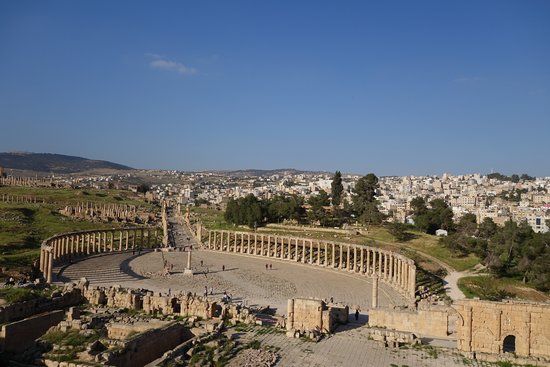
Unique to Jerash, this impressive oval-shaped plaza lies below the Temple of Zeus and marks the southern end of the Cardo Maximus. It measures 90 metres in length and 80 metres in width and is surrounded by a colonnade of 56 Ionic columns. The ground is paved with limestone in a pattern that traces the oval shape of the Plaza. It is thought to have been constructed in the first half of the 2nd century AD, but its function has been debated. Initially, it was believed to be the Agora or Forum (i.e. marketplace), but most historians now agree the Oval Plaza was an extension of the Temple of Zeus, where religious processions would have arrived after traversing the length of the Cardo Maximus and before entering the enclosure of the Temple. It also served as an aesthetic solution to the challenge posed by the misalignment of the Temple of Zeus with the Cardo Maximus. The best views of the Oval Plaza are from the highest terrace of the Temple of Zeus.
Dedicated to Saints Cosmos and Damianus, this church is the northernmost of the Three Churches. Its outer walls are intact (or have been rebuilt), which made it easy to block access to the church to protect its wonderful and nearly complete mosaic floors. They contain human and animal depictions, along with floral and geometric motifs. Luckily, it is adjacent to a hill, from which one can admire the full mosaic floor. According to an inscription, it was built in 533 AD and funded by many local donors, some of whom are depicted in the mosaics (such as a certain Theodore and his wife Georgia).
For more photos, take a look at the travelogue: "Mosaics of Saints Cosmos & Damianus".
Comments