Pamukkale Favorites

  Great spot for a photo!
by balhannah
 
  • Great spot for a photo!
      Great spot for a photo!
    by balhannah
  •   Favorites
    by Tuna_ank
  •   Favorites
    by Tuna_ank
  • Hierapolis map
      Hierapolis map
    by Kuznetsov_Sergey
  • Hierapolis map
      Hierapolis map
    by Kuznetsov_Sergey
 

Most Recent Favorites in Pamukkale

Photo"s
balhannah profile photo

3.5 out of 5 starsHelpfulness

balhannah 7581 reviews
Great spot for a photo!

Favorite thing: At the bottom of the "Cotton Castle " on the edge of the road, is a nice pond, with some Ducks. Its in Town, to the left of the Entrance. Its a nice spot to get a good reflection photo of the Terraces, and yourself sitting in the front. There is a seat there for you to sit on.

Written Jul 13, 2009

Related to:
 Photography

Was this review helpful?

Pamukkale general background
Kuznetsov_Sergey profile photo

4.5 out of 5 starsHelpfulness

Kuznetsov_Sergey 4507 reviews
Pamukkale
4 more images

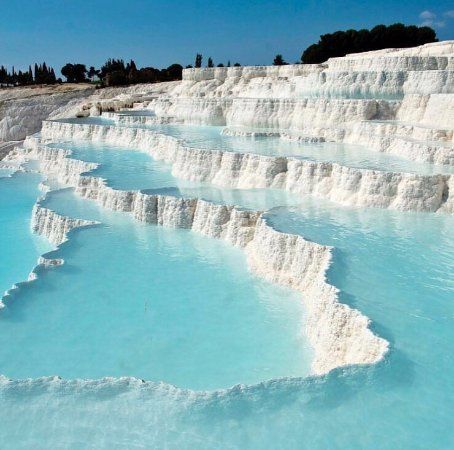
Favorite thing: Pamukkale means "cotton castle" in Turkish. It is a natural site and attraction in south-western Turkey. The ancient city of Hierapolis was built on top of the white "castle" which is in total about 2700 meters long and 160m high.

The tectonic movements that took place in the fault depression of the Menderes river basin triggered frequent earthquakes, and gave rise to the emergence of a number of very hot springs. The water from one of these springs, with its large mineral content - chalk in particular - created Pamukkale.

Today Pamukkale is a famous tourist attraction. It is recognized as a World Heritage Sites together with Hierapolis.

Updated Jan 19, 2009

Related to:
 Spa and Resort

Was this review helpful?

Hierapolis Modern history
Kuznetsov_Sergey profile photo

4.5 out of 5 starsHelpfulness

Kuznetsov_Sergey 4507 reviews
Our tourist group and guide Mohammed
4 more images

Favorite thing: Hierapolis was first excavated by the German archaeologist Carl Humann (1839-1896) during the months June to July 1887. His excavation notes were published in his book "Altertümer von Hierapolis" in 1889. His excavations were rather general and included a number of drilling holes. He would gain fame for his discovery in Pergamon of the Pergamon Altar.

Excavations began in earnest in 1957 when Italian scientists, led by Paolo Verzone, began working on the site. These studies still continue. A restoration of the site has begun. For example, large columns along the main street near the gate named after Domitian, which were toppled by the earthquakes, were erected again. They also unearthed a number of houses from the Byzantine period, including an eleventh century courtyard house.

Many statues and friezes were transported to museums in London, Berlin and Rome.

Written Dec 20, 2008

Related to:
 Archeology
 Historical Travel

Was this review helpful?

Historical Hierapolis background
Kuznetsov_Sergey profile photo

4.5 out of 5 starsHelpfulness

Kuznetsov_Sergey 4507 reviews
Hierapolis
2 more images

Favorite thing: Hierapolis means in Greek: 'holy city'. It was the ancient city on top of the famous Pamukkale hot springs. Now Hierapolis is a UNESCO World Heritage Site.

It's called Hierapolis because of its Mother goddess Cult.
Information about Hierapolis is limited. There are only a few historical facts known about the origin of the city. It is known that the king of Pergamum, Eumenes II, founded the city in 190 BC. It was named Hierapolis after the Amazon's Queen Hiera, the wife of Telephos, the founder of Pergamum. (Pergamum is also called Pergamon or Pergamos).

Hierapolis was completely destroyed by the earthquake in 60 A.D. during the time of Roman Emperor Nero. During the reconstruction after the earthquake, the city lost its Hellenistic Style and became a typical Roman City. Right after the Roman period started, Hierapolis became an important center because of its commercial and religious position. In 80 A.D. St. Philip came to Hierapolis and was murdered by the Jewish inhabitants.

Hierapolis was conquered by the Turks at the end of the 12th century A.D.
Learn more here.

Written Dec 20, 2008

Related to:
 Historical Travel
 Archeology

Was this review helpful?

Cotton Castle
miman profile photo
miman 247 reviews
Pamukkale

Favorite thing: Pamukkale, meaning "cotton castle" in Turkish, is a natural site and attraction in south-western Turkey in the Denizli Province. The ancient city of Hierapolis was built on top of the white "castle" which is in total about 2700 meters long and 160m high. It can be seen from a great distance, eg. when driving down the hills on the opposite side of the valley to the town of Denizli, which is 20 km away. Pamukkale is located in Turkey's Inner Aegean region, in the Maeander River valley, which enjoys a temperate climate over the greater part of the year.
The tectonic movements that took place in the fault depression of the Menderes river basin did not only cause frequent earthquakes, but also gave rise to the emergence of a number of very hot springs, and it is the water from one of these springs, with its large mineral content, chalk in particular. Apart of some radioactive material, the water contains large amounts of hydrogen carbonate and calcium, which leads to the precipitation of calcium carbonate. The effect of this natural phenomenon leaves thick white layers of limestone and travertine cascading down the mountain slope, making the area look like a fortress of cotton or a frozen waterfall.
Pamukkale is a very famous tourist attraction of Turkey

Fondest memory: Here, in a landscape fascinating in its own right, the action of various mineral springs which contain calcium oxides has left fantastic concretions on the travertine structures. The resulting effect is spectacular: these mineral-rich waters have dripped down over a series of terraced levels designing bizarre solidified cascades, dazzling in their radiance and changing their color according to how the sunlight strikes them.

Written Jul 31, 2006

Was this review helpful?

ruins of Hierapolis
Tanechka profile photo
Tanechka 382 reviews

Favorite thing: The ruins of Hierapolis are the other main attraction. The city was founded in 190 B.C. by Eumenes II, king of Pergamon. In the 2nd and 3rd centuries, it reached the height of its development as a Roman thermal bath center.

Written May 14, 2006

Related to:
 Archeology
 Romantic Travel and Honeymoons

Was this review helpful?

snow or cloud or balls of cotton
Tanechka profile photo
Tanechka 382 reviews

Favorite thing: Pamukkale is located in the Inner Aegean region at a distance of 20 km from the town of Denizli. This lovely, rapidly developing district in the Menderes valley, which enjoys a temperate climate over the greater part of the year, has all the conditions required for an ideal touristic resort.

Written May 14, 2006

Related to:
 Singles
 Romantic Travel and Honeymoons

Was this review helpful?

Take off your shoes
Diana75 profile photo

3.5 out of 5 starsHelpfulness

Diana75 1519 reviews
Walking in Pamukkale
1 more image

Favorite thing: When you enter the basins you are informed that you should take off your shoes.

This is not only the best way to experience these unique sensations, but it also for protection reasons.

Unfortunately I've seen during my both visits there many persons walking with the shoes on which obviously didn't understood we are very lucky to enjoy this wonder but it's also our responsibility to protected it.

Updated Mar 28, 2006

Related to:
 National/State Park
 Archeology
 Historical Travel

Was this review helpful?

Pamukkale (Hierapolis) map
Diana75 profile photo

3.5 out of 5 starsHelpfulness

Diana75 1519 reviews
Pamukkale (Hierapolis) map

Favorite thing: Once you enter the site you are tempted to wander around by your own, but it's better to have at least a map of Hierapolis in order to be sure that you'll not miss the important parts.

In any case there is a board with a map located near the western entrace which helps you identify better the ancient buildings.

Updated Mar 28, 2006

Related to:
 Historical Travel
 Eco-Tourism
 National/State Park

Was this review helpful?

Swimming in 50 degrees celsius...
Maria_75 profile photo

3.5 out of 5 starsHelpfulness

Maria_75 808 reviews
In front is the 30 dg pool and the warmers above

Favorite thing: I'm sorry to say that I don't remember the name of the hotel we stayed at in Pamukkale. It was a small and very charming hotel, just a short busride from Pamukkale.

The hotel had four different pools, that all was supplied from the natural thermal water. In the first and highest pool the water was 50 degrees! The staff told us to take care and don't swim to much in that pool, because the blood could be so overheated that it would start boiling! I don't know if it was actually true, but they didn't really have to worry. The water was so warm that it was more than enough just to put one finger inside. I never say anyone try to go inside there.

The next pool was a bit lower and the water from the first ran into this one. Here it was about 40 degrees, but I didn't stay too many minutes inside of there... A bit lower than this one was the next, and biggest, pool. The water continued it's way down here, and the temperature was about 30 degrees. It was great to lie in this pool and watch the sunset!

In the lowest and last pool the temperature was about 20 degrees, but it felt much colder when you came from the other pools. But it was great to go a bit back and forth between the 20, 30 and 40 degrees pools. They also said it was good for the bloodsirculation. And the best of all is that the thermal water contains plenty of minerals that are good for the skin, and also for asthma, rheumatism, and other illnesses.

Some even say swimming in this water will make you look ten years younger, but I have still not seen the effects of that... ;)

Updated Oct 1, 2004

Related to:
 Historical Travel
 Spa and Resort
 Beaches

Was this review helpful?

Comments

Top 3 Hotels in Pamukkale

Koray Hotel Pamukkale

 5 Reviews and 67 Opinions  Arrived in Pamukkale as one person of a couple and another single friend. After unsuccessfully... 

 Hotels in Pamukkale

Show Prices

Melrose Allgau Hotel

 1 Review and 413 Opinions  The Melrose Allgau is a small hotel on the edge of Pamukkale's town. While it doesn't have the best... 

 Hotels in Pamukkale

Show Prices

Hal-Tur Hotel

 1 Review and 194 Opinions  This is a nice hotel, right across the street below the travertines, with an easy walk to the park... 

 Hotels in Pamukkale

Show Prices
Map of Pamukkale