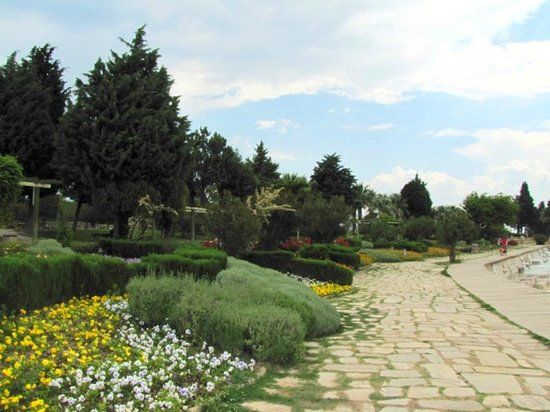
On the left side of the photo, you can see the well preserved theatre of Hierapolis. It has been relocated and renovated during centuries and its present state of ruin is still an impressive structure.
Updated Jan 29, 2012
It is a beautiful sight from distance (smaller than expected), the white mountain with the water running slowly downwards.
It is still pretty when you approach.
But don't be mistaken by the usual photos of people in the water: It's not a bathing area. The crowds follow the course of the water, here and there put their feet in a small natural pool, and it's done. And, with all those people it couldn't be otherwise.
Updated Oct 27, 2011
unfortunately,in the past,the site wasn't protected:many hotels dug swimming pools ,taking advantage of warm spring waters!
what was the result of it?
basins became dry...so the magic was gone!
spots began spreading and hiding the whiteness.(as in the pic)
finally,a plan of rescue made by unesco is restoring the natural site:all the hotels have been demolished!
and tourists may walk only in authorised basins!
it was high time!
nowadays,the cliff keeps scars from mass tourism:ancient and modern ruins stay side by side!
maybe,but it'll take a long time,natural whiteness will come back!
Updated Apr 4, 2011
Since we were staying the night in Pamukkale we had plenty of time to explore and relax. If you have the time, the travertines and antique pool are much more enjoyable later in the day. My wife almost had the pool to herself after the last tour bus left and we were the last ones on the travertines watching the sun go down.
While the antique pool is a great place to people watch in the afternoon, it would be difficult to navigate the masse of humanity that clamors for the seats on the sunken columns.
Written Oct 19, 2010
The hill has two entrance gates: The North Gate & the South Gate.
Generally, most visitors enter from the South Gate, as it is from this side that you can see the travertines right in front of you.
The North Gate is convenient if you want to head directly towards the Necropolis.
Pay for your ticket at the South gate, start walking up for a while till you reach the signs telling you to take off your footwear. This would be the section where you'll actually walk over the calcite-deposited surfac, with the white scallop-shaped basins of water and small waterfalls around you.
A great tranquil feeling, and a spectacular sight.
Updated Jul 19, 2010
The views of both the travertine terraces, and surrounding countryside is stunning & peace-inducing.
Due to water diversion in parts, for preservation of the mineral-rich terraces, not all the terraces have water in them.
Once, the whole area was under threat due to rapid proliferation of hotels in the vicinity that were diverting the waters for their own use (to attract guests). Now, the site is regaining some stability after the hotels were knocked down & removed.
Updated Jul 19, 2010
This is quite grand. At the bottom are statues of Apollo & Artemis.
You can just about make out the amphitheatre, at the rear right, as you arrive at the top of the travertines. It is certainly a fair walk!
The stones near the stage were marked with the official's name initials, so certain people sat on specific seats.
It's fun walking around the ruins, and figuring out how these huge stones were put together to form such a large structure.
From the top, the views of the surrounding landscape are far-reaching and delightful. Definitely worth checking out.
There are information boards at the rear, detailing the restoration project over the years.
The restored Roman theatre dates back to the 2nd century, and the stage buildings and elaborate reliefs are in exceptionally good condition.
Construction began in 62 A.D. by Flavius, two years after a large earthquake, and was completed in 206 A.D. It once had a capacity of around 12,000, and was adorned with columns and statues which were unearthed during excavations. There are marble bas-reliefs on the backstage walls.
The theatre is still the venue for the annual International Pamukkale Song Festival in June, during which 7000 spectators can be seated.
Updated Feb 28, 2010
Address: Top of Cotton Castle!
This pool is at the top north entrance of the Pamukkale travertines, at the entrance to Hierapolis. We were there in April, so we didn't see the hords of other bathers that appear in some photos. There were maybe four people including us in the pool, total. It is heated naturally by hot water springs and there are countless old Greek columns in it under the water. In fact, you really have to be careful to avoid banging your shins on them. A marble portico fell into the pool in an earthquake in the 7th century AD, and the bits were never removed.
There are ample clean and decent changing facilities and lockers available. It really is a super cool experience - one of the highlights of our whole trip.
Updated Feb 4, 2010
Address: Pamukkale Northern Gate Entrance, Denizli
Phone: + 90 (258) 272 20 44 / 272 24 6
Website: www.pamukkale.org.tr/eng
The ancient site of Hierapolis (190 BC - AD 1334) is just above the travertines. The ruins were fairly sparse but it was a good walk through wide open fields, there were some good photo opportunities, and we were practically the only people there.
Afterwards we took a dip in the very cool thermal hot springs.
Written Feb 4, 2010
Address: Pamukkale Northern Gate Entrance, Denizli
Phone: + 90 (258) 272 20 44 / 272 24 62
Website: www.pamukkale.org.tr/eng
These are amazing limestone formations on the side of a cliff, best seen at sunset. We had seen one of Rick Steves' travel shows in the early 90s where he came here and showed all the people swimming. They have changed since then; they have degraded. They do not look like they do in thousands of travel posters. There isn't much water left flowing down through them, and most of the pools are now empty. The natural pools on the main hill are off limits, which are the ones in the show and on the posters. There are other seemingly man-made concrete pools by the man-made path/road carved up from below. That said, they are still a sight you are unlikely to see anywhere else in the world, and worthy of a visit.
It is a UNESCO World Heritage Site, along with Hierapolis.
Updated Feb 4, 2010
Address: Pamukkale, Denizli
Phone: + 90 (258) 272 20 44 / 272 24 62
Website: www.pamukkale.org.tr/eng
Sponsored Links
5 Reviews and 55 Opinions Arrived in Pamukkale as one person of a couple and another single friend. After unsuccessfully...
1 Review and 337 Opinions The Melrose Allgau is a small hotel on the edge of Pamukkale's town. While it doesn't have the best...
2 Reviews and 330 Opinions Expensive and bad a otel not good
Reviews and photos of Pamukkale attractions posted by real travelers and locals. The best tips for Pamukkale sightseeing.

These are amazing limestone formations on the side of a cliff, best seen at sunset. We had seen one of Rick Steves' travel shows in the early 90s where he came...
2 members live in Pamukkale
Q: Hi, we are a group of 4 and we would like to go to Pamukkale during our trip to Turkey. I was able to buy a 2 way air ticket from...

A: okey i got the answer....:)) i thought it s the best way and i called the company for you. http://www.ismailbaytur.com/iletisim.html 41 43 denizli airport is about...
Read 3 Replies
1

Pamukkale, meaning "cotton castle" in Turkish, is a natural site and attraction in south-western Turkey in the Denizli Province. Hierapolis was the ancient city on top of the famous Pamukkale hot...
2
Pamukkale (Hierapolis) - The Cotton Castle

I've got some interesting experiences in Pamukkale. I'd love to share with you the 22 tips I've written, the 40 photos uploaded, and 0 travelogues I've created.
4

I remember the first time i visited Pamukkale, it was sunset and this made the place almost glow in the dark, this was an amazing sight to see. The locals call it the cotten castle and has been...
5

Take a trip to Pamukkale, 20 km from the town of Denizli, in the Inner Aegean region southwest in Turkey. The white, beautiful hills looks almost like a cottoncastle from a distance. In leveled...
Build your own Pamukkale page
Sponsored Links