Favorite thing:
The Poet Homeros and the Meles River
Illiad and Odyssey
Although Homer never mentioned the city in his legends, all through ancient time, Smyrna, like any other city during that time, claimed Homer’s citizenship to the city and built an altar, and respected him to the point of worship. The arguments Smyrnians put forward on the subject of where Homer was born are far more realistic than the claims put forward by other cities.
Connection with Smyrna seems to be alluded to in a legend that his original name was "Melesigenes" ("born of Meles", a river which flowed by that city), and of the nymph Kretheis.
The Meles River running through Smyrna is often mentioned both in myths about the establishment of Izmir and the myths about Homer. There are illustrations of the Meles River, in a human form, worshipped as a river goddess to be seen on some Imperial period coins. A translation of a poem found in Bornova on an inscription and then brought to Halkapinar is as follows.
"I say my prayers to Meles (Goddess of River) who is my saviour and who has protected me from dangers and epidemics".
We don’t know exactly which among the rivers those run into the sea in Bayrakli and Kadifekale is the ancient Meles. As the descriptions of Aristides and some other antique authors, "Many springs outside the city flowed into this river and took the shape of a circle. This river outside the city gates was so small that one could hardly see it at first glance. It ran into the sea at this point. The river was full of fish. It ran regularly all through winter and summer.
It was possible to travel by boat up to its spring. "Near the river's spring, there were various other water springs and a cave." As it can be seen there is no river near Ýzmir that satisfies these criteria. According to scientists, the Kemer/Uzundere brook or the Halkapýnar can be two rivers that could be identified with the Meles River.
Favorite thing:
Smyrna was built on the slopes of Pagos (present-day Kadifekale). Its remains are located within the urban zone of Izmir. Old Smyrna was located on a small peninsula connected to the mainland by a narrow isthmus at the northeastern corner of the inner Gulf of Izmir
Homer is said to have been born in Smyrna. A common and consistent tradition connects Homer with the valley of Smyrna and the banks of the Meles River.
You can watch my 4 min 15 sec Video clip Izmir Konak Slide-show with Turkish pop music by Ebru Gundes - Telafi.
Favorite thing:
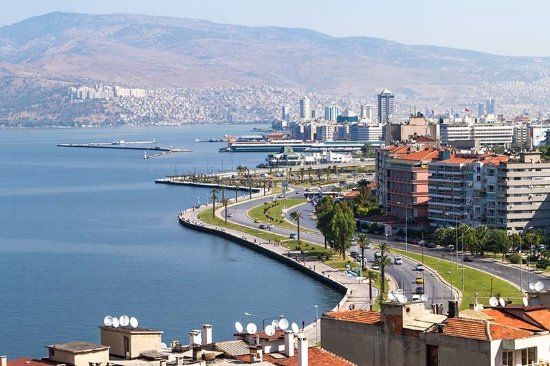
Izmir also has its Greek name Smyrna. Izmir is almost 3,500 years old. It has more than 3 million people and is Turkey's third most populous city.
Izmir was nearly destroyed by fire in September 1922. Izmir was badly damaged by earthquakes in 1928 and again in 1939.
So it has quite a modern view now without many ancient or medieval sights. May be that’s why tourist groups (like ours) usually make a short stop there before visiting other sites at the Aegean coast of Turkey.
You can watch my 4 min 07 sec Video clip Izmir Konak with Turkish pop music by Kenan Dogulu – Demedi Deme.
Fondest memory:
You may watch my high resolution photo of Izmir on the Google Earth according to the following coordinates 38° 25' 0.10" N 27° 7' 31.96" E or on my Google Earth Panoramio Izmir .
Favorite thing:
It’s almost impossible to see how Izmir looked like before the Greek-Turkish war. As an international port and trade center Izmir had always many people from other countries. The fire that broke out on 13 september 1922 is one of the big disasters of Izmir and destroyed a major part of the city. The city rebuilt after the proclamation of the Turkish Republic in 1923 but it was a completely different city because a city isn’t only the buildings but basically the people that live into.
Both countries have their point of view for that period and one accusing the other of committing atrocities but you’ve got to consider the lack of comprehensive and reliable sources from that period to be sure. After long conversions with Turkish people we have seen that both countries have more common things to share than the politicians like. That’s why after several trips in Turkey I have made some real good friends there. One of my favorite greek books is "Farewell Anatolia" written by Dido Sotiriou. It is a fine example of the era that both communities were living together till they "forced" to hate each other.
In the pictures you can see the greek and the german embassies in building that must be much older than the new ones next to them.
Favorite thing:
The statue of Kemal Ataturk is everywhere in Turkey but this one is very important for the people of Izmir. After the defeat of the ottoman empire in world war 1 the winners took back regions that Ottomans had before. Greece took some of the western regions of Turkey with the Treaty of Sevres.
On 1919 (15 of May) the greek army occupied Izmir but then the decision to go further inside Anatolia turned into a disaster for them. The end of the Greek-Turkey war at 1922 found Greece loose all regions there but the most important many local Greeks of turkey died or forced to seek refuge in Greece. Kemal Ataturk took back Izmir on 9 september 1922 and of course the local people of Izmir still celebrate about it(it’s the biggest celebration day in Turkey).
In 1923 after the proclamation of the Turkish Republic, because of Lausanne treaty the exchange of greek and Turkish populations took place and many people forced to leave their homes in both countries. The same old story, no one really cares about the people…
Favorite thing: We went to Izmir thinking it would be a good base to explore nearby Ephesus and the rest of the region. That was a mistake. It is just a big city with no real local charm. It is extremely difficult to get around without knowing Turkish or taking taxis which will rip you off. I would recommend you stay at a surrounding town like Selcuk rather then visiting Izmir.
Favorite thing:
Another important sight is the Roman agora, constructed during one of the most brilliant periods of the province. The seven churches mentioned by St. John in the Book of Revelation are also in Turkey and are spread around Izmir, which are Izmir (Smyrna), Efes (Ephesus), Eskihisar (Laodlkia), Alasehir (Philadelphia), Sart (Sardis), Akhisar (Thyatira and Bergama (Pergamum).
Fondest memory:
East Propylon, the east entrance to the Roman Agora had a row of four Ionic columns made of gray Hymettian marble. It was built in 19-11 B.C.
Favorite thing:
Karþýyaka is another attractive district on the opposite side of the bay, where the Olaf Palme Park exists near the open-air museum, which houses many interesting statues.
Fondest memory:
Open-air museum and interesting houses
Fondest memory:
It has not yet been possible to state with certainly the derivation of the name
Some researchers say that the name derived from Apasas a city of Ahhiyava. Other researchers maintain that the name derived either from the word meaning bee or the city was founded by the female Warriors, the Amazons. Another story is that Androcles, son of Codros, King of Athens, founded Ephesus. Ephesus was attacked by the Cimmerians in the 7th century BC got back on to its
feet again soon afterwards. The 6th century BC brought a prosperous period of
Ephesus. Later, Ephesus came under the rule of the Lydians and then under the
Persians. In 334 BC, Alexander brought dark days to Ephesus, which was ruled in
287 BC by Lysimachos. Most of the works of art seen today came into being during
period. Later on Ephesus came under the sovereignty of Rome, and Emperor Augustus declared Ephesus a metropolis. In the year 262 AD Ephesus was attacked and destroyed by the Goths and after this, it never regained its previous importance.
Favorite thing:
There was great counterversies during the construction of this shopping place.. The old fisherman stores has been restorated and becama a big shopping mall..
However it took a long time for it to start to operate.. Now Konak pier is serving its customers with deluxe shops, a fine food court and a big movie theater..
Just near the Konak square
Sponsored Links
Sponsored Links
Comments