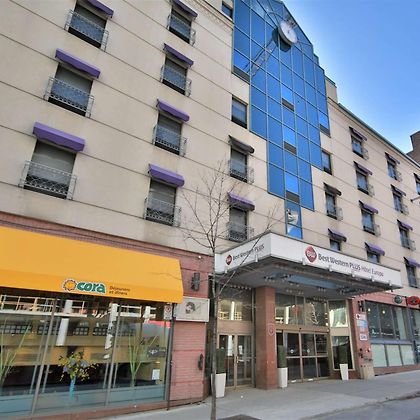
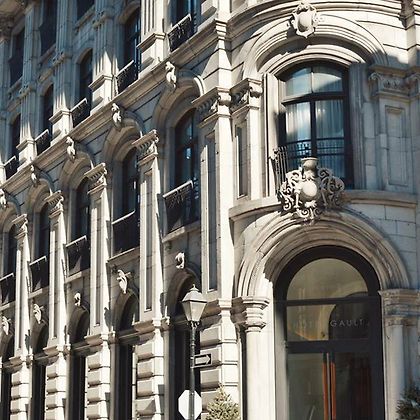
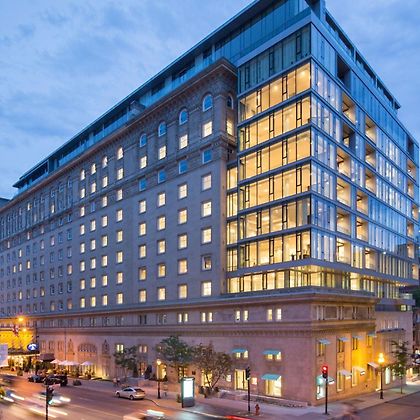
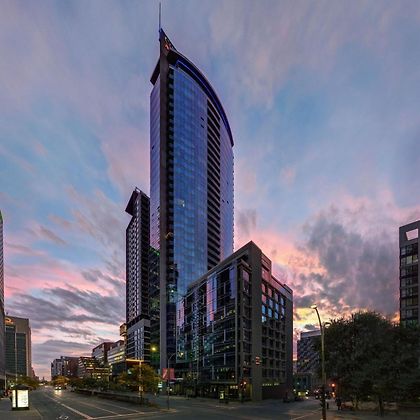
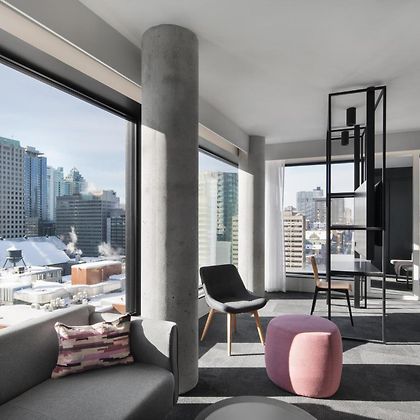
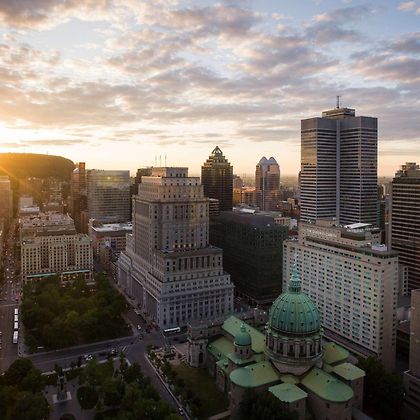
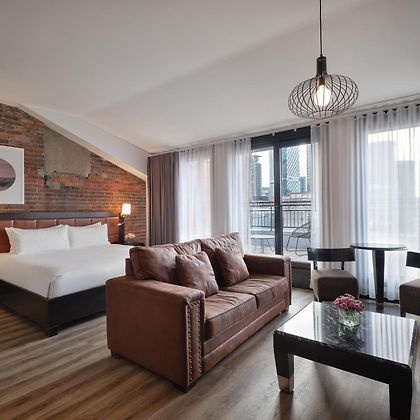
The central area of Montreal shows a perfect combination between historic and modern buildings. If I had to choose a place to live in North America, I think this would be my first choice. Harmony, quality of life, safety, and a natural blending of races and cultures, attracted me.
Was it a wrong idea, caused by the rushing visit? Maybe! And, of course, I know that I was there in summer, winter being another thing, but the solution of using the subterranean resources may help.
Updated Jan 19, 2011
Living under the ground is a spreading solution in the congested modern cities, but nowhere I found such an effective solution as in Montreal.
The numbers that the guide announced as the length of subterranean roads, parks and shops, are smashing. And we could confirm for ourselves the good integration between the road system, the metro, and the big buildings that, despite their elevation, start living from several floors below ground level, with responses to all the commercial needs. Wise solution!
Updated Jan 17, 2011
I had heard about the underground city in Montréal and always wanted to see it. It lies parallel to the main shopping street in down-town Montréal, St. Catherine's Street, with a mindblowing 120 entrances, f.ex. from several stores and shopping malls in St. Catherine's Street.
Now, the underground city is made in that way that you can take the metro close to your home and can exit the metro in the underground city as there are 7 metro stations there and a bus terminal. This is so hard to imagine but must come in very handy during the very cold winters in Canada.
The underground city has over 32 km of tunnels with shops and restaurants and connections to the shopping malls in St. Catherine's street - making it the largest underground complex in the world so it is well worth a visit.
Montréal is often called "The Double-Decker city" - now we know why.
Updated Jun 14, 2010
The main shopping street in down-town Montréal is Rue Saint-Catherine with its myriad of shops and cafés and churches. It is 11,5 km long so you can imagine that there is a lot going on in this street. And it also lies parallel to the underground city which can be reached from this street (see my next tip)
I have only been there twice, once only with the purpose of shopping - and I will be back there again. It has got a pure cosmopolitan feel to it, truly buzzing with life.
Updated Jun 14, 2010
Address: St. Catherine's street, Montréal
I just came back from a 4 week trip to Montreal to improve my French. I did a lot of research before I went and ended up booking with www.frenchinmontreal.com. What convinced me is that they partner with YMCA, because YMCA has such a good reputation.
I did a intense French course for 6 hours a day at the YMCA language school downtown. I liked that my class had only 10 students. This way I got to learn a lot. Also they offer 6 levels of French, which was good because I spoke some French already. I stayed with a host family. Being in a family was great, because they showed me around and I got the chance to practice my French with them. Being at the YMCA was also good because a fitness membership was included and I met many people that way.
I shopped around for a while to get the best deal. I paid C$ 874 for the French course and C$616 for the accomodation in the family. If you are looking for a good French school in Montreal, I can definitely recommend www.frenchinmontreal.com.
Written Apr 13, 2010
Address: YMCA Language School
Website: www.frenchinmontreal.com
Montréal is a city that should be explored not only for its vibrant nightlife, its bicultural flavour and its numerous cultural institutions, but also because the city has benefited greatly for a unique and interesting architectural heritage. The part of the downtown area to the west of Place d'Armes was developed through the latter half of the 19th century, when the influx of business and commercial caused by the construction of canals helped to turn Montréal into a leading mercantile and financial centre. Many of the building along St. Jacques Street were constructed for banking and insurance firms, and their grandiose neo-Classical architecture is characteristic of the desire to exude wealth and influence that pervaded the city's financial élite. These buildings are further complimented by the obvious French modernist influences between the Place d'Armes and the Palais des Congrès, an section of the city that hosts numerous high-end hotels and residences. A Sunday morning stroll through these streets, especially on a sunny, warm day is well-advised, especially for those who like to get a feel of the city's history from its architecture.
Written Dec 13, 2009
Perhaps the one institution of Montréal that is best known around the world is McGill University. One of the city's two anglophone universities (the other is Concordia), McGill is the oldest institutions of higher learning in Canada and is probably far better known that the University of Toronto in Europe (but not in Asia, where U of T holds the advantage). McGill was founded in 1821 and was originally a private institution (it was founded when the Province was still known as Lower Canada), but then became a public institution, as are most universities in Canada. The university is unique because of its law school's policy of passive bilingualism (although students learn in English, they are expected to become capable of working in French by the end of a four-year degree) and the fact that, although courses may be taught in one language or the other, work may be submitted in the language of the student's choice. The buildings at McGill's main campus (located at the foot of Mont Royal) are typical of British neo-Classical and neo-Gothic structures from the beginning and middle of the 19th century. The campus is a typical urban intellectual oasis - that is, in the midst of the skyscrapers of the downtown core, McGill has managed to maintain a quiet and verdant area in which the focus is on learning and student life, rather than the hectic pace of the city.
Written Dec 13, 2009
Address: End of Ave. McGill College
The Golden Square Mile is a section of Downtown Montréal that is known for its eclectic mix of architectural styles and notable residents. This area was built up once English commercial and political dominance was at its height in the city, and as a result the Golden Square Mile resembles sections of Boston or Toronto much more than Vieux-Montréal. Many of the buildings were constructed in the pre-war period of the 20th century, which explains the presence of some beautiful Art Deco and Modernist structures side-by-side with the neo-Classical and neo-Gothic buildings of the late 19th century. In addition to the neo-Classical Musée des beaux-arts de Montréal, you will find the Art Deco Holt Renfrew flagship store along Sherbrooke. Apart from the Quartier du musée (where the various pavilions of the Fine Arts Museum can be found) much of the rest of the Golden Square Mile is occupied by high-end shops and restaurants, although there are also some mid-range ones that have moved in as well. The gradual exodus of Canada's business élite from Montréal has meant that this section of the city no longer wields the same influence that it once did, but it is an impressive reminder of the way in which Montréal was once one of the premiere cities of the British Empire.
Written Sep 3, 2009
The Place des Arts is so named because it houses several different cultural installations as well as the large UQAM (Université de Québec à Montréal) building. The square is also a prime spot for the festivities of the world-renowned Montreal Jazz Festival. I was there just at the start of the festival, but the tropical storm-style system that was moving across the entire regon and many of the festivities had yet to start. The Place des Arts is home to five different theatres as well, and you can see everything from ballet and symphony orchestras to rock concerts in this small section of the city. The Musée d'art contemporain de Montréal (Contemporary Art Museum) is also located in the Place des Arts, easily visible from the Complexe Desjardins. The great part of the complex is that, although it is outdoors, it is connected to the underground city through Complexe Desjardins, which means that access to all shops, restaurants and cultural attractions is very, very easy, even during the city's harsh winters.
Written Sep 1, 2009
Address: Place des Arts
Rue Sainte Catherine is the main shopping street in Downtown Montreal. It is not exactly the highest-end shopping area (there are plenty of sleazy and lower-end stores along here), but you can pretty much find all kinds of stores and goods on the long walk through the area. Sainte Catherine is pretty much equivalent of Yonge Street in Toronto, with lots of entertainment on the side streets that run off of it. Despite the sleazy feel of some of the stores, and the impersonal aspect lent by chains like Zara, H&M and Chapters, there is still plenty of history along Ste. Catherine. This was the core of the Anglophone area built up in the 1800s, after Quebec was definitively incorporated into the British Dominions and, following 1867, the birth of Canada through Confederation. Between the mid-1800s and the 1960s, Montreal's elite was solidly English, and the large number of Protestant churches and English architecture pay tribute to this part of the city's heritage. Following the Quiet Revolution, the core became much more Francophone, but the atmosphere has remained, providing an interesting contrast to the French influence of Vieux-Montreal.
Written Sep 1, 2009
Address: Ste. Catherine Ouest
Sponsored Links
Le Square Phillips Hotel Montreal
5 Reviews and 696 Opinions The stay was unremarkable. The hotel was drab. Dark, old, office building appearance. Our bedroom...
Loews Hotel Vogue Montreal
4 Reviews and 345 Opinions Service is exceptional, the largest bathroms you will ever see, seriously I spent more time in there...
Auberge Bonaparte Montreal
3 Reviews and 253 Opinions Old Montreal has many fine 'boutique' hotels, so I cannot with experience say which I find best, but...
Downtown tips and photos posted by real travelers and Montreal locals.
Write a Review
Rue Sainte Catherine is the main shopping street in Downtown Montreal. It is not exactly the highest-end shopping area (there are plenty of sleazy and lower-end...
2,117 members live in Montreal

Q: Our friends from France (a family of 6) are coming to visit in August. They are travelling from France to Quebec in July to visit...

A: The cost of dropping in NYC could be very expensive, a lot more than 6 train tickets to NH. I would suggest renting a minivan on arrival and drop in Montreal as they...
Read 6 Replies
1
Bienvenue a Montreal! (Welcome!!!)

I lived in Montreal from December 2002 until April 2004. It's a very unique city to visit. A lot of people ask me what it was like to live in. I initially found it difficult to describe but a friend...
2

I love visiting cities, and Montreal was a great quick get-away from our home in New Jersey, about a 7-hour drive. This is the view from our hotel window. What an unexpected delight to throw open the...
3

I've been around the world and the only place i can see myself live, is here in Montreal. Just big enough to have many great activities (the Jazz festival, the formula one Grand-Prix, many film...
4

I think the entire summer is a festival in Montreal, maybe to combat the long winters spent indoors or underground. Our first day we caught the tail end of the Jazz Festival, when we came back the...
5

I visited Montreal on a last minute travel deal. I had always wanted to visit Quebec but had viewed Montreal as its poor substitute. Boy , was I wrong! This is a great french city with tons to do and...
Build your own Montreal page
Sponsored Links