Val-Kill is the only National Historic Site dedicated to a First Lady. A guided tour is given at this home. It is depicted almost down to the detail of the way it was when Eleanor Roosevelt called this place home. There is a very good movie to see before the tour. On the back side of the house there is a nice garden.
The Culinary Institute of America's campus in Hyde Park is the most prestigeous culinary center in the country. There are more than 125 instructors from 16 countries, including the most American Culinary Federation-Certified Master Chefs in all of culinary education. 41 outstanding kitchens and bakeshops, five public restaurants, a comprehensive culinary library and professional shop.
We make reservations at either the American Bounty, Escoffier, Ristorante Caterina de' Medici, and St. Andrew's Café. On campus we tasted and purchased baked goods from the Apple Pie Bakery Café.
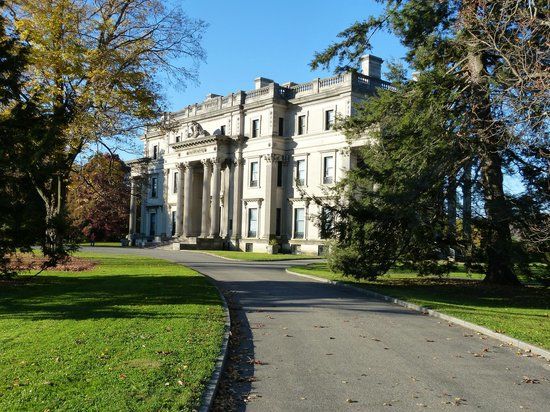
Architecturally the Vanderbilt Mansion's architecture, interiors, mechanical systems, road systems and landscape, is a remarkably complete example of a gilded-age country place, illustrating the political, economic, social, cultural, and demographic changes that occurred as America industrialized in the years after the Civil War. We toured the magnificent historic house and estate grounds.
The only National Historic Site dedicated to a First Lady, Val-Kill welcomes you as Mrs. Roosevelt welcomed her many guests. We saw a :16 introductory film "Close to Home" then our guide brought us through the first floor of Mrs. Roosevelt's Val-Kill Cottage. We enjoyed the small gift shop, gardens, stream and grounds on the site. We left with an insight into Eleanor Roosevelt that we didn't have before.
The Franklin D. Roosevelt Library & Museum is home to many displays on the life and times of our longest serving President and his wife. The displays range from his oval office desk to his private study with many memories of events that shaped the world during his lifetime.
If you go downstairs, they have the vehicle he drove with hand levers and even a cigarette dispenser.
There was a larger exhibit on FDR's New Deal in place when we visited. Our docent offered up an interesting tour drawing comparisons to the new deal and Obama's current plan.
The Culinary Institute of America is a not-for-profit college dedicated to the culinary arts. The campus is located in Hyde Park, NY, right on the main highway - Route 9. You can tour the campus and can also have dinner there. The college operates four student-staffed restaurants on the campus, for which reservations are recommended: American Bounty, Escoffier, Ristorante Caterina de' Medici, and St. Andrew's Café.
We ate at their Italian restaurant - Ristorante Caterina de' Medici. After dinner, you have a chance to help grade the staff on their service and the food quality; making this an educational experience for the students.
Take a look if you have an interest in the culinary arts, but be careful, there are a lot of guys walking around with big knives! :-)
The Franklin D. Roosevelt Library is the first of the presidential libraries and was built in 1939-1940 to house the vast quantity of historical papers, books, and memorabilia the President had accumulated during a lifetime of public service and private collecting.
The Library contains papers from all of Roosevelt's political offices, New York state senator (1910-13), assistant secretary of the Navy (1913-19), governor of New York (1929-32), and President of the United States (1933-45) and his private collections of papers, books, and memorabilia on the history of the U.S. Navy and Dutchess County, New York. In keeping with Roosevelt's wishes, the Library also contains the papers of Eleanor Roosevelt.
Built on land donated by Franklin D. Roosevelt and his mother, Sara Delano Roosevelt with privately donated funds of $376,000, the Library was donated to the federal government on July 4, 1940.
Tours begin at the Henry A. Wallace Visitor and Education Center. There is a great deal to see even in here. There is a 1/4 mile walk from the Center to the FDR home so be prepared for a walk. The grounds, rose garden and burial site are are free and cost for the tickets for admission to the home is $14 and is good for two days. We used our Golden Pass for admission, so there was no charge.
It's very easy to locate the Vanderbilt mansion on Route 9. They have plenty of good parking and a visitor's center where the tours can be bought. We were able to get right in with a tour that was ready to start. I didn't take any pictures inside the house.
The house and gardens are really a tribute to an era rather than a person or family. It gives a good idea of how life was like in the United States in the Gilded Age.
This can take about 2 hours for the tour of the house, walking the grounds and strolling through the gardens.
We were surprised by how understated Hyde Park is - a sleepy little village with a tremendous amount of sites to see.
The Vanderbilt Mansion is a National Historic Site. We were able to use our Golden Pass aka Interagency Senior Pass to get in so there was no charge for us. The fee is $8 for an adult.
No charge for age 15 and under.
The Vanderbilt Mansion is an example of the Gilded-Age country place. It displays all the features of the economic, cultural, and industrial progress of American life after the Civil War.
The estate grounds are open daily dawn to dusk. The mansion was the first home to have electricity in the town of Hyde Park. I did not take pictures of the inside of the house.
The Italian gardens have been restored as closely as possible to their appearance in the 1930s. After the National Park Service took over the estate in 1940 they were not able to maintain the gardens. When Frederick Vanderbilt purchased the estate in 1835 he added a rose garden to the exisiting gardens. We enjoyed wandering around the garden area but it is apparent that the years have taken their toll. In 1984 the F.W. Vanderbilt Garden Association was organized with the desire to restore the gardens. This is accomplished through various fund raisers and volunteer workers.
The total area of the estate is 211 acres set on the stunning Hudson River. Allow plenty of time for wandering and taking in the beautiful setting with the mature trees and gardens.
Sponsored Links
Sponsored Links
Comments