Clifton, originally called Cliff Town, was named for the cliffs of the gorge where the town's mills were established. The first mill here was constructed in 1802 to take advantage of the natural force of the Little Miami River as it sped through the narrow gorge. The original grist mill is still standing, five others were built in the gorge, including a woolen mill, saw mill, paper mill, barrel mill and another grist mill.
Today the town is the tiniest of villages with just 179 permanent residents. At one time, in the height of the mill industry, the town had around 600 people, and you can still see vestiges of the past including big churches, schools, and even an opera house! Today the only remaining businesses are the original Clifton Mill, which is still in operation, a post office, and a bed and breakfast.
Written Sep 19, 2011
Clifton Gorge is a beautiful state park about 10 or 15 miles northeast of Dayton, in the village of Clifton near Yellow Springs. The 268 acre park encompasses a National Natural Landmark along two miles of the Little Miami River. The park has about three miles of trails all along the north side of the River.
The gorge was created by glacial melt 15,000 years ago following the last ice age (how's that for global warming?). The hard dolomite stone forms the high cliff walls, 40-50 feet above the river, while the lower layers of rock are shale and softer dolomites, allowing the river to slowly widen its path and create rock falls.
The historical marker at the park reads:
Clifton Gorge
A feature of Ohio's Glacial Past
Clifton Gorge is a classic example of a canyon
cut into dolomite and shale bedrock that dates
to the Silurian Period 400 million years ago.
Created by meltwater released from the retreating
continental glacier some 15,000 years ago. The
cool, moist gorge has maintained a diversity
of native plants, such as the red baneberry
bush, that are now rare elsewhere in Ohio.
The Little Miami River powered grist and
cotton mills, paper factories, and breweries
in the gorge during the nineteenth century.
In 1973 the upper gorge became a state
nature preserve.
The Ohio Bicentennial Commission
Ohio Department of Natural Resources
The International Paper Company Foundation
The Ohio Historical Society
2003
Updated Sep 19, 2011
Located on Wright Patterson Air Force Base's Area B is the historic "Accelerated Runway." What is accelerated runway? This stop on Wright Patterson's heritage tour, features a long, sloping downhill flight strip that was used in 1942 to test the maximum load takeoff capability of four engine bombers. Why the downhill slope? I can only guess they built the bombers bigger than the engines of the time, so they needed to see if the thing was even able to fly. Or perhaps it was an idea to launch a heavy, bomb-laden aircraft, once in the air, it would drop the bombs, burn fuel, and land easily.
Interesting note: the accelerated runway has also hosted soap box derbies.
Another interesting note: nearby the top of the accelerated runway is the old nuclear reactor. Yes, the air force at one time had their own reactors. This was a small, 10 megawatt reactor, completed in 1965. It was briefly used for scientific research until decommissioned in 1970, and the fuel rods removed.
Written Sep 19, 2011
One of my favorite things to do in Dayton is eat. And if you take a look at my gut, you will know how much I love to eat.
Each year the pinacle of eating and International Culture come together in Dayton at the Dayton World A'fair. Many cities have International Festivals, so your may be similar. In 2004, it is being held in late may, early june. Each year it differs, and is one weekend only.
In addition to shopping for goods from various countries, and watching performances by the various ethnic cultural groups, you can stuff your face with some of the best food ever! Oh yeah, you can come see the ol' Kdoc at the Scotland booth, and ask for a peek at what's under the kilt.
Scotland has some great food, as do Vietnam, Korea, and Italy. But the best booth there is Japan. Not only do they have great food, but they have Sake! Yep, you can get boozed up in front of the kids at the festival and try your hand at polka dancing or celtic lord of the dance type stuff. It is safe and fun for the whole family, plus it helps you to understand other cultures. Check out the web site for more info, or who to contact. If that's no help, contact the Dayton Convention Center at the number below. Or do www.daytonconventioncenter.com and check out the info there. Or just go to the contact page and stare at the beautiful and dreamy salesperson named Elyse! I would marry her!
Updated Apr 4, 2011
Phone: 1.800.822.3498
Fifth Third Field is named after Fifth Third Bank, which has the logo showing the fraction 5/3... last I checked this was pronounced "Five Thirds." Anyway, Fifth Third Field is the beautiful home of the Dayton Dragons, the Single A affiliate fo the Cincinnati Reds. It was built in 2000 and holds over 7,000 spectators.
The Dayton Dragons have great fans, with some 9 straight years of sellouts and the 6th highest attendance of all 160 minor league baseball teams.
Written Dec 12, 2009
Website: http://web.minorleaguebaseball.com/index.jsp?sid=t459
A plaque nearby reads:
The first Masonic Lodge in Dayton was founded in 1808, located in the first Montgomery County Courthouse. Various other locations were home to Masons in Dayton, but by World War I, rapid growth of the Masonic community called for the creation of a new Lodge building. Masons of the time, including civic and business leaders of Dayton, conceived the idea of a new Masonic Center located on the hill at Belmonte Park North and Riverview Avenue. Ground was broken and construction of the $2.5 million Masonic Temple began on July 20, 1925. Through contributions from the Masonic community, the tremendous task of raising a majority of the building cost, $1.5 million, was accomplished in merely ten days in 1924. It is doubtful that the Temple could be duplicated given the fact that the large quantities of marble and mahogany and cherry woods used in construction would be difficult to procure today.
and
The Dayton Masonic Temple was completed and dedicated on April 3, 1928. The building and grounds occupy eight and a half acres on the west bank of the Great Miami River. The firm of Herman & Brown of Dayton was hired to design this imposing building with its unique Grecian Ionic architectural design. Two hundred and fifty rooms and seven auditoriums, each with a pipe organ, are contained within the eight-story building. Throughout the building's history, the Dayton Masonic Temple has been adapted to different situations. With the onset of World War II, a plan for the Temple to become a temporary hospital was put in place. The Cuban Missile Crisis saw the Temple outfitted as a community Fallout Shelter. Today, the Dayton Masonic Temple stands as a solid memorial to Freemasonry and will continue to serve the community and future generations of Freemasons.
Written Dec 12, 2009
Erma Bombeck was born in Dayton in 1927 and lived here during her early years. She grew up on Hedges Street, and her father was a crane operator in the city. While still in high school Erma got a job with the Dayton Herald, and her future husband worked at the city's other paper, the Dayton Journal. Later she went to college at the University of Dayton and wrote for the school paper.
From meager beginning, Erma Bombeck gained great fame and success. She wrote some 4,000 newspaper columns as well as 15 books, of which most became bestsellers. At her peak, some 30 million people read her columns in about 900 newspapers.
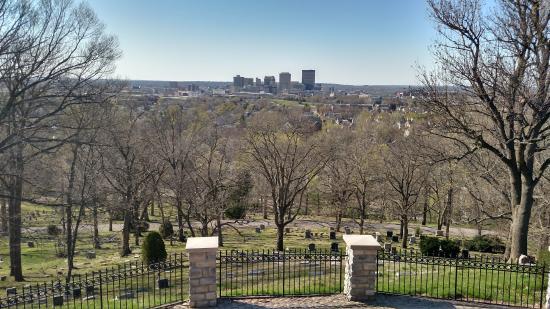
Erma Bombeck died in 1996 and is buried at Woodland Cemetery in Dayton, Ohio.
A plaque nearby reads:
Erma Bombeck
Erma Fiste was born in Dayton on February 21, 1927. While attending Patterson Cooperative High School, she worked as a copygirl for the Dayton Herald. After graduating from the University of Dayton in 1949, she married Bill Bombeck. She returned to the Dayton Journal-Herald as a reporter. Four years later she left the paper to raise three children, Betsy, Andy and Matt. She continued to write part-time from home. In 1965, Glenn Thompson of the Dayton Journal-Herald spotted her column in the Kettering-Oakwood Times and offered her a twice-a-week column. After three weeks he brought it to the attention of Newsday Syndicate. “At Wit’s End” grew to become nationally syndicated in over 900 newspapers. Erma wrote twelve books; nine made The New York Times Best Sellers List. In 1975 She joined the original cast of “Good Morning America” on ABC-TV and appeared regularly for eleven years.
The Ohio Bicentennial Commission and The Ohio Historical Society 2003
Updated Dec 12, 2009
Huffman Dam, spanning the Mad River between Fairborn and Dayton, was built in 1922 as a flood control measure after the flood of 1913 in Dayton. The Huffman Dam is is 65 feet (20 m) high and spans 3,340 feet (1,020 m). This is one of five regional dams built after the flood; the others are Englewood Dam, Germantown Dam, Lockington Dam, and Taylorsville Dam. It is said that the success of these dams helped to inspire the Tennessee Valley Authority a few years later.
The Great Dayton Flood of 1913 is the largest natural disaster in Ohio history. This flood raised water levels some 20 feet over downtown Dayton, killing some 360 people, displacing 65,000 residents, destroying 20,000 residences,
Written Dec 5, 2009
Huffman Prairie is a 109-acre area, of which of which 78 acres comprise the Huffman Prairie Ohio Natural Landmark, which is located just north of the Huffman Prairie Flying Field, where the Wright Brothers perfected their manned aircraft.
Adjacent is the Huffman Prairie Flying field which is marked by a plaque reading:
Huffman Prairie Flying Field, a unit of the Dayton Heritage National Historic Park, is the site where Wilbur and Orville Wright flew and perfected the world's first practical airplane, the 1905 Wright Flyer III, after their first flights in Kitty Hawk, North Carolina in 1903. The Wright brothers mastered the principles of controlled, powered flight at Huffman Prairie during 1904 and 1905. From 1910 to 1915, they operated the Wright School of Aviation here, training many of the world's first pilots, including many military pilots.
Updated Dec 5, 2009
On Old Troy Pike coming from Huber Heights going towards Tipp City you will hit the Stillwater Valley area. There are some beautiful water falls on back country road at a state walking park just look for the sign.
Written Feb 11, 2007
Sponsored Links
4 Reviews and 73 Opinions Nice looking hotel. Indoor/outdoor heated pool and hot tub. Great place to stay after a night out...
1 Review and 48 Opinions 138 suites, 7 handicapped rooms, 6 meeting rooms, restaurant, lounge, indoor/outdoor pool, exercise...
Courtyard by Marriott Dayton-University of Dayton
1 Review and 29 Opinions Excellent hotel handy to the National Museum of the US Air Force, being south of downtown Dayton...
Reviews and photos of Dayton attractions posted by real travelers and locals. The best tips for Dayton sightseeing.

On Old Troy Pike coming from Huber Heights going towards Tipp City you will hit the Stillwater Valley area. There are some beautiful water falls on back country...
276 members live in Dayton
Q: Is there parking for tractor-trailer trucks at the museum? Usually, if there is parking for tour buses, big trucks can park there,...

A: There is available parking at the museum for buses and motorhomes. Sorry, I don't know the museum's policy as far as big trucks using these spots. -Gary
Read 2 Replies
1

Dayton, Ohio. A little slice of hell along the Great Miami River, which happens to be my hometown. It also happens to be the home of the Wright Brothers (yeah, North Carolina, we know, you had wind)...
3

Founded in 1796 and named after Jonathan Dayton, who owned was a captain in the American Revolutionary War and one of the signatories of the U.S. Constitution. Much like many communities during the......
4

It's not called the Birthplace of Aviation for nothing. Many sites here are geared towards the Wright Brothers and aviation in general. It's not too bad for a medium-sized city. I have to admit that...
5
Dayton - Home of the Brothers Wright

I've got some interesting experiences in Dayton. I'd love to share with you the 46 tips I've written, the 225 photos uploaded, and 3 travelogues I've created.
Build your own Dayton page
Sponsored Links