Oberlin Local Customs

  Dascomb in the snow 1959
by grandmaR
 
  • Dascomb in the snow 1959
      Dascomb in the snow 1959
    by grandmaR
  • Back of Dascomb 2004
      Back of Dascomb 2004
    by grandmaR
  • Dascomb from Pyle Inn 1959
      Dascomb from Pyle Inn 1959
    by grandmaR
  • Tank in 1959
      Tank in 1959
    by grandmaR
  • Senior year (1959) science building
      Senior year (1959) science building
    by grandmaR
 

Most Recent Local Customs in Oberlin

Science
grandmaR profile photo
grandmaR 6477 reviews
Kettering Hall with bikers June 1969
4 more images

When I attended Oberlin I had my big Biology lecture in Hall Auditorium, and labs and smaller classes were in Wright Zoo Lab or the Botany Building. Senior year, classes being held in a temporary annex to the gym (photo 5). By 1961, science classes were in Kettering Hall, and that's where they were when I went back for my 10 year reunion in 1969.

It was named for the late Charles F. "Boss" Kettering, renouned automotive engineer and inventor. The Charles F. Kettering Foundation gave $800,000, the largest single gift. But by 2004, Kettering Hall was passe.

The Class of 1904 Science Library and the eastern half of the building had been removed. The western half of the building, which housed the biology classrooms, laboratories, and offices was incorporated into the new Oberlin Science Center.

Updated Mar 25, 2012

Related to:
 Budget Travel
 Seniors
 Study Abroad

Was this review helpful?

Diagonal Parking Downtown
yooperprof profile photo

3.5 out of 5 starsHelpfulness

yooperprof 3387 reviews
a red-brick town

Oberlin is one of those classic small American towns that retains diagonal parking downtown. This is one of the features of Oberlin that makes it precious in my mind. Diagonal parking helped make the United States the great country that it is today. Truly, we would be a better country if we had more of it these days.

Written Oct 27, 2005

Related to:
 Road Trip

Was this review helpful?

Tank Hall (Co-op)
grandmaR profile photo
grandmaR 6477 reviews
Tank in 1959
3 more images

Tank Hall ( formerly Tank Home) was built at 110 East College Street in 1896 as a home for children of missionaries of the American Board of Commissioners for Foreign Missions. It was named in memory of Mrs. C.L.A. Tank of Green Bay Wisconsin, who gave $10,000 toward its construction. For ten years, 1922 to 1932, it was used as a hall of residence for women. After three years, it became a freshman women's dorm for forty-seven women. All the women were freshmen except for the junior consellors.

Now forty-two students live in Tank, and an additional forty take meals in the co-op.
This large old house is located on the east side of campus in a residential section of town. The dining room is paneled with wood, and the huge front porch (with swing) and spacious lawn are popular places to relax. Rivalries with Keep are the source of many friendly traditions. Menus at Tank tend to be varied (which is probably a polite way of saying that sometimes it's not edible.)

The students that live and board at Tank are part of the 582-member Oberlin Student Co-operative Association (OSCA) which is the largest co-op program of its kind in the country. In addition to Tank, it includes three other housing and dining co-ops (Harkness, Keep, and Old Barrows), and four board-only co-ops (Fairchild, Baldwin, Kosher Co-op, and Third World House). Students involved in a co-op typically work from four to six hours each week, preparing meals, washing dishes, and, in room-and-board co-ops, cleaning hallways and bathrooms.

Updated Mar 27, 2005

Website: http://www.oberlin.edu/campusmap/Tappan.htm

Related to:
 Budget Travel
 Study Abroad
 Road Trip

Was this review helpful?

First Congregational Church
grandmaR profile photo

2.5 out of 5 starsHelpfulness

grandmaR 6477 reviews
Left - in 1958 Right from car 2004

In the 50's,anyone could sing in First Congregational Church choir directed by Robert Fountain. People joined the choir just to work with him. I sang, and also sang with Musical Union (also directed by Prof. Fountain) which also had no maximum number or stringent audition.

On June 17, 1842, the cornerstone was laid at 106 North Main Street.

The plans were a modification of New York City's Broadway Tabernacle. It was built of brick and had seating capacity of 1400. Upon many occasions more than 2000 people have been crowded into it. In addition to church services, it was used for the Commencement and other public exercises of the Institute and College, and for town meetings. It was the church home for all Oberlin people from 1843 to 1860.

Commencement exercises were held in it in August, 1843, although it was still unfinished. It was completed in August, 1844, and at that time it was the largest building west of the Allegheny mountains. The First Church was the only church in Oberlin until 1855, when the Episcopal Church was organized.

At that time, students were required to attend church. By 1860, First Congregational Church had over 1500 members, plus students. They voluntarily split into the First and Second Congregational Churches.

In 1920, the two congregations decided to reunite and took the name United Church (Congregational) of Oberlin. They met in Finney Chapel on the campus of Oberlin College until 1928.

When the college ceased requiring students to attend church, attendance dropped sufficiently to allow the church to resume meeting in its own, newly refurbished building. Soon thereafter, in 1929, a new name was adopted: First Church of Oberlin.

Although never subsidized by Oberlin College, First Church was always an integral part of college and community life. It was very much involved with the progressive reform movements generally associated with Oberlin, including anti-slavery and temperance.

The Congregational Church is very attractive to students because they are not a creedal church

Updated Jul 8, 2004

Phone: 440-775-1711

Related to:
 Religious Travel
 Music
 Budget Travel

Was this review helpful?

Check out the Art
grandmaR profile photo
grandmaR 6477 reviews
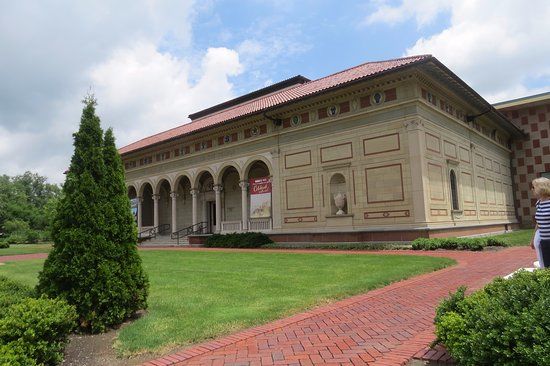
Courtyard of Allen Art Museum in 1959
4 more images

My college art professor, Ellen Johnson believed that all students should experience living with art. So in the early 1940s, she started an art rental program which allows students to borrow original works of art. With a student I.D. and $5, any Oberlin student can rent two pieces from the rental collection of the Allen Memorial Art Museum for one semester. Since 1940, only one artwork has been damaged beyond repair. The rental collection now includes more than 400 paintings, including works by Goya, Matisse, Picasso, Joan Miro, Andy Warhol, Jasper Johns, and Moriko Mori.

The directions at the checkout include a plea not to hang the art in the bathroom.

Written Jun 23, 2004

Website: http://www.oberlin.edu/news-info/99sep/studentartrental.html

Related to:
 Arts and Culture
 Museum Visits
 Budget Travel

Was this review helpful?

Dining Hall and Dorm
grandmaR profile photo
grandmaR 6477 reviews
Dascomb in the snow 1959
4 more images

Dascomb was a new women's dorm in 1956.

The custom at Oberlin was that the men were housed basically without much supervision and the women were in dorms with house mothers (and curfews and lots of rules). All the dining halls were in the women's dorms. Lunch and dinner were at round family style tables - girls and guys in alternate seats. Dascomb was the first dorm to have cafeteria service.

Dascomb is home to 154 students mostly open doubles. What's different is that the three-story building is divided into five sections, one of which is all-male, one of which is all-female, and three of which are coed by alternating room.

The long, narrow modern building is parallel to the street. The main entry, a set of double doors with wide sidelights and a transom, is near the center of the south façade. On the left side of the entry, the wall is clad with panels of turquoise marble that bear the name "Dascomb" in metal letters. To the left of the marble is a row of seven large windows, covered by a continuous flat arch of concrete. A one-story dining hall extends from the north side of the building, and there are entries on its north and east sides. Dascomb also contains two kitchenettes, several lounges, and a Steinway grand piano.

James Dascomb was a charter member of the Oberlin faculty, having arrived from New England in 1834 to teach chemistry and biology. He was also the town's first doctor. His wife Marianne headed the female department of the college from 1852 to 1870 and helped organize local female opposition to woman suffrage. He had a gothic house on West College Street.

Prior to 1950, most of Oberlin's students lived in large houses around town, some owned by the College, and others by individual landlords. But Oberlin's student body swelled in the years after WW II, and the College decided to house them in large dormitories on campus. In Oberlin's own version of urban renewal, many wooden houses were torn down to make way for Dascomb Hall. Dascomb is named for the James Dascomb house it replaced.

Written Jun 12, 2004

Related to:
 Study Abroad
 Road Trip
 Budget Travel

Was this review helpful?

Painted Rocks
grandmaR profile photo
grandmaR 6477 reviews
Tappen Square Boulder
1 more image

The boulders in Tappen Square are painted with good wishes the graduating class.

I don't remember this from my time at Oberlin. I think this tradition started later.

Updated Mar 25, 2012

Related to:
 Budget Travel
 Study Abroad
 Road Trip

Was this review helpful?

Music
grandmaR profile photo
grandmaR 6477 reviews
Band at 1959 graduation in Tappan Square
4 more images

Part of Oberlin is the Conservatory of Music. So naturally, the graduation music is played by a live band. This picture was taken by my dad in 1959

Updated May 16, 2005

Related to:
 Study Abroad
 Family Travel
 Music

Was this review helpful?

Comments

Top 2 Hotels in Oberlin

Oberlin Inn

 3 Reviews and 74 Opinions  If you visit Oberlin College, the Conservatory or Art Museum, you cannot beat the Oberlin Inn. It is... 

 Hotels in Oberlin

Show Prices
Map of Oberlin