Near the western end of downtown, near the Lithia Park is a small plaza across from city hall with a statute and public water fountain for the local Lithia water, a mineral water that people once tried in vain to market. It is sulphury and minerally and effervescent, overall quite interesting. Most people seem not to like it but I find it fairly enjoyable and others find something about it enjoyable and something unpleasant at the same time. It is certainly worth a go if you're in town. It is interesting also because after the locals failed to market it and make the water a prized health commodity, ultimately they decided to build this fountain so all could enjoy it.
Walking south from Main Street, it is a short hike up Siskiyou Boulevard to Triangle Park. Along the way one can admire many fine and restored homes and Bed and Breakfasts Hotels. Private and city landscaping are well maintained and beautiful all along Siskiyou Boulevard.
Ashland's map is not a grid, rather business oriented Siskiyou Boulevard is a street that runs the full length of the city, until it turns into Main Street, and most residential roads intersect with it. At one end of Lithia Park Siskiyou Blvd intersects with several other streets to create Lithia Plaza, the most active center of town. There are a great number of shops and restaurants along Siskiyou Boulevard. The Ashland Hotel and Film Theater are located a few blocks south of the plaza.
A stunning memorial to Ashland is found up these stairs on the northside of Lithia Park. Butler and Perozzi donated the Florentine sculpted found in 1916. The Italian sculputure of A. Frilli was restored in 1987 by Ashland sculpter Jeffrey Bernard. The fountain has a pleasant view across the park.
There are numerous places where picniking is formalized with tables, benches, and barbeque pits. A favorite of mine is the Madrone Grove picnic area. The recently restored classic table and benches in the lovely Madrone Grove is easy to appreciate in image.
In the center of the park, with easy parking access on the northside of the river, and a bridge crossing at that point, there are a number of swing sets and a variety of climbing play equipment for children. Ashland Creek at this point is reduced to several shallow ponds where children can swim without fear of a white water rush or stumble.
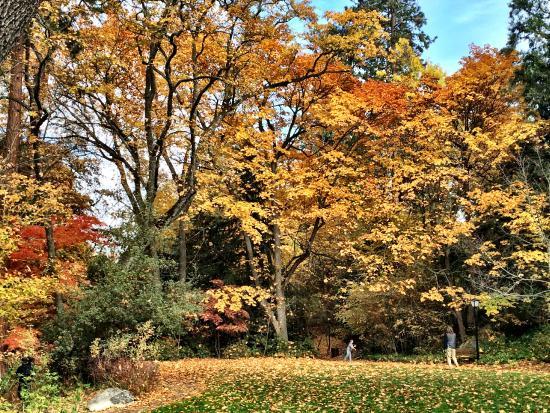
Ashland Creek, originally the sight of the lumber mill that gave birth to the town at the Lithia Plaza area, comes quickly off of Mt. Ashland several miles away, providing most of the city's drinking water supply before flowing into Bear Creek, and thence into the wild Rogue River. In 1908, the Women's Civic Improvement Club petitioned the city to build a city park along Ashland Creek, and because the Lithia Springs had become known at the time, the first idea was to supply the park with fawcets, thus the park name became Lithia Springs Park. John McLaren, landscape designer for San Francisco's Golden Gate Park was hired, and the city created 93 acres of what today is known simply as Lithia Park. The park originally was landscaped in part as an English garden, bringing in English Ivy and other foreign plant and flower species into the landscaping plan of the park. Today, many of the grassy areas are bordered with lovely annuals and old growth tree specimens that are painstakingly maintained by the Ashland Parks department. Indeed, I have seen few city parks better maintained than Lithia Park. In the upper reaches of the park along Ashland Creek are now focused upon indigenous landscaping. So, a wide variety of wild flowers and natural madrone forests are typical of the upper creek area. The creek itself is a babbling brook of sorts that tumbles over rocks for an exciting descent down to the more placid Bear Creek. Visitors can dip their toes into the creek in many places, and in several places, the parks department has created swimming holes save enough for children to play.
In 1914 the city passed a bond measure that would purchase the Lithia springs and construct pipes bringing the carbonated and slightly sulphurous water into town. Today, the property is still owned by the city, but only the plaza fawcett and a fawcett near the bandstand in Lithia Park still work. Try them out but don't expect to greatly like it. The springs at Lithia Plaza don't come through the fountain statue, but actually though a small corroded fawcett nearby. Plans are in th works for renovation of this system, but city planning meetings have also discussed sale of the Lithia Springs source property. One problem with the springs source is the wells tapped last for only a while before they turn into fresh water. The name Lithia, which is also given to the park and plaza, seems to be derived from the word "lithium", a trace mineral in the water thought to have medicinal properties.
The Oregon Shakespeare Festival is a more than a complete organization being one of the oldest and largest not for profit professional theaters in the nation. The operating budget is some $26 million, with some 780 performances, and some 400,000 performance tickets sold annually. There are three theatres, and a number of ancillary activities. The original and recently improved Globe Theatre venue is a wonderful medieval stage setting, while the New Theatre provides a stage venue for contemporary adaptations of Shakespeare's work. Plus, there's the outdoor theatre. Tickets can be bought at the box office, but tourists are advised to buy tickets on-line as performances are often sold out. My wife and I were unable to take in a performance one weekend when we passed through town.
The Ancient Men perform Gregorian chants and other early music. The Ancient Men are a seven-man a cappella vocal group founded in 2007, led by Dave Marston. Although they since ancient music, the men are not required to be ancient :)
They participate in various venues.
Sponsored Links
Sponsored Links
Comments