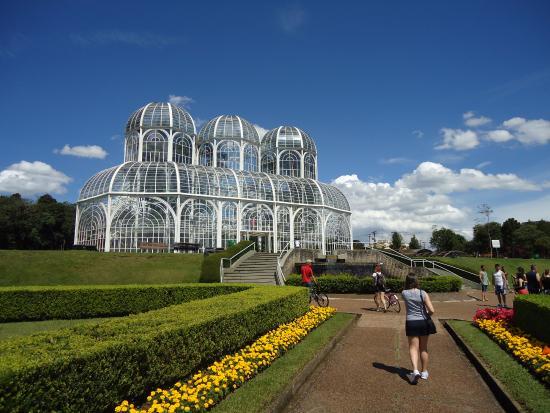
Curitiba has some lively streets and the area around Tiradentes square is particularly inviting. On the square you can visit Basilica Cathedral, and check out the local markets. Curitiba has an rich ethnic mix, with many settlers from Germany, Poland, Ukraine, Russia and Italy.
A good day trip from Curitiba--it's only about one and a half hours from Curitiba. You can get there by public bus (there is a bus stop right outside the park entrance, on the way to Ponta Grossa) Or, you can sign up with a day tour operator who will take you in a van and narrate. My guide and four van mates spoke Portugese only--I was totally lost language-wise, but the the physical beauty of Vila Velha made the trip well worth the few hours of being "lost in translation."
You will enter the park and be led to the visitor's center. There, they will show you a short film of Vila Velha's history. There is a water cooler (to cool you down on a hot day.) From the visitor's center, you will be taken by mini-bus to various areas of the state park.
The main attraction is the incredible rock formations; you feel like you are perhaps on another planet. There is time to explore around the rock formations, while being led by a park guide. You also have time to take a walk through the mini-rain forest-type area on one side of the rocks. Great photo opps--I have soooo many pictures of the incredible stone formations, too many to post!
If you can, try not to go to Lagoa Dourada at the park (Dourada Lake- See Tourist Trap Tip.) It was a 25-minute, bumpy bus ride each way, for a 10-minute walk around a murky lake, where the mosquitoes feast on everyone. Definitely put some repellent on if you must go to the lake area.
But do visit Vila VelhaState Park; "Stone City" is truly a sight to behold.
Florianópolis (nicknamed Floripa) is the capital city of Santa Catarina State in southern Brazil. It is composed of one main island, the Island of Santa Catarina (Ilha de Santa Catarina), a continental part and the surrounding small islands. It has a population of 406,564, according to a 2006 Brazilian Institute of Geography and Statistics estimate. The metropolitan area has an estimated population of 821,552.
The economy of Florianópolis is heavily based on tourism and services. The city has 42 beaches and is a center of surfing activity. Newsweek put Florianópolis in the "Ten most dynamic cities of the world" list[1]. Veja magazine, a Brazilian publication, named the city as "the best place to live in Brazil." As a result of this publicity, Florianopolis is growing as a second home destination for many Paulistas, Argentines, U.S. citizens and Europeans.
Most of the population lives on the island's northern half. The southern half is less inhabitated. Many small commercial fishermen populate the island. The fishing boats, the lacemakers, the folklore, the cuisine and the colonial architecture distinguish the tourism and attract resources that compensate for the lack of large industry. Villages immersed in tradition and history, such as Santo Antônio de Lisboa and Ribeirão da Ilha resist the advances of modernity.[2]
Camboriu Beach (Balneário Camboriú), Brazil is nestled along the Atlantic coast in the State of Santa Catarina. Camboriu has become the biggest Brazilian tourist region south of Sao Paulo, hosting more than one million Brazilian and foreign tourists every year. The region's history dates back to 1592 as a Spanish settlement. The Portuguese took control in 1675, and soon large numbers of immigrants from Italy, Germany, Poland, and other European countries began arriving. The beautiful natural surroundings will please any vacationer looking for outdoor activities. A day's itinerary in Camboriu can include swimming, fishing, bird watching, kayaking, hiking, scuba diving, surfing, horseback riding, or just sitting on a beautiful beach.
The main reason people flock to Camboriu is for the beaches. Balneário Camboriú, the main beach in town, twists and turns for miles, backed by high rise buildings, restaurants, and boutiques. All manner of watersports and beach related activities are available. You can rent jet skis, go parasailing, paddle around in canoes and kayaks, rent boogie boards, join in a volleyball game, or just spend time working on your tan. If you like your tanning time far from the madding crowds, head south about 11 miles to the relatively uninhabited Estaleiro Beach. The clean water and calm waves make this a great spot for an afternoon dip, or to try your hand at surf fishing. Just past Estaleiro is Estaleirinho Beach, another less-populated stretch of sand that is great for watching Nature at her most undisturbed.
Another great reason for visiting Camboriu Beach is for the culture and active nightlife. The street that parallels the beach offers outdoor bars, restaurants, dance clubs, and other street-side eateries. The little ones will appreciate a visit to the zoo located in Cyro Gevaerd Park. The animals on display highlight many of the species found in a Brazilian rain forest. A popular pastime is taking a ride on the cable car that goes from the upper portion of town to the beach, stopping for your favorite beverage along the route.
Iguazu Falls, Iguassu Falls, or Iguaçu Falls (Portuguese: Cataratas do Iguaçu, (Portuguese pronunciation: [kataˈɾatɐz du iɡwaˈsu]; Spanish: Cataratas del Iguazú, Spanish pronunciation: [kataˈɾatas del iɣwaˈsu]) are waterfalls of the Iguazu River located on the border of the Brazilian state of Paraná and the Argentine province of Misiones. The falls divide the river into the upper and lower Iguazu.
Their name comes from the Guarani or Tupi words y (IPA:[ɨ]) (water) and ûasú (IPA:[wa'su]) (big).[1] Legend has it that a god planned to marry a beautiful aborigine named Naipí, who fled with her mortal lover Tarobá in a canoe. In rage, the god sliced the river creating the waterfalls, condemning the lovers to an eternal fall.[2] The first European to find the falls was the Spanish Conquistador Álvar Núñez Cabeza de Vaca in 1541, after whom one of the falls in the Argentine side is named.[1] The falls were rediscovered by Boselli[2] at the end of the nineteenth century, and one of the Argentine falls is named after him.
Iguazu Falls was short-listed as a candidate to be one of the New7Wonders of Nature by the New Seven Wonders of the World Foundation. As of February 2009 it was ranking fifth in Group F, the category for lake, rivers, and waterfalls.[3]
Contents [hide]
1 Geography
2 Access
3 Comparisons to other famous falls
4 2006 drought
5 References
6 External links
Only a short walk from Museu Oscar Niemeyer is the Bosque do Papa (Pope's Wood), a park created to commemorate the visit of Pope John Paul II to Curitiba in 1980. It occupies the area of more than 46.000 m2 where was an old candle factory Estearina.
In the heart of the park is an open-air museum, Memorial Polones (Polish Immigration Memorial). It's made up of seven log cabins, built by Polish immigrants in the 1880s, and are a live remembrance of the faith and battle of the Polish immigrants. The cabins contains displays of typical objects used by the first families, and one building has been turned into a shrine to the Black Virgin of Czestochowa. There's also a shop selling Polish handicrafts, books, vodka and souvenirs marking the papal visit.
On the side road as you enter the park, there's a tearoom, Kawiarnia Krakowiak (open daily 10am-9pm), where you can get delicious home-made Polish-Brazilian cakes, light meals and superb locally produced vodkas.
Bosque do Papa is open daily 6am-8pm and the Memorial Tue-Su 9am-6:30pm.
Inaugurated in 1996, Memorial de Curitiba is a space for art and culture, information and memory, the past and the future. The bold project constructed by the architect Fernando Popp, contrasts with the old buildings of historical quarter. The installation of the Memorial has three rooms for exhibitions, the theatre Londrina and a large square for events. The building has steel and concrete structure with laminated glass covering. It has four floors and a terrace, connected with spiral stairs.
In Memorial the public can assist scenical and musical presentations, see exhibitions of art, attend discussions or participate in courses about art and culture. Works of art of John Turin, Poty Lazzarotto, Antonio Maria, Sergio Ferro, Zaco Parana and Elvo Benito Damo are permanently exposed here.
It is open Tues-Fri 9am-12am and apm-6pm; Sat-Sun 9am-3pm.
Praca Tiradentes is the main square in Curitiba and also its historical cradle. In this area on March 29th 1693 Curitiba was founded. The square is dominated by the Basilica Cathedral Minor de Nossa Senhora da Luz. It was inaugurated in 1893, built in the neo-gothic style and inspired by the cathedral of Barcelona. The cathedral is dedicated and houses the image of 'Our Lady of Light of Pinhais', the patron of Curitiba.
Anciently known as Largo da Matriz, the square is the city's initial landmark. It started to be called Largo Dom Pedro II in 1880 when the emperor visited Curitiba. Nine years later, with the republican regime, it has received the name Praca Tiradentes.
The square is also an important public transport terminal as is the departure point of 'Linha Tourismo de Curitiba'.
Curitiba is a city with more than 350 years of history. The old town is centred on cobblestoned Largo da Ordem and the neighbouring Praca Garibaldi. This is an area of perfectly preserved 18th and 19th-century buildings where you find bars, restaurants, art and craft galleries, antique shops and cultural centres. Every Sunday (9am-2pm) there is Feira de Artesanato which has a great selection of local handicrafts and cuisine, an exciting meeting point with live music.
Two of Curitiba's oldest churches dominate the historic quarter. Igreja da Ordem on Largo da Ordem is the city's oldest surviving building. Plain outside, the church is also simple inside, its only decoration is typically Portuguese blue and white tiling and late baroque altars. A short distance uphill on Praca Garibaldi is Igreja do Rosario. It dates back to 1737 and was built by slaves in colonial style. The church was completely reconstructed in 1946 in baroque style and the current facade still has original tiles.
Other places of interest in the area are: Curitiba Memorial, a space dedicated to memory, art and culture; neoclasical building Palacio Garibaldi; the oldest surviving Curitiba's house Casa Romario Martins and the Flowers Clock (it has 8 meters in diameter and the flowers are changed every season).
Curitiba has its pedestrian precinct like many great cities around the world. Rua das Flores (Flower Street), one of the major streets, was in 1972 transformed in pedestrian street. It starts where the traffic is no longer permitted. This happens at the end of Rua XV de Novembro, one of the main avenues in the city that cuts directly through the middle of the downtown area, passing numerous squares and important buildings (Teatro Guaira, Universidade do Parana and the publick library) on the way.
When you reach Rua das Flores, the atmosphere changes. The street is lined with those traditional Brazilian black & white patterns and graceful restored pastel-coloured early 20th century buildings. Rua das Flores is home to numerous stores and business offices and the centre's main late afternoon and early evening meeting point. You find bars, restaurants and cake shops and it's quite common to see street performances and musicians.
At the far end you reach Praca Osorio which leads to the landmark, a small shopping arcade Rua 24 Horas (24 Hours Street), an attempt by city planners to keep the centre of Curitiba alive outside of office hours. As its name suggests, it open around the clock.
Sponsored Links
Sponsored Links
Comments