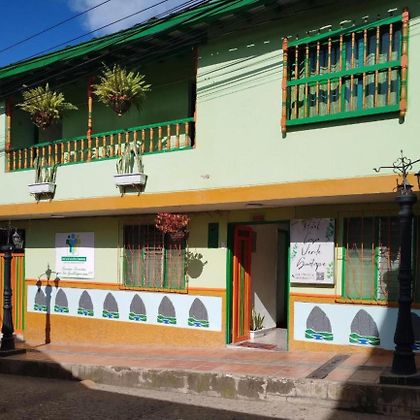
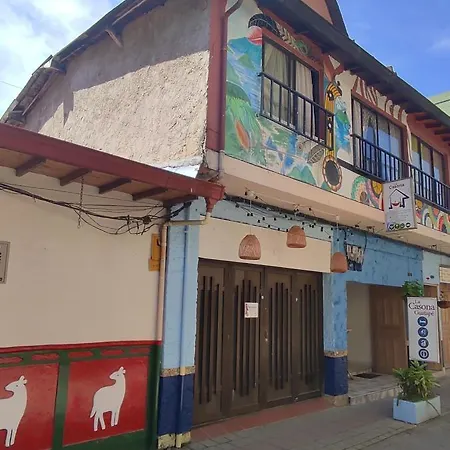

After visiting the lovely church I took a stroll around the pleasant plaza and came across a typical colonial building with colourful balconies and zócalos, Palacio Municipal (Town Hall). It houses various offices, like Tourism and Promotion Office, Police Station, Property Register, Town Council, Secretary of Government and Mayor's Office.
In Tourism and Promotion Office you can get all the information about what to do and see, restaurants and accommodation. The office was open at the time of my visit. But since I was just about to leave Guatapé in a short time I did not need them anymore.
Tourism and Promotion Office is open Mon-Fri 8:00am-12:00pm and 01:00pm-06:00pm.
Updated Sep 10, 2011
Address: Calle 31 No. 30-08
Phone: +57 4 861 0359
Website: alcaldia@guatape-antioquia.gov.co
Guatapé is wonderful to just wander around without any particular plan, admiring colourful architecture, observing life of the local people and children playing on the street. I started my walking tour on the main plaza. It was around lunch time and I was getting hungry, so I decided to walk to malecón first and find a nice restaurant by the lake. After lunch I still had a few hours to explore the town before going back to Medellín.
Without any doubt, Calle de los Recuerdos (Memory Lane) is the most charming street of Guatapé. It is well-known for its zócalos, brightly painted decorations of the houses. Simply adorable! Also quite nice and enjoyable is the main plaza with a fountain, trees and benches to relax, a meeting point for the community. Facing the plaza is impressive church Iglesia de Nuestra Señora del Carmen, there is Palacio Municipal, a few bars and a great number of mini chiva taxis.
Updated May 7, 2010
Be sure to visit Calle de los Recuerdos, most traditional street of Guatapé, one block up from the main plaza. This romantic cobblestone street boasts colourful houses with the most excellent examples of zócalos, brightly painted decorations, depicting geometric figures, animals and images tied to the family, unique to Guatapé. They are genuine jewels of art, showing the creativity of its inhabitants, and most striking attraction of the town.
Calle de los Recuerdos (Memory Lane) is named so because it tells the story of this town. In 1978 Guatapé was flooded by the overflowing reservoir in its proximity. Perhaps Calle de los Recuerdos was the only street that managed to survive this catastrophic event. That's why the inhabitants wanted to leave it as it was as a homage to those who lost everything after this event.
more pics in the travelogues
Updated May 6, 2010
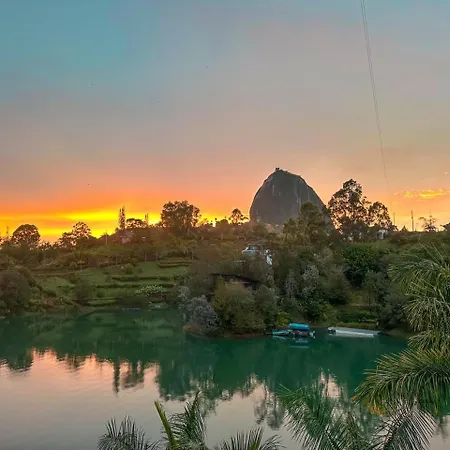
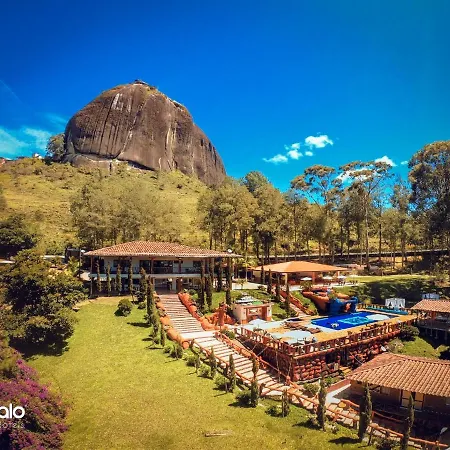
El Peñon de Guatapé (The Guatapé Rock) is a 200m high monolith set near the edge of a man-made lake surrounded with green hills. Declared a national monument in the 1940s, the giant rock is well worth a visit. At the base of the rock is a parking lot with numerous stands with local handcrafts, and restaurants offering grilled meat and fish from the lake (mojarra and trucha). There is also a bronze statue of the first man that climbed the rock.
The entrance to climb the rock was 7.000 COP (December 2009). There are 649 steps to get up and the views over the lake and beyond are breathtaking. Half way you can take a short rest at a little viewing platform with a statue of Mary. At the top are a few bars/restaurants and souvenir shops. Make sure you climb to the roof of the three-storey tower for the spectacular 360° view. You will be delighted by the panorama of numerous islands and small bays in front of you as far as your eyes can see.
El Peñon de Guatapé was certainly one of the most interesting sights I visited around Medellín. It's a place where natural and man-made wonders came together to create spectacular surroundings and harmony.
more pics in the travelogues
Updated May 5, 2010
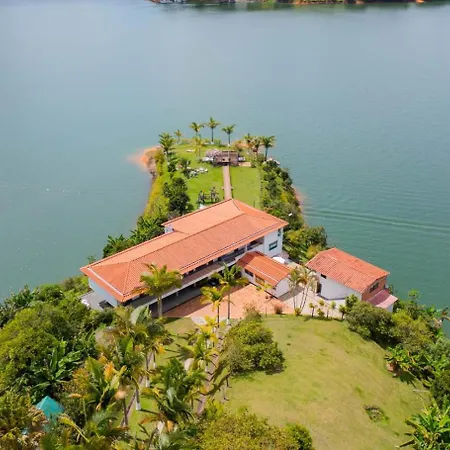
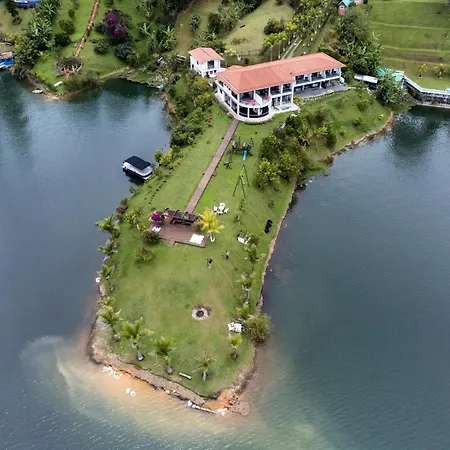
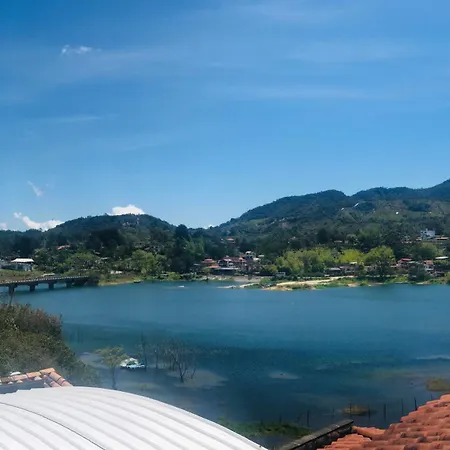
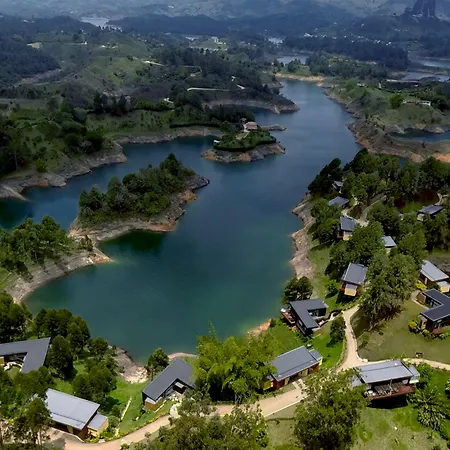
Guatapé has a pretty malecón (promenade) along the lake shore lined with boats and restaurants serving delicious trout. The lake is much more beautiful than I thought and provides an excellent outlet for water activities, such as boat tours, fishing, water sports, walks, chilling out, and the adventurous can take a ride on the cable vuelo, a zip wire (known as 'canopy') over the lake.
Several boating companies can take you out onto the lake, including several with bars and dance floor. The tours usually include a trip to La Cruz, La Piedra and to the Isla de las Fantasis. You can see many luxury homes while riding on the boat. Some of them belonged to Pablo Escobar and his Medellín drug cartel. One of them is an easily viewed landmark; it sits out on the lake, abandoned for more than 15 years.
On weekends Guatapé is full of Colombian tourists, mostly from Medellín. Then malecón tends to fill up with party boats blasting out music, and local vendors sell beautiful Paisa art, food and souvenirs.
Updated May 4, 2010
Overlooking a pleasant plaza with fountain and garden, meeting place for the community and visitors, is a lovely church, Iglesia de Nuestra Señora del Carmen. Built at the beginning of the 19th century, it boats its Greco-Roman exterior. The church has white and red façade with rhomboid zócalos. If you look closely you will notice a gaping mistake on the church clock. The Roman numeral for '4' has been written incorrectly (IIII instead of IV).
The church has a polished wood interior. In December, when I visited, it was decorated with Christmas ornaments. The altars are the most beautiful replicas of Vicentino and Quiteño art existing in the eastern Antioquia, and stained-glass windows glow in a number of colours. It generally remains open during the day.
more pics in the travelogue
Updated May 3, 2010
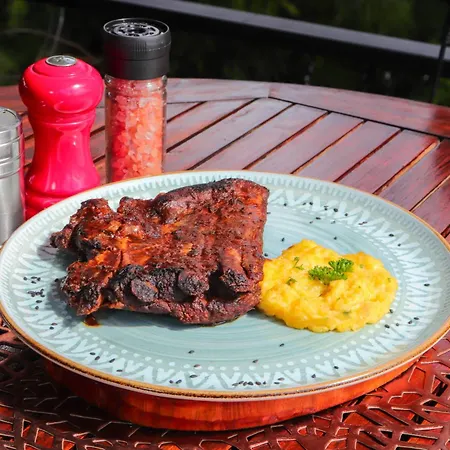
There is no shortage of good eats in Guatapé, centered mainly around the plaza. The lake is very pictures and there are some neat little restaurants on the malecón. While taking a tour of the town I asked a local woman if she could recommend any particular. She mentioned Asados Mi Casita which seemed to have fame for the good food and service. And I was not disappointed with the choice.
Asados Mi Casita is located right opposite the lake with the view of the water and the boats. Their speciality is trucha (trout). But if you are really very hungry, try the bandeja paisa, a typical Colombian dish, very popular in the Paisa region.
The restaurant is open daily from 7:00am to 9:00pm.
Favorite Dish: A trip to Guatapé wouldn't be complete without sampling the local speciality, fresh lake trout served in your choice of many delicious preparations. After a long consideration, and with the waiter's suggestion, I opted for trucha a la marinera. It was prepared in a sauce with shrimp, squid and octopus, and served with rice, salad, white arepa and a toasted toast. The trout was nicely soft, sweet and most delicious. Together with a glass of orange juice the bill came to 18.000 COP (December 2009). In fact, this was one of the most expensive dishes on the menu, but quite affordable for European standards.
Updated Sep 10, 2011
Address: Calle 32 No. 26-27
Phone: +57 4 861 0464
One day I took a day trip to El Peñon de Guatapé (a giant rock formation) and then further to the charming town of Guatapé. Natalie from hostal Tamarindo suggested that I should leave early as it was the area with a lot to see and explore. Buses to Piedra del Peñol leave from Medellin's Terminal de Norte. There is a 15-20 minutes walk from the hostel to Poblado metro station. I took a metro to Caribe station which is connected to the bus terminal.
Sotrasanvicente bus company has regular service to El Peñon de Guatapé. The 1 hour and 45 minutes journey was 12.000 COP (December 2009). I got off the bus at a gas station and then it was an easy 20 minutes walk up the hill to the parking lot at the foot of the rock.
After climbing the rock I walked back to the main road and wanted to continue to Guatapé, when a fully restored oldtimer jeep stopped and offered to drive me to the town for 2.000 COP. I returned to Medellín in late afternoon. Busetas (minibuses) leave from the main square. The journey takes 2 hours. You have to buy the ticket in advance in Sotrasanvicente office on the square.
Updated Sep 10, 2011
Phone: +57 4 230 6637
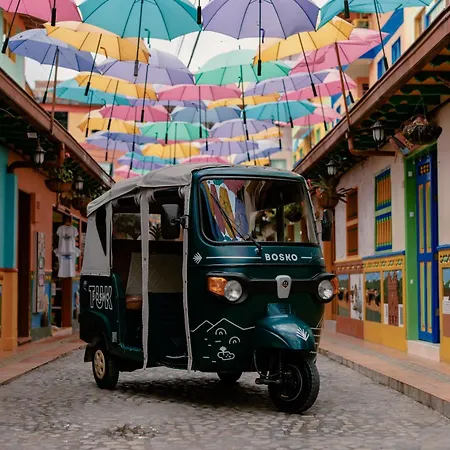
An interesting sight in the main plaza is the large number of three wheel mini chivas. These comical little vehicles are designed as typical Colombian chivas, artisan modified old-style buses now used to take tourist around town. They are painted colourfully (usually with yellow, red and blue colours of the flag of Colombia) with local arabesques and figures.
These mini chivas are fun way to go around. Most of the people use them to get from Guatapé to El Peñon de Guatapé. Coming from Medellín, I first stopped at El Peñon de Guatapé. From there I wanted to take one of these mini chiva taxis to Guatapé. They leave when there are enough people, unless you are prepared to pay the full price. A 10-minute journey is 2.000 COP (December 2009). Since there were no other passengers I walked to the main street, and it did not take long until I got another transportation to the town.
Updated May 2, 2010
Known for its zócalso, a brightly painted boards along the façade's lower walls, Guatapé is a real hidden gem. Guatapé zócalos are part of the roots and tradition. Many were made in the early 20th century and still remain on the façades of the houses. The story goes that children in the street often played with little glass balls, damaging the cement of the façades. That's why people decided to use this visual architectural element of protection.
The first zócalo built was a sheep looking towards the passage in the Casa Museo building and later others started to appear. The first ones were simple, such as geometric figures, then much more developed designs like animals or religious images, until they started to create true stories that reflected on the walls, showing all the richness of tradition, culture beliefs and identity of the people of Antioquia.
Calle de los Recuerdos, one block from the main plaza, has the best examples of this fascinating public works of art.
more pics in the travelogue
Updated May 1, 2010
Comments