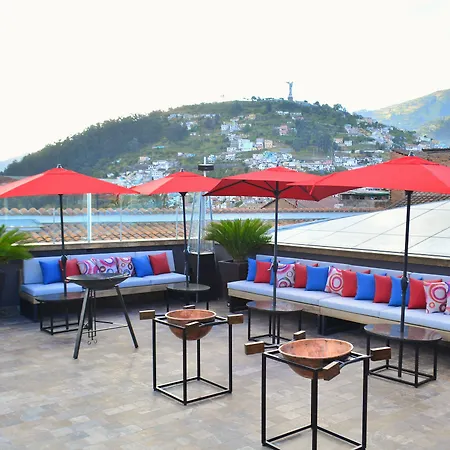














El Panecillo, which means the Little Bread Loaf, is a small round hill south of Centro Histórico. On top of El Panecillo there is a big statue of La Virgen de Quito. The statue has got wings like an angel and a crown of stars above the head. She is standing on a dragon on top of a globe. There is an observation deck around the globe.
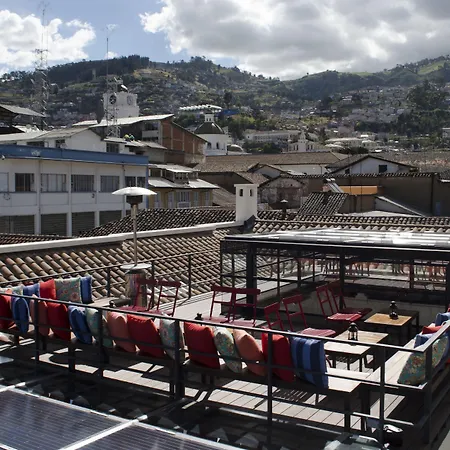
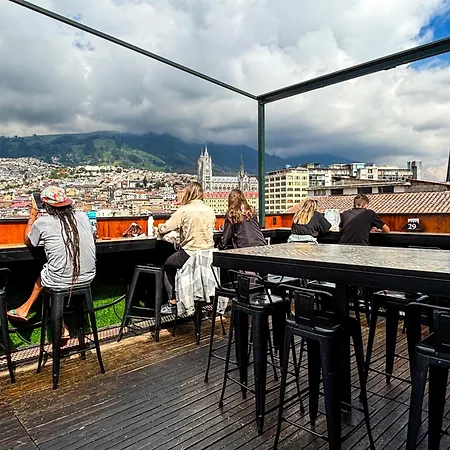
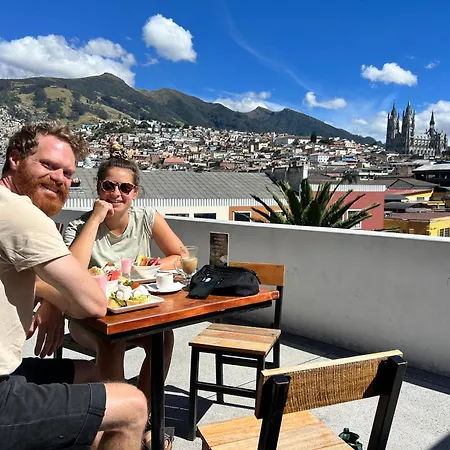
From El Panecillo there is a great view over Quito and the surrounding mountains. I visited in the afternoon, but it is better to come in the morning of a clear day, before all the volcanoes you can see from Quito are covered in clouds.
The Incas called El Panecillo Yavirac, and it was a place for sun worship.
From the end of García Moreno in Centro Histórico stairs are leading up to El Panecillo, but it is strongly advised not to climb those stairs. I have read many warnings saying that people often get mugged walking up to El Panecillo. So I decided to take a taxi, and as I didn’t know how easy it would be to get another taxi at El Panecillo I told the taxi driver to wait while I walked around for a while. I took the taxi from La Marín. From there El Panecillo looks to be quite close, but there is no strait road. On the way up we drove through a rough neighbourhood, which we didn’t drive past on the way down. When we arrived to El Panecillo the meter was on $3 and something and when I came back to the taxi it had very rapidly increased to $6 and something, even if I hadn’t been away for very long. Well, when we were back to El Marin the metre was on $8.50 (June 2011).
When I came to El Panecillo there were to other taxis waiting there, but when I was leaving there was only mine. Anyway, I think that if I would go again I would not ask the taxi driver to wait but hope to find one to go back with. Now I was a bit in a rush.
Written Nov 25, 2011
From here you will get a beautiful view of old Quito. You can get up to the Mirador which is to the bottom the the feet of the Virgen but you are still high enough to see at a distance. Take a taxi from El Centro (Old Colonial Quito) at La Marin (where all the buses cogregate on the east side of El Centro). It should cost about $5-6, and for that amount the taxi driver will drive you up the hill, wait for half an hour while you take in the view and take photos, and then drive you back again.
La Virgen del Panecillo towers over the city of Quito. It is 9,840 feet above sea level. It is a winged 148-foot tall aluminum Virgin that stands at the top of Panecillo Hill. The hill was a sacred site since the days of the Inca. El Panecillo was first known as Shungoloma during the time of the Incas. Shungoloma means “Hill of the Heart” and it was used by the Inca as a religious site for sun worship. When the Spanish invaded Quito, the sun temple was destroyed and a fortress was built during the years 1812 to 1815. The sculpture was created from seven thousand pieces of aluminum by Agustìn de la Herràn Matorras.
Updated Aug 30, 2010
El Panecillo is a hill to the south of Quito’s historical Colonial centre that is most noticeable for the large Virgin of Quito statue atop it. The statue was constructed in the 1970s and watches over the city from the lush, green slopes of the hill. Panecillo was important during the reign of the Shyris, the Quechua kings, when it was used for worship of the Sun God that was the centre of Quechua religious belief. After the Conquest by the Spaniards, the hill began to attract lower-class citizens, who built their houses on its slopes. This development picked up remarkably after the post-Independence boom, although the installation of the statue of the Virgin has given greater emphasis for preservation of the green space, especially as the number of visitors to the site has increased. The Virgen de Quito was sculpted by a Spanish artist, Bernardo de Legarda, who took his inspiration from the statue of the Virgin on the altar of the Church of San Francisco.
Updated Aug 20, 2010
Even during the night when I arrived from the airport, I could already see the well lighted 134-foot Winged Virgin of the Apocalypse, located on Panecillo Hill (literally means “little bread” and located in the middle of Quito’s Old Town). The Virgin, made of aluminum and completed in 1976, is believed to protect the city from the anger of the volcanoes.
I had my tour guide bring me the next day to the Panecillo Hill and the unique qualities of the statue are evident during the daylight. The statue was copied from a 17th century painting by Bernardo de Lagarda, who in turn is said to have modeled his painting after the typical Quiteña. As to why he added the wings, I don’t know. I’m sure there are several theories about it though. Also, the image is supposed to look like the Virgin is “dancing”, unlike other non-committal poses of the Virgin Mother.
And since I was there, why not climb up! For a small fee (US1-2? I don’t remember well), I went up the inside and saw views of Quito from the top and waved down at my tour guide but I wish he took a picture of me too (but I had my camera with me…). So, if you are with someone, maybe the other can stay behind below to take your pic? Take turns?
However, if you are foreign to Quito, it is safer to either get your guide and driver (as I did) or just have a cab bring you up to the statue and wait for you to go down. But make sure you already decide on a price for the cab before you go in, maybe about US$15 (?) if they wait for you…
Updated Jan 30, 2009
Before the Spanish Conquistadores gave it this funny name, Panecillo – “little bread roll” - was called Yavirac and locals had built a temple to worship their god, the Sun. In 1976 by order of the church, 7000 pieces of aluminum were brought and assembled on top of the hill. So the 45m-tall Virgen de Quito monument standing on the peak, at more than 3000m of altitude, has been the dominating figure of Quito ever since. Locals are proud of their Virgen as it's the only one in the world that has wings and reminds of an angel. It also has a chain tied to a dragon at her feet and is stepping on a snake. What is really unique is that the Virgen is in a dancing position in contrast to the usual static Madonnas, and is an inspiration of the “dancing “ Madonna of the famous Ecuadorian sculptor Bernando de Legarda, kept in the altar of San Francisco church. Legarda was considered an artist of “tremendous” talent and his artwork can be seen not only in Quito but in Bolivia, too.
There is a small balcony at the feet of the monument for spectacular views of all around the city and the valley, but you have to pay 2$ to climb up from inside. The taxi driver who took you there can wait for half an hour and take you down again for totally 5-6$. But if you feel like staying more to browse at the handicraft stalls or have something to eat, you can find another taxi at the top for your way down. Personally the setting with the monstrous iron constructions for the lights so conspicuous that can be seen even from the town, disturbed my aesthetics... just between you and me...
Updated May 19, 2008
El Panecillo means "little bread loaf" in Spanish and that's an apt way to describe the hill on the southern edge of the Old Town. It's topped by at statue of the Virgen de Quito and can be accessed by a path from below, but it's more advisable to take a taxi because muggings are supposedly common for the daring few who walk up the hill. I'm daring, but having been mugged before and knowing from experience that this is not a pleasant experience, I took a cab.
The evening I was here was great because a short and weak rainfall came and went and left a beautiful rainbow in the sky over the Old Town making the already beautiful views from here even more serene. Standing at the base of the Virgen de Quito, the sky was an indecisive color - not quite blue, not purple, not red, not pink - and all the colors of the rainbow permeated the scene and my memory of it now.
Cabs will be lined up at most hours, but if it's after dark when you leave, you might need to call a taxi, which can be done at the nearby Pim's restaurant just below the statue, where I enjoyed a meal and more great views.
Updated May 4, 2008
La Virgen de Quito cannot be missed and is perhaps the landmark that keeps both tourist and locals oriented. Though a bit cartoonish compared to Rio de Janeiro’s statue of Jesus it nonetheless adds a bit of distinction to the many hills that surround Quito. The hill on which it stands is called El Panecillo and supposedly affords great views of not on the city but also distant volcanoes on a clear day. It also is reportedly dangerous to walk up there. It goes through a poor part of town and though a cab can be hailed to the top it never seemed clear enough to warrant that. Besides the walk up was something I would have liked to do for an acclimatization exercise. Maybe they’ll clean up this area much as they seemed that end of town when we were there. Something tells me I may walk up there yet.
Updated Nov 9, 2007
Address: atop El Panecillo
El Panecillo means 'little piece of bread' in Spanish.
This refers to the little hill in the southern end of colonial Quito. Quito is a long city (like a sausage) of about 35km in length and 5km wide. From the top of the hill, facing north, you will see the New City of Quito stretching ahead. This is the 'richer' part of Quito. Facing south, you will see the 'poorer' section of Quito.
At its peak, there is a monument of a Madonna with Wings, also known as 'Virgen de Quito' (Quito's Madonna). From several narrow alleyways of colonial Quito, you can capture a pretty image of this unique and iconic virgin.
I was driven here at midnight by my hosts. Frankly, colonial Quito at midnight is frightfully eerie as not a single shop is opened and nearly all the streets are empty of cars. But my friends were determined to show me a night-view of Quito and we endeavoured to find the way up the little hill. We found the way heading DOWN, not UP, so... would you believe it, my friend REVERSED his car up all the way (so that we would be facing the 'right' direction, if you know what I mean).
At the top, there are some fancy restaurants and security guards (poor guys, freezing in the cold). This area was notorious for crimes, and I guess this is Quito's city council's way of increasing police control to tackle this issue.
Frankly, the view of twinkling Quito, both north and south, was worth it. Very strategic location and not too far or difficult to go. Go prepared for the cold as although I call it a 'little hill', the peak is about 3,000m above sea level. This is because Quito is quite high in altitude, being named the 'second highest capital in the world'.
Written Oct 25, 2007
El Panecillo is a little hill, South of the historical center of Quito. I could see it from my hotel room, and it is always an attractive presence. I didn't go to the top, however, as it has the repution of being a dengerous spot. Since the construction of the clean and safe Teleferiqo (see off the beaten path), the Panecillo has lost part of its appeal as a vantage view point.
Updated Sep 7, 2007
The Panicillio is a hill in the center of town that someone thought looked like a loaf of bread, Pan is bread in Spanish. I admit I don't think much of this. Unlike the Jesus in Rio (only seen it in Pictures), the Mary in Bogota, the Jesus in Medellin or the Jesus in Havana, The Angel in Quito does not sit off byitself up above the city. The hill is covered in Houses, right up to the top. It takes something away in my opinion.
Written Dec 22, 2006
Sponsored Links
Four Points by Sheraton Quito Quito
6 Reviews and 82 Opinions I knew this hotel as the Sheraton Quito, but I suppose that it was, at least at one time, a Four...
JW Marriott Hotel Quito Quito
4 Reviews and 230 Opinions Traveled thur Quito on a Eco Tourism trip. The Marriott was unforgetable. Beautiful hotel in every...
Radisson Royal Quito Hotel Quito
2 Reviews and 148 Opinions The Radisson Royal Quito is a luxury Hotel connected to the World Trade Center and centrally located...
El Panecillo tips and photos posted by real travelers and Quito locals.
Write a Review
The Panicillio is a hill in the center of town that someone thought looked like a loaf of bread, Pan is bread in Spanish. I admit I don't think much of this....
114 members live in Quito
Q: Hello everybody, during our trip to Sth America we are visiting the Galapagos islands for a couple of days. We certainly do not...

A: I don't know how it is at the airport, but some hotels can store luggage for you. I stayed at Hotel Viena Internacional in Centro Histórico and while I was away for a few...
Read 2 Replies
1

As soon as I got back from my last trip to South America (January, 2002), I knew somewhere in South America would be my next foreign destination. For the longest time, I thought my next South American...
2

My one-month roundtrip in Ecuador started (and ended) in Quito. Quito is the Capital of Ecuador. Quito is at 2800 m altitude, which makes a bit tough to walk around after you have just landed (and...
3
Thinking of South American Cities? Think Quito

Ask the average person what city comes to mind when they think of South America and most will reply Buenos Aires or Rio de Janeiro. Some with a bit more savvy may venture forth with the continent’s......
4

The city of Quito (pop. 1.5million), capital of Ecuador and the country's second largest city (Guayaquil is the largest), stretches along a large valley, surrounded by volcanoes. The combination of......
5

I've got some interesting experiences in Quito. I'd love to share with you the 23 tips I've written, the 54 photos uploaded, and 0 travelogues I've created.
Build your own Quito page
Sponsored Links