This is one of the most important buildings of the world history.
Ulug bey decide to build this observatory in 1428-1429 on one of the hills . In the main hall huge instrument was placed for observations of Moon, Sun, and other stars of the vault of heaven. Observatory was unique construction for its time.
The basis of observatory was giant goniometer (vertical circle), radius of circle was equal 40,212 meters, and the length of arc was 63 meters. The main instrument-sextant-was oriented with amazing exactness by line of meridian from south to north.Scientific knowledge of Ulug bey provided amazing exactness of astronomic observations.
Contribution of creation astronomic catalog-“Zidji-Gurgani”, known as “Star tables of Ulugbek” belongs to Ulugbek. Whole galaxy of great scientists was working on them for a long period and finished them to 1437.Before Copernicus and Kepler...
Exactness of observations of Samarkand astronomers is amazing because they were made without help of optical instruments, with unaided eye. Astronomic tables contents coordinates of 1018 stars, which by Ulug bey’s calculation star year is equal to 365 days 6 hours 10 minutes 8 seconds. Actual length of star year by modern data is 365 days 6 hours 9 minutes 9,6 seconds. Thus the mistake is only less that one minute.
After Ulugbek’s death observatory was destroyed . Unfortunately only underground part of sextant and basis of the building were saved.
I am proud to take a role in the renovation of this important monument for humanity..
Updated Apr 10, 2011
Timur means “clever, talented”.Tamerlane, two sons and two grandsons, including Ulug bey, lie beneath the modest Gur Emir Mausoleum.
As with other muslim mausoleums, the stones are just markers; the actual crypts are in a chamber in the basement. In the center is Timur's stone, once a single block of dark-green jade.The plain marble marker to the left of Timur's is that of Ulug bey, and to the right is that of Mersaid Baraka, one of Timur's teachers. In front lies Muhammed Sultan, Timur's grandson by his son Cihangir. The stones behind Timur's mark the graves of his sons Sahruh and Miransah. Behind these lies Seyh Umar, the most revered of Timur's teachers.
So according to the west culture one of the most "cruel" ruler is buried with his teachers...
I think that you know already the famous legend about the tomb and the IIWV.
I dont know if any westerner ruler which is not considered as "cruel" accept to be buried with his teachers?
Updated Apr 10, 2011
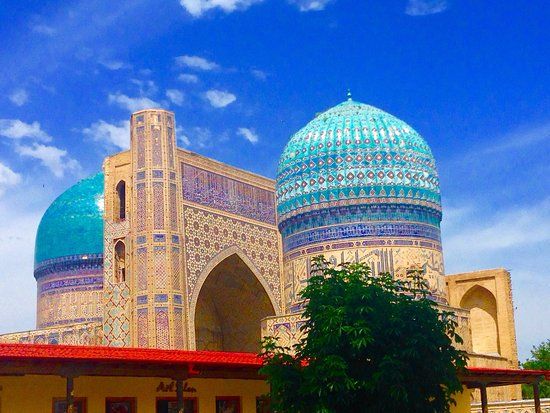
Lady Bibi was the beloved wife of Timur.Bibi Hatun Mosque (15th century)was the largest structure of its time in the world.Tamerlane's idea was to to build the most beautiful mosque of the world and he did it . It was built between 1399 and 1404 by 600 slaves and 100 elephants brought from India, with 200 architects, artists, master craftsmen and masons from the rest of the empire. An observer wrote of the finished mosque: "Its dome would have been unique had it not been for the heavens, and unique would have been its portal had it not been for the Milky Way".However Timur was not satisfied of construction. He hang the architects There is also a legend about construction of Bibi hatun mosque..
Updated Apr 10, 2011
Hazreti Hizir mosque was built in the 18th century on the entrance to Samarkand. Hazreti Hizir (Saint Hizir) is very important for us "travellers" because we believe that he is the protector of travellers and he helps us in our desperate moments of our travels.Which I think that I ve met him in one of my travels in Germany...This is another story...
Updated Apr 10, 2011
Inside the Gur Emir there are eight sarcophagi, seven of marble and one of deepest green jade, the top a single massive slab, that marks the burial place of Temur himself. No bodies lie within them, the actual tombs are in the crypt beneath, simple stone tombstones lying directly in alignment with the grander markers in the hall above.
Buried beside Temur are two of his sons, Ulugh Bek and another grandson and two un-named children. The last tomb is that of Temur's spiritual advisor at whose feet the conqueror wished to lie.
The hall is beautifully decorated with marble, gold and painted panels above a deep frieze of celadon-coloured onyx tiles. The whole place radiates a solemn dignity and restraint that is very moving.
2009 update Back in 2005 a small sum slipped to the guardian of the mausoleum gained us entry to the crypt below the main hall. A narow staircase led down to a low room where simple stone sarcophagii lay lined up in the same positions as the hall above. In 2009, this is no longer possible and the crypt remains firmly padlocked.
Updated Feb 5, 2010
Samarkand's Gur Emir -the Ruler's Tomb - is both magnificent and restrained, inside and out. It was never meant to house the body of Temur - he wanted to be buried in Shahrisabz, the place of his birth - but it was here that his body was brought after his death in 1405 whilst he was enroute for China and more conquests.
It is the dome above all that makes this place such an amazing sight. 32 metres high, it is a huge, soaring, swelling melon, its 64 ribs covered in a glorious mosaic of turquoise, green and gold. The Kufic inscription around the base of the dome proclaims the immortality of God in lettering 10 metres high and the building itself is decorated with elegantly geometric patterns.
Nothing remains of the buildings that were once within the courtyard but, under a light roof, you can see the massive stone that once was used as the coronation stone for the emirs of Bukhara and a huge stone basin that was used to serve a ceremonial drink to the Emir's warriors before they went into battle.
2009 update Work continues on the restoration of the Gur Emir. Outside, the portal that was only partially restored in 2005 (photo 2) is now complete (photo 3). Inside, workmen were busy restoring the lovely honeycomb of pale celadon alabaster that lines the lower walls. It's still just the main chamber under the dome that survives here - walk around the side of that, and all that is standing is a shattered husk of raw brick.
Updated Feb 5, 2010
There was a bazaar on this site near the Bibi Khanum mosque long before the mosque was built, and no doubt much of what was for sale here was the same then as it is now - mini-mountains of fresh and dried fruit; fresh-baked loaves; seeds, grains and other dry goods; spices, nuts, vegetables and the sticky sweets beloved of adults and children alike as well as household essentials, clothes and the like. Early summer is stone fruit time - peaches and delicate white apricots that perfume the air. Autumn brings melons in such quantities there is hardly room to move between them. Even under Soviet rule this was mainly a farmer's market and so it continues today. Come early in the morning - by 11 or so the crowds are thinning, women going home with their bags laden.
2009 update The old bazaar we saw last time has been demolished and a new market hall built. Not that things have changed a lot - it's bigger, and more of the stalls are under a roof, but essentially nothing has changed. The stalls are still heaped with seasonal produce, the mountains of dried fruits, nuts and spices are all there still.
This was one of the very few places in Uzbekistan we encountered children being prompted to beg by their mother (I got a photo - 5 - but I'm afraid I sent her empty-handed back to Mama), and where our guide warned us to be careful with our bags.
Updated Dec 31, 2009
Address: Off Tashkentskaya
Like the much larger Sher Dor medressa at the Registan, and built at the same time, the portal of the Khodja Akrar ensemble features the most-unIslamic lion/tigers (maned and striped - you choose) and deer, but without the smiling sun-heads this time. Here a 17th century medressa has been built around the shrine of an earlier holy figure -the Dervish, Sheikh Khodja Akrar (1404- 1490), leader of the Nakhshbandi order of Sufis and an influential political figure in Transoxiana following Ulugh Bek’s death. Held by his followers as both ascetic and miracle-worker, he greatly influenced Timur's great-grandson Abu Said and his sons and even today, he is still revered.
Following his death, Akrar's sons built a funerary mosque in his honour. Between 1630 and 1635 the medressa was added - complete with a portal that featured those strangely heretical beasts.
The complex has been fully restored and, since Independence, it is once again a functioning medressa, and is usually closed to tourists. Even though access is not possible, those lions make it a worth seeking out - it is a bit out of the way and you might want to take a taxi .
Updated Dec 8, 2009
That's the translation of the local name - Rukhabad - for the mausoleum built by Timur in 1380 for the mystic, Sheikh Burhan al-Din Sagarji. It's said that Timur used to walk around the mausoleum every night before retiring.
Ibn Battuta, the traveller from Tangiers, writes of meeting the sheikh in India and some time after that he became the chief Mufti of Peking, but when he died his son had his body brought to Samarkand in accordance with his wishes. In what would have been a considerable honour and mark of the respect and veneration felt for the sheikh, popular belief tells that 7 hairs from the head of the Prophet were buried with him. Other members of his family, notably his Chinese wife were also buried there.
In considerable contrast to the other monuments surviving from Timurid times, the Rukhabad s notable for its simplicity and lack of ornament - in keeping perhaps with the recorded ascetism of the sheikh it was built for.
The mausoleum forms part of an ensemble that includes the Summer mosque, the 19th century Hodja-Nisbatdor mosque, its free-standing turban-hatted minaret (a feature typical of Samarkand mosques)and several grand old trees. The mosque has a charming wooden -pillared iwan, typical of mosques of the period and a particularly finely decorated ceiling.
Updated Dec 8, 2009
Address: Ulistsa Yutuk
High above the road to Tashkent that leads away from Samarkand's main bazaar area you will see the pillared portico of the Kharzret Khyzr Mosque. A 19th century building, it has both an interesting appearance and an equally interesting legend attached to it.
This is the Traveller's mosque - Khyzr is the patron of travellers, but they must pay him due regard before he will grant them his protection. This belief predates Islam by many centuries and is a clear case of old beliefs being absorbed and reworked into those that came later.
Access to the mosque seems to be a bit problematical - as it is for many mosques here in Uzbekistan -sometimes they're open to non-Muslims, sometimes they're not. It also seems to depend on your guide if you have one - some are quite open to the suggestion of visiting mosques and churches whilst others are not so keen - an indication perhaps of the state of flux about religion here generally in these post-Soviet days.
The iwan here is very lovely and its high position makes for a splendid view, so it is worth a visit, even if access to the prayer hall is not possible.
2009 updateThe road has been realigned since we were last in Samarkand. and now it no longer cuts right across the front of the mosque. Istead a park has been laid out, trees planted and a new, less steep, flight of stairs constructed. Last time we climbed up and sat under the iwan for a while as we couldn't go in; this time we just looked on from afar so I still don't know whether access is now possible, but I do know that getting a good photo is easier.
Updated Dec 7, 2009
Sponsored Links
4 Opinions
30 Opinions
2 Reviews and 16 Opinions Hotel Afrosiyab is a modern highrise buillding. It does not look very nice from outside. But it...
Reviews and photos of Samarkand attractions posted by real travelers and locals. The best tips for Samarkand sightseeing.

High above the road to Tashkent that leads away from Samarkand's main bazaar area you will see the pillared portico of the Kharzret Khyzr Mosque. A 19th century...
4 members live in Samarkand
Our members can help!
1

Garden of the Soul, the Centre of the Universe, these are just some of the names given to Samarkand by those who saw it in its days of glory. The beautiful blue domes, creamy stone walls and...
2
Samarkand - Central Asia's Eternal Beauty

Samarkand was the fourth Uzbek city I visited, after Tashkent , Khiva and Bukhara , on my way to Tajikistan and Pamirs . Please make sure that you also read what Leyle of the WanderingCamels wrote......
3
Take the Golden Road to Samarqand

During three millennia Samarqand, located in the valley of the Zarafshan river, was the main trading and cultural center of Central Asia. Samarqand, one of the most ancient cities of the world,...
4

“It’s too much for my eyes” (Els, one of our travelling companions, at the Shah-i-Zinda) After Khiva and Bukhara, Samarkand seems big and full of bustle, but unlike Tashkent it retains more...
5

Samarkand was the final stop on my tour through Centralasia. The city is an absolute highlight, much more a city with life and people than Bukhara, which always seemed to me like an open air museum. ...
Build your own Samarkand page
Sponsored Links