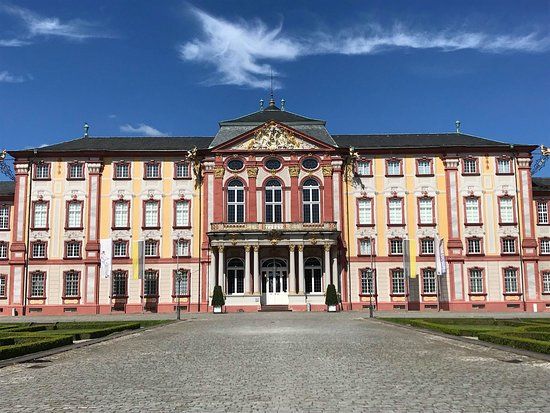
Bruchsal Things to Do

  Hands on exhibits
by suvanki
 
  • Hands on exhibits
      Hands on exhibits
    by suvanki
  • Bruchsal Palace exterior
      Bruchsal Palace exterior
    by suvanki
  • The Garden Rooom
      The Garden Rooom
    by suvanki
  • Paints used in the reconstruction
      Paints used in the reconstruction
    by suvanki
  • Photo of the bomb damaged palace
      Photo of the bomb damaged palace
    by suvanki
 

Most Recent Things to Do in Bruchsal

Columbia Grafonola de luxe
Nemorino profile photo

4.5 out of 5 starsHelpfulness

Nemorino 2616 reviews
Columbia Grafonola de luxe

For two decades the mechanical music market was dominated by machines using perforated metal disks, but then at the beginning of the twentieth century newer technologies such as the phonograph started gaining ground.

During the transition period a company called the Regina Music Box Company of Rahway, New Jersey, USA (an offshoot of the Polyphon company of Leipzig) tried to preserve its market share by producing combination machines which could play both the old metal disks and the newer 78 RPM phonograph records.

This seemed like a good idea at the time because of lot of people still had collections of old metal disks that they wanted to go on playing, but in the long run Regina was not successful in their competition with phonograph makers such as Edison, Victor, Columbia, Pathe, Zonophone and many other makers of modern music machines.

The machine in my photo, on display at the German Mechanical Instrument Museum in Bruchsal, was manufactured by Regina but was marketed by Columbia as the "Columbia Grafonola de luxe".

Of course later transitions from older to newer technologies also led to combination machines, such as three-speed phonographs we all used to have that could play the old 78 RPM records as well as the newer 45 or 33 RPM variety.

Today many of us still have combination machines that can play our old audio cassettes as well as the newer CDs and MP3s.

Updated Nov 20, 2012

Website: http://www.reginamusicboxcenter.com/history.php

Related to:
 Music
 Museum Visits
 Historical Travel

Was this review helpful?

Palace decorations
Nemorino profile photo

4.5 out of 5 starsHelpfulness

Nemorino 2616 reviews
1. Restored pillars, walls and paintings
3 more images

Starting in 1964 the palace decorations were carefully and elaborately restored, using traditional materials and techniques whenever possible.

As in the Semper Opera House in Dresden, the apparently marble pillars are not made of marble at all but of plaster that has been carefully painted to look like marble. Only very skilled artisans can do this, often using techniques that have been passed down from father to son for many generations.

Second photo: The palace staircase with restored and re-painted pillars.

Third photo: In the elaborately restored palace.

Fourth photo: Statue of a man as a pillar holding up the roof. (Isn't there some special name for this sort of statue??)

Update: Thanks to VT member german_eagle (Ingo) for his comment about the fourth photo: "Btw, that figure holding up the roof is remarkable. Usually they are female figures, called Karyatide. But a man?"

That comment provided me with a word to start searching for. After looking up the word Karyatide in a few places I found that it is usually spelled caryatid in English, and that a male figure which is used in place of a column to hold up a building is called an Atlas or Atlant (stress on the second syllable), after the mythological figure Atlas, who was forced to hold up the sky on his shoulders for ever and ever. In ancient Roman architecture this sort of male figure was called a telamon.

Updated Jul 12, 2012

Address: Schönbornstraße 2 -10, 76646 Bruchsal

Website: http://www.schloss-bruchsal.de/sixcms/detail.php?id=staatsanzeigerbw01.c.245607.de

Related to:
 Architecture
 Arts and Culture

Was this review helpful?

Peterskirche - by Balthasar Neumann
robertbaum profile photo
robertbaum 433 reviews

The Baroque Church of St. Peter's is a very special church for the city of Bruchsal - partly because it is the work of famous Baroque architect Balthasar Neumann, partly because it is the only church in Bruchsal that survived the heavy bombing of March 1945 undamaged. Underneath its 22 meter high dome lies the royal tomb, the resting place of the mortal remains of the prince bishops of Bruchsal. The interior has been remodeled several times during the church's 250 years of history. The modern celebration altar dates from 1999. At regularly scheduled tours you can learn more about the historical baroque jewel.

historic timeline:
1278 a "capella sancti Petri" is mentioned for the first time
1320 the church is destroyed during the throne dispute between Louis of Bavaria and Frederick of Austria
1360 reconstruction of the Church as a Gothic hall with 15-meter deep choir and a high tower, a parish church for the whole city until 1588
1689 destroyed during a fire, only parts of the chancel, the walls of the nave and the tower remain
1721 choir of the church repaired by order of the Prince Bishop Damian Hugo von Schönborn to the extent that services can be held
1736 Prince Bishop Schönborn commissions architect Balthasar Neumann with the planning of a new building, to be the sepulchre for the Prince Bishops of Speyer
1738 completion of design work and demolition of the ruins of not required parts
1740 start of construction
1742 March 26 - an Easter Sunday - Prince Bishop Damian Hugo von Schönborn sets the foundation stone for the new St. Peter's Church
1744 June 08 - completion of the church under the bishop of Speyer, Franz-Christoph von Hutten
1745 inauguration of St. Peter Church.
1755 completion of the Episcopal crypt. In the same year the coffin containing the remains of Cardinal Schönborn, who was previously buried in the Capuchin monastery, were transferred. Later, his three successors, Cardinal Christoph Franz von Hutten, Prince Bishop August von Limburg-Stirum and Prince Bishop wild Erich Count von Walderdorf, were also buried in the bishops' crypt.
1768 the installation of a loft and erection of the organ, the interior of the church is completed
1907 St. Peter was extensively renovated under the direction of the Grand Duke's building inspector Dr. Fritz Hirsch. On this occasion, it receives a painting by Munich artist Josef Mariano Kitschker
1960-1962 refurbishment and renovation of St. Peter Church
1988-1991 interior renovation
1994-1996 exterior Renovation

Updated May 4, 2012

Address: Peter-und-Paul-Str. 59, Bruchsal

Related to:
 Religious Travel
 Historical Travel
 Architecture

Was this review helpful?

Town Hall
Kathrin_E profile photo

2.5 out of 5 starsHelpfulness

Kathrin_E 2846 reviews
Town hall 2011: fresh paint but no flower pots
1 more image

Bruchsal's baroque town hall was destroyed in the bombing of March 1, 1945. The new town hall was built in 1954 and shows the typical Fifties style.

The coat of arms above the entrance, a silver cross on dark blue ground, is the old coat of arms of the prince bishopric of Speyer, with the addition of a silver circle.

Another visit in 2011 (photo 2) shows that the town hall has received fresh paint in lemon yellow. Behind the town hall a new shopping mall with a handful of chain stores has been built, named Rathausgalerie.

Updated Jun 18, 2011

Address: Marktplatz

Related to:
 Historical Travel
 Architecture

Was this review helpful?

Bürgerzentrum
Kathrin_E profile photo

3.5 out of 5 starsHelpfulness

Kathrin_E 2846 reviews
B��rgerzentrum and castle keep
2 more images

The Bürgerzentrum (citizens' centre), erected in the 1980's around the medieval castle keep, is the centre of the town's cultural life. The building complex unites the theater, the public library, the Volkshochschule (adult education centre), rooms for congresses, exhibitions and other events, the town archive, the tourist information, and restaurants.

Emergency hint: public toilets can be found inside the Bürgerzentrum but only when it is open. If not, the only chance are the toilets down at the far end of the parking garage.

Updated Jun 18, 2011

Related to:
 Arts and Culture
 Theater Travel
 Architecture

Was this review helpful?

Bürgerpark
Kathrin_E profile photo

2.5 out of 5 starsHelpfulness

Kathrin_E 2846 reviews
Sculpture
3 more images

The small park behind the Bürgerzentrum offers the best views of the castle keep. It is a new park with some modern sculptures, a playground and some benches to rest - nothing special but a nice place to sit down if the feet are tired.

The small pond in the park is marked as "biotope", reeds and other water plants have been planted around it to create a home for insects and frogs and fish. As I noticed at my last visit, though, the biotope is not being taken care of and the creatures that feel happiest in it are algae. In other words, it is in urgent need of some measures to remove the algae, or it will soon turn into a dead muddy hole.

Updated Jun 18, 2011

Related to:
 Arts and Culture
 Historical Travel

Was this review helpful?

SCHLOSS: Details of the Architecture
Kathrin_E profile photo

3.5 out of 5 starsHelpfulness

Kathrin_E 2846 reviews
Palace: Chinese dragon gargoyle
4 more images

Note the elaborate architectural details of the palace.

Photo 1: Chinese dragons serve as gargoyles on the roof of the Corps de logis.

Photo 2: A stucco detail on the facade above the main entrance

Photo 3: Athena, the goddess of wisdom, was painted above the entrance door of the Latin school.

Photo 4: Wall paintings on the Western facade of the chamber wing. Ancient mythology was popular even in clerical circles. Here we find Paris and Venus on the facade of a catholic bishop's palace.

Photo 5: The prince's crown on the roof above the gate between main and side wing, and another dragon-shaped gargoyle

Updated Jun 18, 2011

Related to:
 Historical Travel
 Castles and Palaces
 Architecture

Was this review helpful?

Town Centre
Kathrin_E profile photo

3.5 out of 5 starsHelpfulness

Kathrin_E 2846 reviews
Modern town centre: Sch��nbornplatz
1 more image

Bruchsal's town centre has mostly post-war architecture. Along the pedestrian malls you'll find a lot of shops that sell about everything and even a small, locally owned department store - the shopping is at a small-town level, though. You'll get what you need, but if you want a wider choice a trip to Karlsruhe, Heidelberg or (best) Mannheim is recommended.

Update 2011: Quite a bit has been done recently to improve the town centre. Since the completion of Rathausgalerie mall some new shops have settled in Stuttgart. The pedestrian zone has partly been redecorated with sculptures and fountains and looks much nicer than before. The small town department store closed down but a large fashion store has moved into the building. Bruchsal is still much smaller than the cities around but all in all the efforts to modernize the town are visible.

Updated Jun 18, 2011

Was this review helpful?

Glockenspiel (carillon) from around 1790
Nemorino profile photo

4.5 out of 5 starsHelpfulness

Nemorino 2616 reviews
Glockenspiel (carillon) from around 1790

This is an automatic bell-ringing machine that was made around 1790 in Geneva, Switzerland, by a company called Ferdinand Adler and Sons.

The metal drum at the bottom had metal pins or knobs on it corresponding to the different bells. When you rotated the drum, the pins plucked wires which rang the different bells at different frequencies, so as to play a tune. The metal drum was in effect a data storage medium, serving the same purpose as the hard disks, CD-ROMs and USB sticks that we use today.

There doesn't seem to be an English word for this sort of machine, so we use either the German word Glockenspiel or the French word carillon.

This is not the oldest machine in the museum, it's just the oldest one I happened to take a picture of. The oldest machine on display was made 170 years earlier, around 1620.

Switzerland, by the way, turns out to have been an important center of the self-playing musical instrument in the eighteenth century. This is because they already had numerous skilled artisans who had been trained as clockmakers.

People who could make clocks evidently had little trouble adding a few extra gears to make them into self-playing instruments.

Many of these trained clockmakers lived in poor rural areas, so they were willing to work for low wages, thus keeping prices competitive.

Updated Apr 4, 2011

Related to:
 Music
 Museum Visits
 Historical Travel

Was this review helpful?

German Mechanical Musical Instrument Museum
suvanki profile photo

2.5 out of 5 starsHelpfulness

suvanki 2259 reviews
The 20th Century bar
4 more images

Admission to this museum in Bruchsal Palace is included in the Palace admission price.
After looking around the Palace, we arrived at this museum, in time to catch one of the guided tours (These run 3 times per day) The museum contains 500 instruments and 6,000 Sound Media, and is one of the largest of its kind in the world!
Even so, I hadn't expected the tour to last so long, nearly 2 hours.
The tour was conducted in German. Although I didn't understand much of the guides spiel, I still found it very interesting. Bernd attempted to translate some of the information, but he admitted later that some of the information was very technical.

I have downloaded some videos of the various instruments, but for more in depth information of the exhibits, I'd recommend visiting Nemorinos Bruchsal page

The museum covers the 350 year history of self playing instruments. These include pianos, violins, organs, musical clocks, barrel organs, music boxes and mechanical figures.

Some of these can be operated by visitors (pic2) or the guide will demonstrate the various exhibits.

Hi-lights included the early 20th Century pub.(Pic1) This was donated to the museum by its last owner, and is completely authentic. It can be hired out for parties etc, with seating for 30-50 people. (Tel.0049(0)7251/7426-52 or e-mail ingrid.lamprecht@landesmuseum.de )

The Titanic's Organ - This 1912 Welte organ was commissioned for the luxurious ocean liner HMS Titanic. However, there was a delay in its constuction, which meant that it wasn't installed in time for the fatal maiden voyage.

I particularly enjoyed the Fairground organs or Carousels. I was intrigued by one that had some pretty ghoulish images of children - I thought that these were paintings from a childrens story, but I was told that the pictures were used to tell 'the news'(pic 3)

More light hearted was the organ that had a mechanical orchestra of soldiers-On closer inspection, these were females with moustaches.

The mechanical 'artist' was quite enchanting, with his expressive movements - I videoed this - please check it out.

I was pleased to see a Chinese musical jewellery box, which is very similar to one that I was given as a present in the 1960's from my Auntie, who lived in Hong Kong.

There is also a Silent Movie Theatre, where a playing piano accompanies one of the first moving pictures. We didn't get the chance to see a film, but the old movie posters of Charlie Chaplin and Laurel & Hardy were quite interesting.

Tuesday - Sunday 10.00 - 17.00
Closed December 24, 25 and 31
Open January 1st at 13.00

Entrance Fee - Including Bruchsal Palace and City Museum
5 Euro Adults
2.50 Euro Children
12.50 Euros Families

Guided Tours
11.00/ 14.00/ 15.30 (about 1 hour)

Updated Jan 16, 2011

Address: Schloss Bruchsal Sclossraum 4 76646 Bruchsal

Phone: 0049 (0) 7251/7426-52

Website: www.landesmuseum.de

Related to:
 Family Travel
 Museum Visits
 Music

Was this review helpful?

Comments

Top 3 Hotels in Bruchsal

Hotel Scheffelhoehe

 9 Opinions

 Hotels in Bruchsal

Show Prices

Dormotel Bruchsal

 1 Opinions

 Hotels in Bruchsal

Show Prices
Map of Bruchsal